
American Epilog (Part 2)
On ‘Pure Adrenalin’ Miami (artwork by Chris Gadd as Matrix, completed spring 1992)

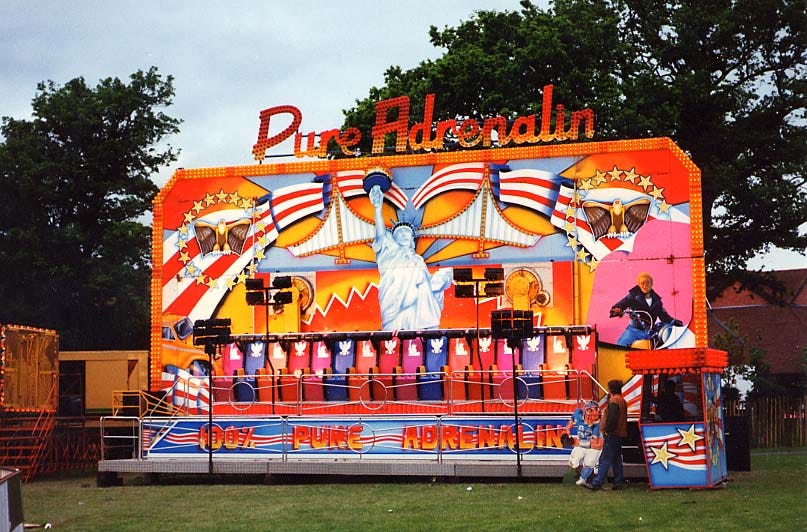
As a follow-up to my previous article looking at Chris Gadd’s artwork on Street Dancer, here is a slightly earlier artwork that he created in spring 1992 for a Miami Trip that travelled in the West Country. It is a parallel to Street Dancer in that he breaks out of the generic beach and surf scene and grasps an equally generic theme of Americana, whilst also working with layers of visuals, dimensionally arranged montage, and blending. Pure Adrenalin is worthy of a closer look as it aligns itself to various tropes of canonical art methodologies (pop art, op art, abstractionism, colourfield theory).
You could argue that fairground art, as a branch of popular art, should remain separate from canonical art and all of the ’circuits’ it invokes (galleries, isms, critiques, markets, exclusivity, fawning documentation). I have always felt different about this. I feel that the critical tools developed for discussing canonical art can and should be applied to all art – we can test how practical the tools are and learn something about the visual world of the popular that we dwell in.
Furthermore, it can be noted that of the 1990s crop of fairground artists, many had an element of art school training and so would be awake to techniques and motifs that go towards making something appear visually strong, or eye-catching, or illusionistic, or disconcerting, or soothing, etc. It is not necessarily a case of summoning Those Passions, to borrow the title from radical art theorist T.J. Clark’s new book – more so a case of applying a few new methods of interpreting the process and output of the artist.
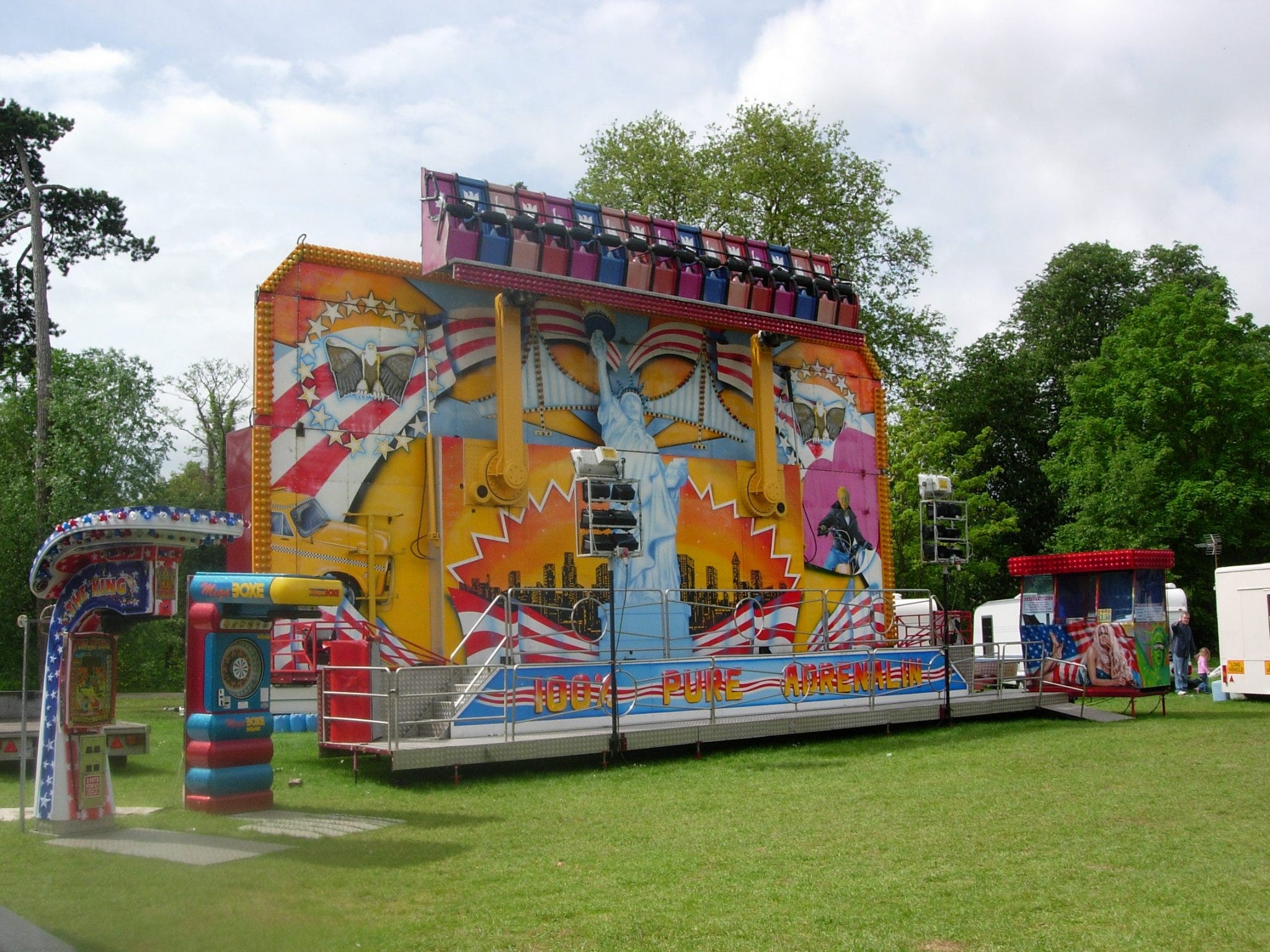
So, here goes with Pure Adrenalin. Slightly misleading in title with a nod towards the soon-to-be-well-trodden subject of extreme ocean-going sports, this artwork is rooted firmly in Americana with a Statue of Liberty taking central place to extend from the lower limit of the backflash and extend to the very top. This is probably the most obvious symbol of Americana, though Chris manages to bundle in a few more before the artwork is complete. There is often a tick-list of symbols and slogans that a fairground artist must complete under the requests of a showman client. You find that both the themes themselves and the motifs that make up the visual elements of these themes quickly converge. Sometimes a bold showman will propose a new theme. Sometimes a clever artist will slip in a few new motifs when painting an established theme. This feeds an incremental dynamic of the genre, where you have to step back and take a long view to see any sense of change.
As with much of Chris’ work, there is a bit more going on in terms of a planned symmetry and balancing of motifs (we see this to great effect with his Street Dancer artwork). In effect, this backflash is a semi-abstract painting, attempting a perfect symmetry of forms, shapes, patterns and colours, reflected across the vertical of the statue whilst being embedded in distinct layers. It is important to understand how a backflash artwork can be visually balanced – and most are - but it is a step further to strive for symmetry in this way. The art critic Norman Bryson talks about back-and-forth movements between degrees of reality, and this can be applied to a number of artworks by Chris. For me, his work in this period is a joy to view.
Like his contemporary Mark Gill’s early work, it feels partly rooted in traditional (pre-airbrush) fairground art – some of the progressive work carried out in the 1970s on Speedway and Waltzer circular rides. For Pure Adrenalin we can propose three layers to the painting, but also extra layers over the artwork and behind the artwork which destabilise a settled picture plane. The background proper has a broad yellow and blue exploding sunbeam pattern, the middle ground is a garlanded red and white stripe denoting the American flag, and the foreground is the Golden Gate Bridge.
These layers jostle for position and disrupt their ‘real space’, with the striped pattern middle layer flowing onto the outside edges of the backflash to re-emerge across the bottom, finally folding behind the statue. There is, in my eyes, a parallel with Jasper Johns’ 1950s renegade work on deconstructing and replicating the American flag, particularly his painting Three Flags. Johns was interested in things that were “seen and not looked at, not examined” – and he focused on targets, letters and flags (very much like the pop art iconography in the UK created by artists such as Peter Blake and adopted by the mod scene).
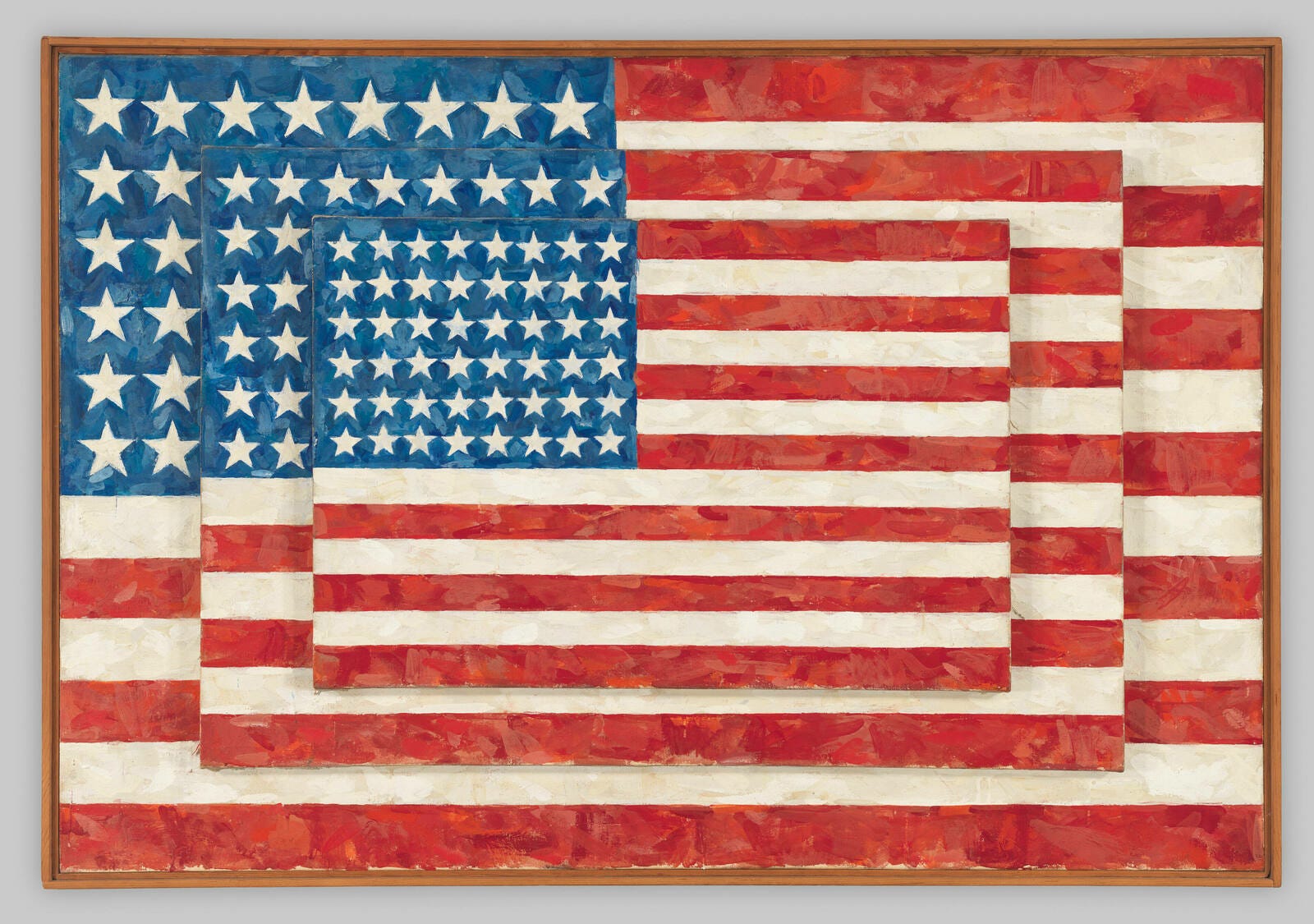
Johns’ painting is said to use structural arrangement to add to its complexity. “The trio of flags - each successively diminished in scale by about twenty-five percent - projects outward, contradicting classical perspective, in which objects appear to recede from the viewer’s vantage point”. On Pure Adrenalin, Chris achieves the same effect. Of course, Johns has a critical/political perspective. Quoting the Whitney website: “by shifting the visual emphasis from the flag’s emblematic meaning to the geometric patterns and variegated texture of the picture surface and the canvas structure, Johns explores the boundary between abstraction and representation. As he remarked, this painting allowed him to ‘go beyond the limits of the flag, and to have different canvas space’.”
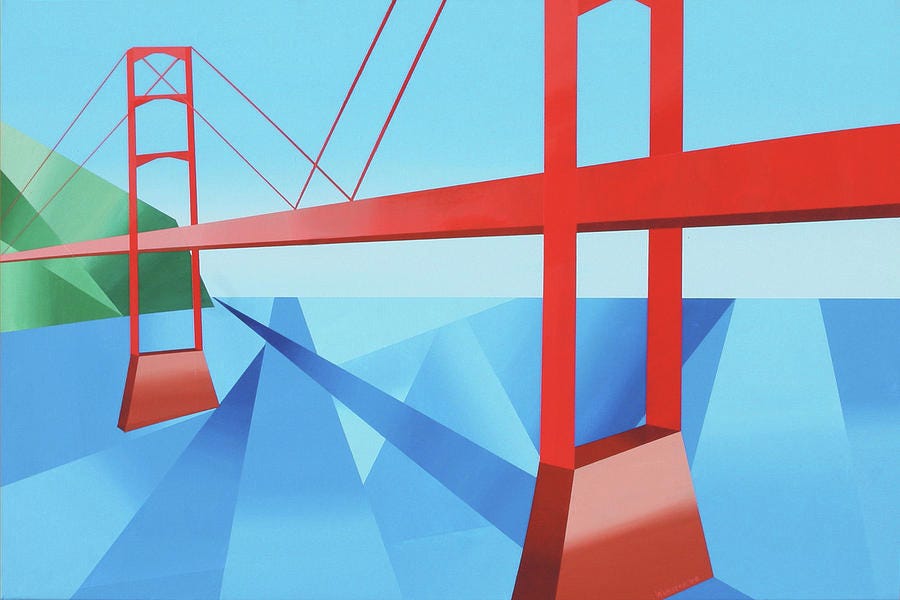
The foreground image of the bridge is used here as pattern structure rather than as mimesis. Again, this is an exemplar image, a synecdoche of a certain type of Americanism. This bridge features in the contemporary art world, with some artists (such as Mark Webster) attempting to create abstract interpretations.
A pair of authenticating eagles with star surrounds (approximating to the presidential seal?) are imprinted large in the top corners and the only break in symmetry (but continuity of balance) is an intruding New York yellow and black cab in the lower-left section, plus an image of James Dean (with blond hair?) on the right. Dean is included as if it’s a large photograph hurriedly pasted over the artwork – like the authenticating eagles, it sits on top of the picture plane, as an extra to the art – with corners peeling away and sitting at a skew-whiff angle. Again, we saw elements of this illusionism on Street Dancer – pictures on top of pictures on top of pictures with ‘reality’ always a remove away.
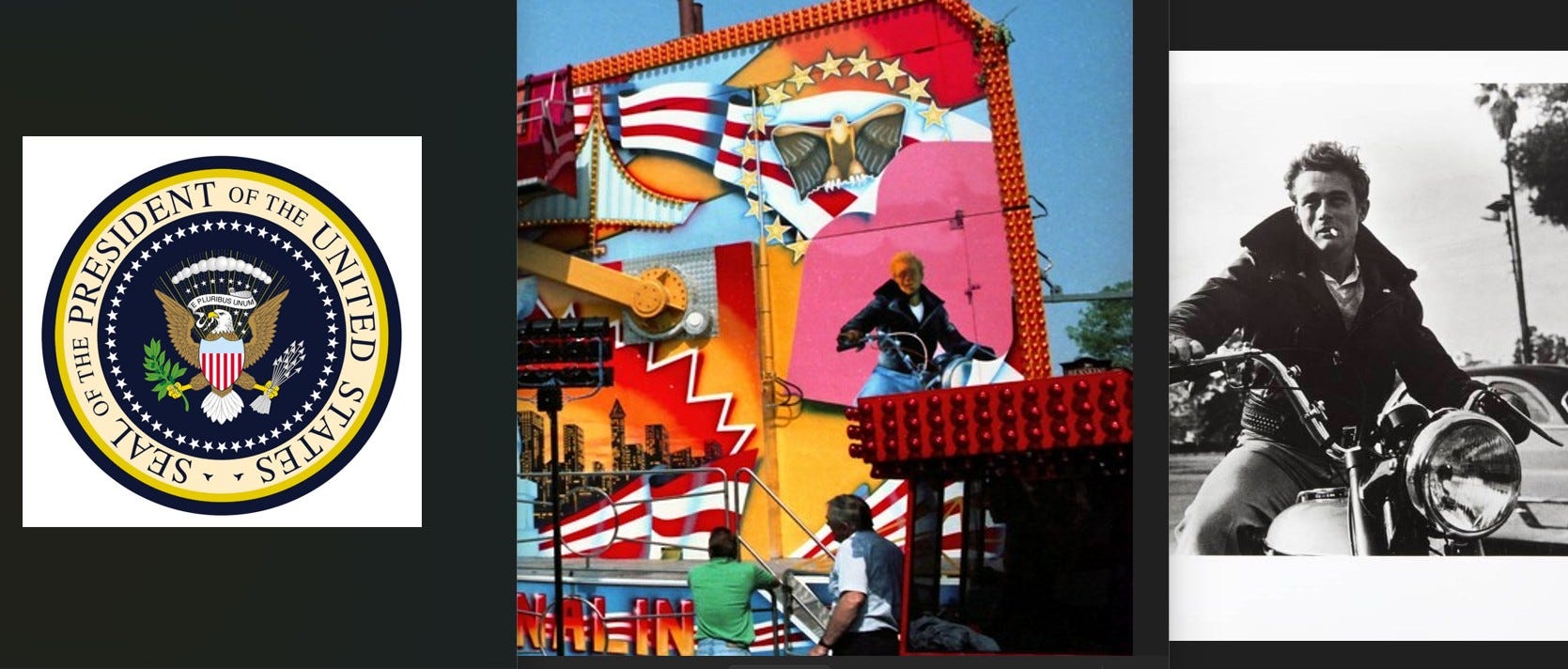
Behind the base of the statue, in the centre of the backflash, a jagged shape aperture takes us to the ‘other side’ of the artwork with a view of the New York skyline. For the final touch, seats are stencilled with alternate silhouettes of the Statue of Liberty and the authenticating eagle. These motifs are repeated around the paybox, with the striped banner, stars and eagles.
In effect, the American Epilog. Which brings me to a musical send-off that informed the title of these two essays, a different kind of American Dream, though perhaps maybe not so different from the current version we are seeing rolled out every day…
Normal service resumed next essay - Martin Margiela vs the donkey jacket