
Atomised (2 of 6)
Part 2 – The celebrity vortex

Continuing with the twin images of Von Teese and Manson advertising Vivienne Westwood, I am now splitting the couple apart and tracking their paths in the spectacle. Let’s start with Von Teese. Firstly I want to make a quick note about the ‘floating’ photograph, secondly I want to use Von Teese as a case study for accelerated celebrity culture (although ANY celebrity would suffice), and finally I want to re-introduce the original garment from her photograph and make a jump towards the visual codes of the selfie.
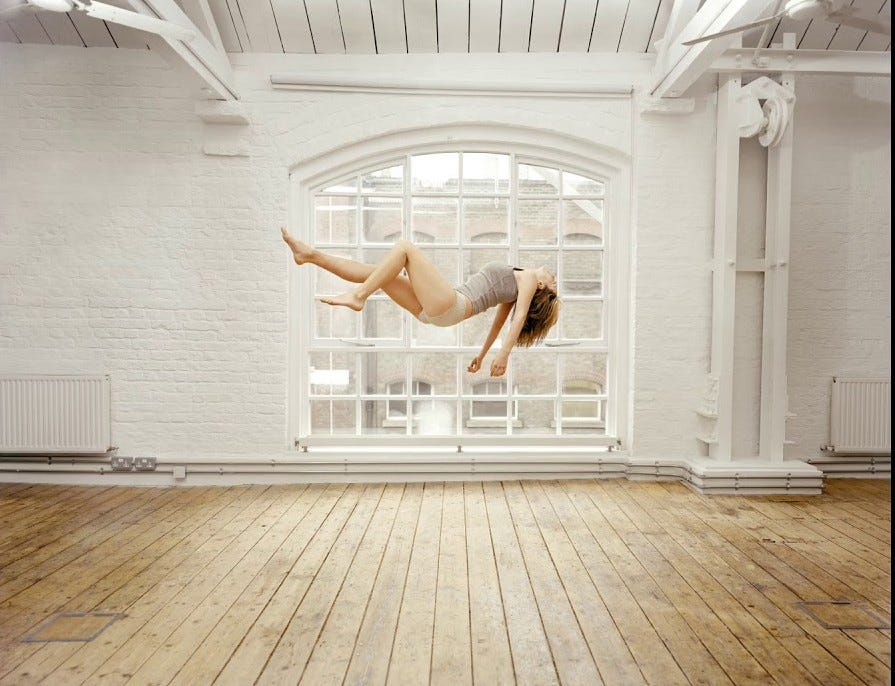
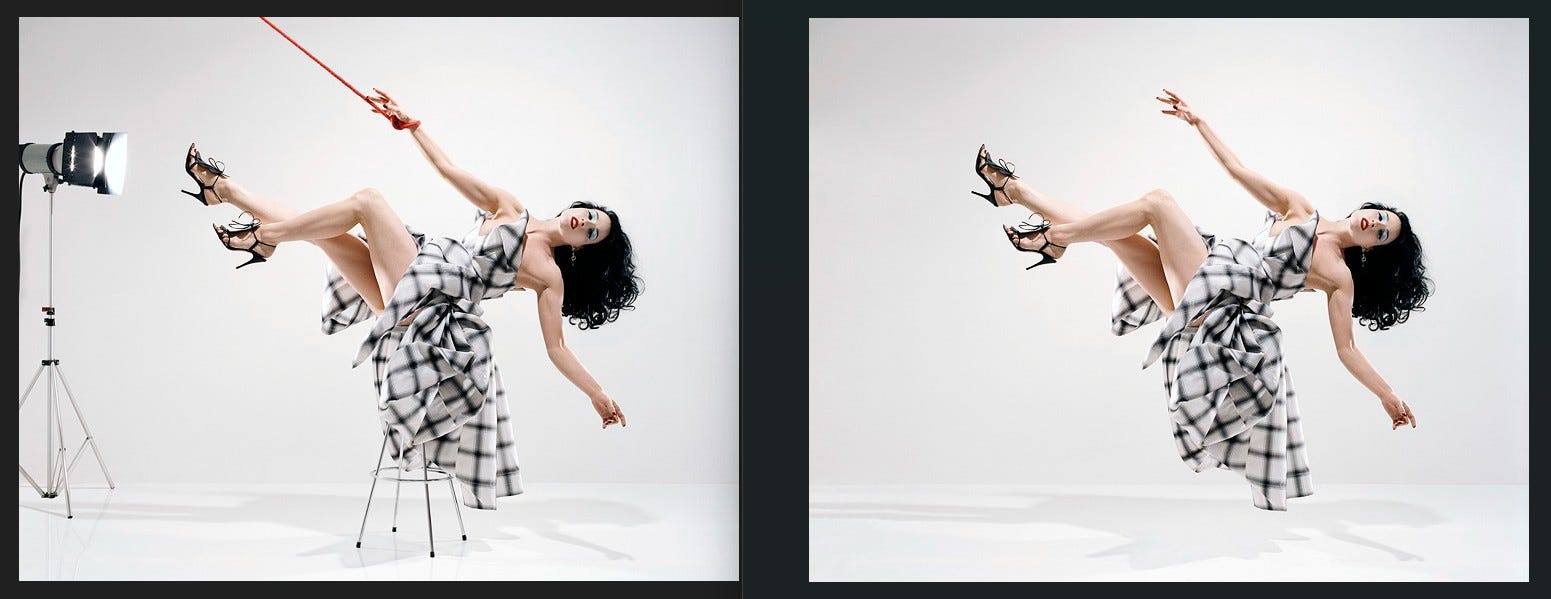
One point that came to light was a possible influence (or synergy) between Perou and the artist Sam Taylor-Wood’s series of suspended self-portraits which began in 2004 – around the time of Perou’s campaign for Westwood. Taylor-Wood was interested in putting herself through various physical constraints to achieve the pose, predominantly in the realm of bondage (so, a connection of sorts to the Westwood clothing). The artist then digitally removed the suspension and bondage devices to give the impression of a free-floating entity. Perou wanted the same effect, and he gets this the first image of Von Teese used in the advert. We have the flashlight, the balancing stool and the wrist grip rope all taken out. However, Westwood wasn’t happy about the removal of the ‘props’ and for the other images a midpoint agreement was reached. Below, kindly sent by the photographer, we have both versions. Props, lights and illusionistic balancing via their concealment will all be revisited over subsequent essays.
Von Teese, made famous for re-popularising the tradition of burlesque, quickly broke away from her marriage to Manson and has settled into a locked groove of reality television programmes. From fashion to music, to gothic subcultural makeovers, to cookery, to Cupcake Wars. Celebrity culture exists as a black hole that sucks in instances of reality to rebrand hopes and dreams, however it has sucked so hard that it has engorged on reality and turned itself inside out. Celebrity culture, the endless interior of the black hole consuming matter, is now the exterior.
In recent years, in line with this flipping of reality and fantasy aspiration into the realm of everyone, and exercising a slight shift of Guy Debord’s Society of the Spectacle and Gilles Deleuze’s Societies of Control, celebrities have been supplanted by influencers who exist solely to cultivate massed followers on social media channels. The script is often that they then enter into online spats with other influencers in an attempt to defund them of followers. The teenage make up specialist James Charles is such an example, his name now coming before other famous James’s such as James Joyce when you instigate typing a Google search. If only Joyce had upped his TikTok game and maybe sexted a few nude pix to a teenage Samuel Beckett instead of wrestling with the gruelling texts of Ulysses and Finnegans Wake.
Celebrity and influencer culture has also instigated the widespread popularity of the selfie, which has mutated in the past few years to the mirror-selfie. The selfie is a quick and easy way of producing a momentary reminder of saying “I’m here” that fits neatly into various image-driven social media tools – the desire to have others bear witness to one’s personhood with the computer or mobile screen acting as inverted lens. Unlike a traditional photograph that is designed to persist through time, having a single manifestation and being placed in an album, a selfie is an image that has no designation or intention of longevity. Instead, it (hopefully) instantly multiplies and proliferates over space as it is shared and shared again across social media networks, garnering likes, follows and re-posts. As instantly as it proliferates it then dissolves, moving down the ever-progressing scroll of social media.
Critical writing on selfie culture is prolific and repetitive, whether it comes from disciplines of sociology or visual culture. For example, social media theorist Nathan Jurgenson addressed the selfie craze in his 2019 book The Social Photo, suggesting that a selfie was more a shared mirror image than a photograph. The selfie is a glimpse of how you see yourself, compose yourself and contemplate yourself – akin to Canadian sociologist Erving Goffman’s theory of the ‘backstage’. Jurgenson also argues that the selfie demolishes a photographic fourth wall, as the subject and object merge.
Subject and object in photography can be confusing. In the classical (philosophical) sense it can mean who does the action or observing and who or what is acted upon or observed. There is some malleability and interchanging depending upon the contextual or power-hierarchical point of view. In photography we could translate this as who is in control of creating the photograph versus the thing that is photographed. However, the wider encompassing field of visual culture often assumes that object means what the photograph is of (for example, a tree) and subject means what the photograph is about (for example, solitude). It can get more complicated when we consider the viewer of a photograph over time – effectively a third person (or person-category). In a way this still buttresses Jurgenson’s theory of the taker of the photograph and the thing in the photograph being the same thing, as the selfie is often then pored over by the same person who is the creator and subject of the photograph.
The mirror-selfie, evidently coming to prominence after Jurgenson’s book and recently propelled by the sequence of pandemics and lockdowns, has numerous additional and complex attributes and causal aspects. Inevitably, the mirror-selfie also becomes constructed as a prescriptive and fixed style trope, with the user positioning the camera-phone partially in front of their face as they stand in front of a large mirror. The earlier selfie was associated with the ‘duck face’, a kind of deliberate pout blended with an anticipated astonished look as you point your camera-phone at yourself and swipe the digital button that activates the aperture. Though it is said to be a product of posing and pouting, it can also come across as a natural reaction to holding a device so close to yourself, such that it resembled something like pointing a loaded gun at your head in a game of Russian roulette.
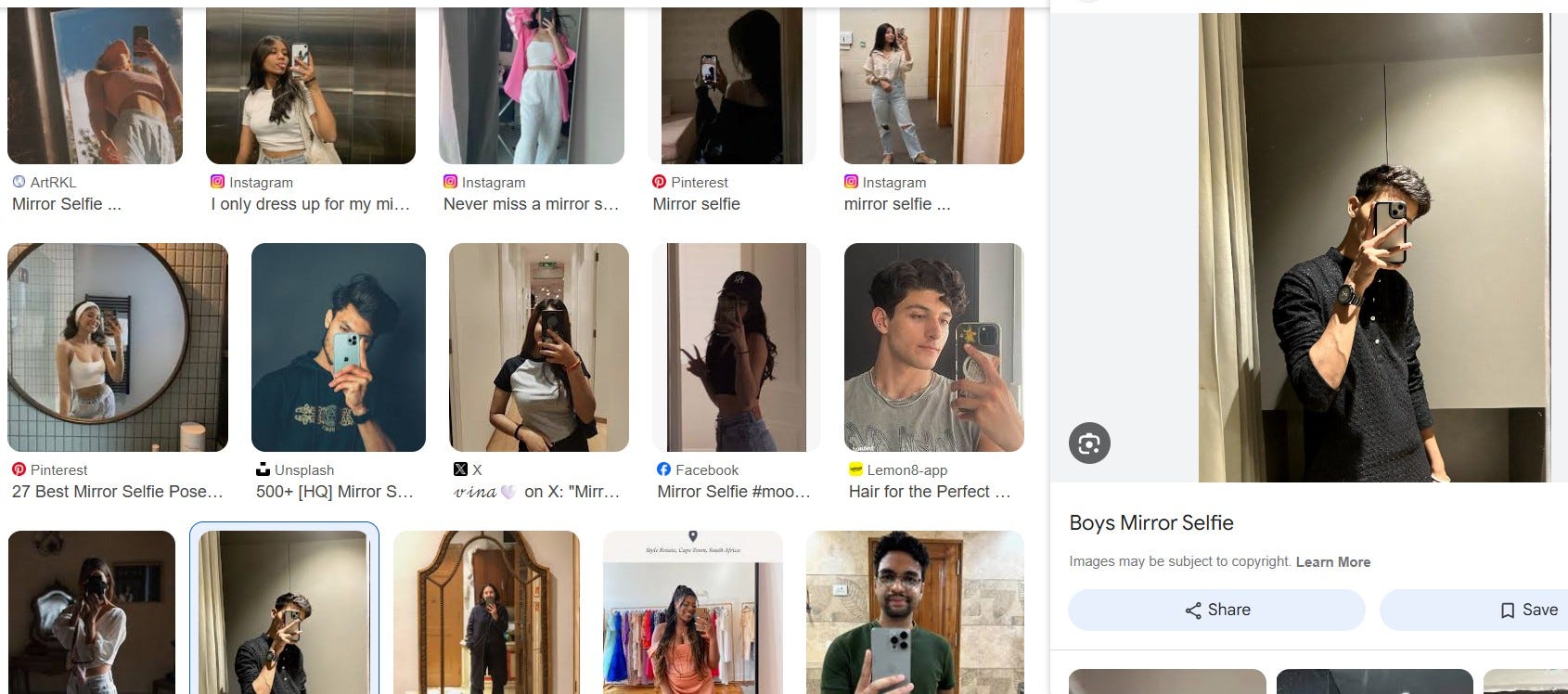
The mirror-selfie glimpses a different expression, a kind of absorption of looking at your own image in the camera-phone screen (which captures your image in the mirror but with the camera-phone partially obscuring your own face). This is not the absorption signalled as a device by art theorist Michael Fried, but more of a narcissistic double absorption – being absorbed in perfecting the look of being absorbed. The absorption of seeing yourself extends to imagining the same image being seen and liked by (hopefully) countless others. You want to be seen to be doing this correctly.
This concept fascinates me. There is a rebounding visual chain of lenses and screens: the eye of the subject/object acting as subject stares into the screen of the phone (and so we never see the eye of the subject), the screen of the phone shows the view from the camera lens as it faces towards the mirror (and so we see this ‘eye’ of the intermediate device as a captured reflection), and the mirror doubles as both lens and screen reflecting the whole assemblage that confronts it.
Mirrors and cameras have optical conventions. Both show their object and what’s behind the object (intentional or otherwise) in different ways. This means that the photo-of-a-mirror shows simultaneously what’s in front of the object and what’s behind, looking both ways at once, but blending together. A personal mise en abyme feeds an anticipated public mise en abyme. This blend of partial obscuring and absorption is key in structuring the image as a valid mirror-selfie.
Additionally, as with Jacques Derrida’s concept of the parergon in art, each of these links in the visual chain includes a necessary surplus, or seepage, that in turn adds authenticity (“this is me”) and ontological authority (“this is a mirror-selfie”) to the image. The phone (from which the resultant image forms) captures a surplus around the mirror – the frame (if it has one), the mounting, the wall, whilst the mirror reflects what is behind and around the subject/object. The idea is that the mirror-selfie offers a normally uninvited double glimpse of a personal or intimate space; both where mirrors dwell – the bathroom or the disarrayed bedroom closet – and also the detritus of life behind the person taking the photograph of themselves. Special admission into an inner sanctuary (of the influencer).

Getting back to the original photograph of Von Teese that caught my eye, I mentioned that the jacket she wears was either the same as, or based on, a jacket I have from Westwood’s MAN collection. It’s a typically odd piece, slightly cartoon-costume, with a grey-going-pink twinned with a pink-going-grey contrast on collars, pockets, etc. It has a distorted and oversize shape that is held down with buttons and straps… there is also a secret interior detail that revisits the blow-up sex-doll script from an earlier McLaren scheme.
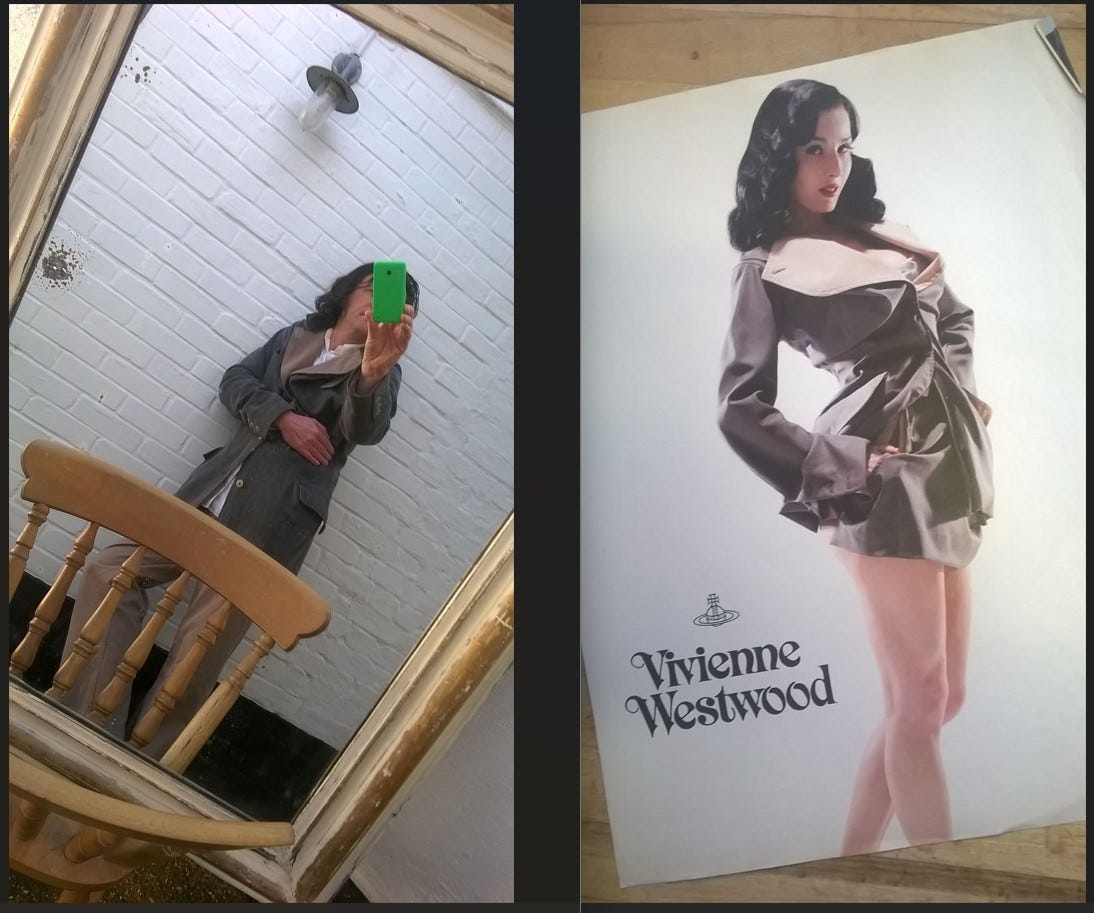
With it being lockdown at the time of exploring this, I went for a mirror-selfie. I have heaved the big mirror from upstairs (a private realm) into the external narrow access space alongside our old house. The potential glimpse of the upstairs private realm does not travel with the mirror, instead we have the narrow channel between two white walls of adjacent houses - a semi-private realm. With the mirror positioned on a supporting chair the white wall attains continuity of a sort – the regular white wall seen outside the frame of the mirror, the hidden white wall (nominally the glimpse of a private realm) now seen inside the mirror. The chair is visible both in front of the mirror and behind the mirror at once. As a mirror-selfie, it’s pretty disastrous. But what did you expect?
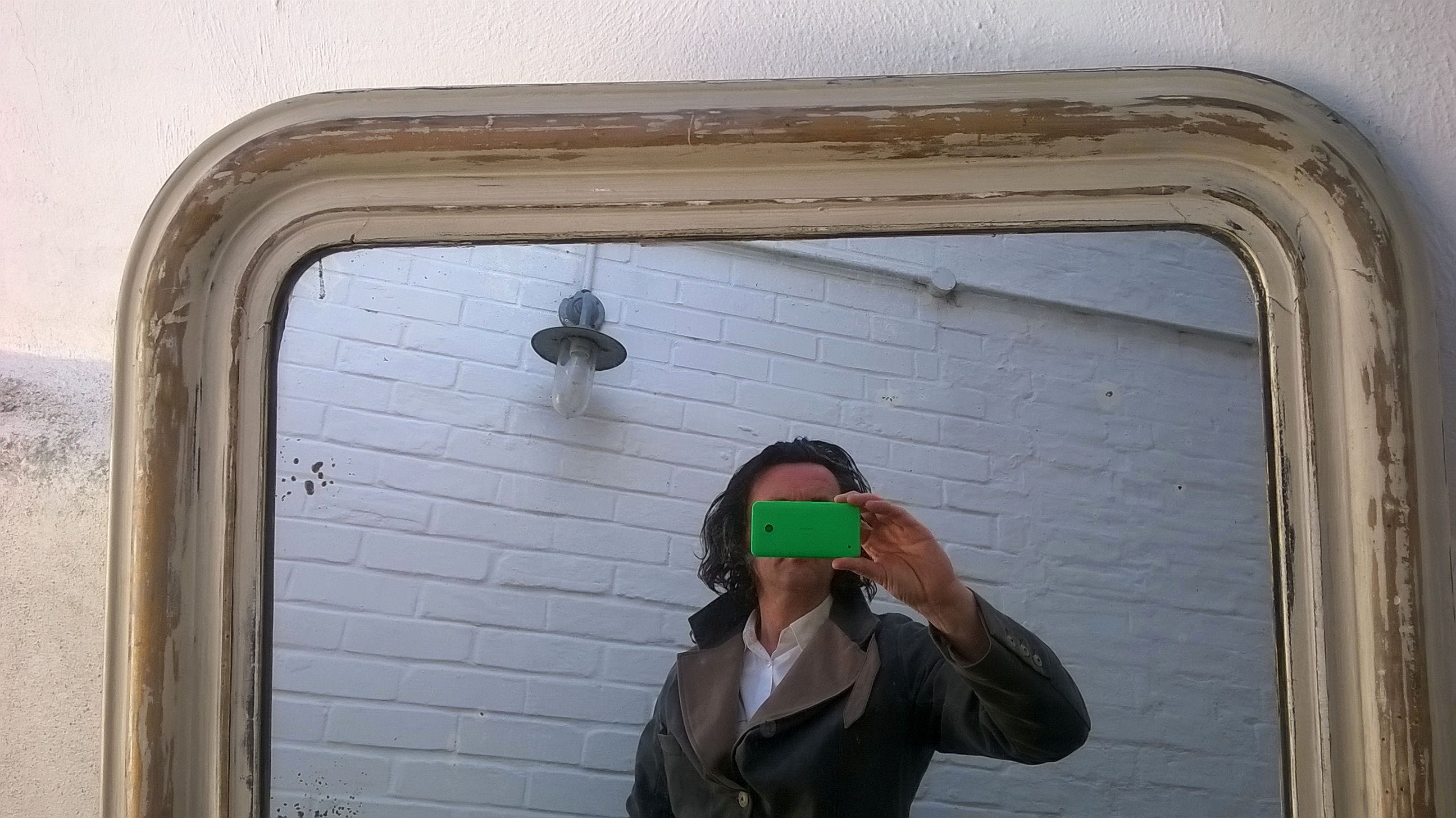
A mirror has a magic, or heterotopic, space behind it. Mirrors contain backgrounds (as reflections) but are generally not used to project backgrounds, instead the background is momentarily seen when the person wishes to view himself or herself. Other mirrors with an oblique or convex engagement offer a line of sight around a corner, from a convex disc on a corner point in a maze-like system, to the device a dentist inserts in your mouth. The reflected background on a flat mirror engaged face-on is always there and reflects what is in front of it. To see the extant background you have to put yourself in the line of sight, and so both extend and disrupt what the mirror holds in its clutches.
There has been a minor internet sensation in recent years, the trend for documenting people trying to photograph mirrors to sell on auction sites such as eBay and attempting to avoid being implicated and trapped in the line of sight. To negate presence. This is I suppose the opposite of a mirror-selfie, but with all the optical and visual detritus associated with the practice.
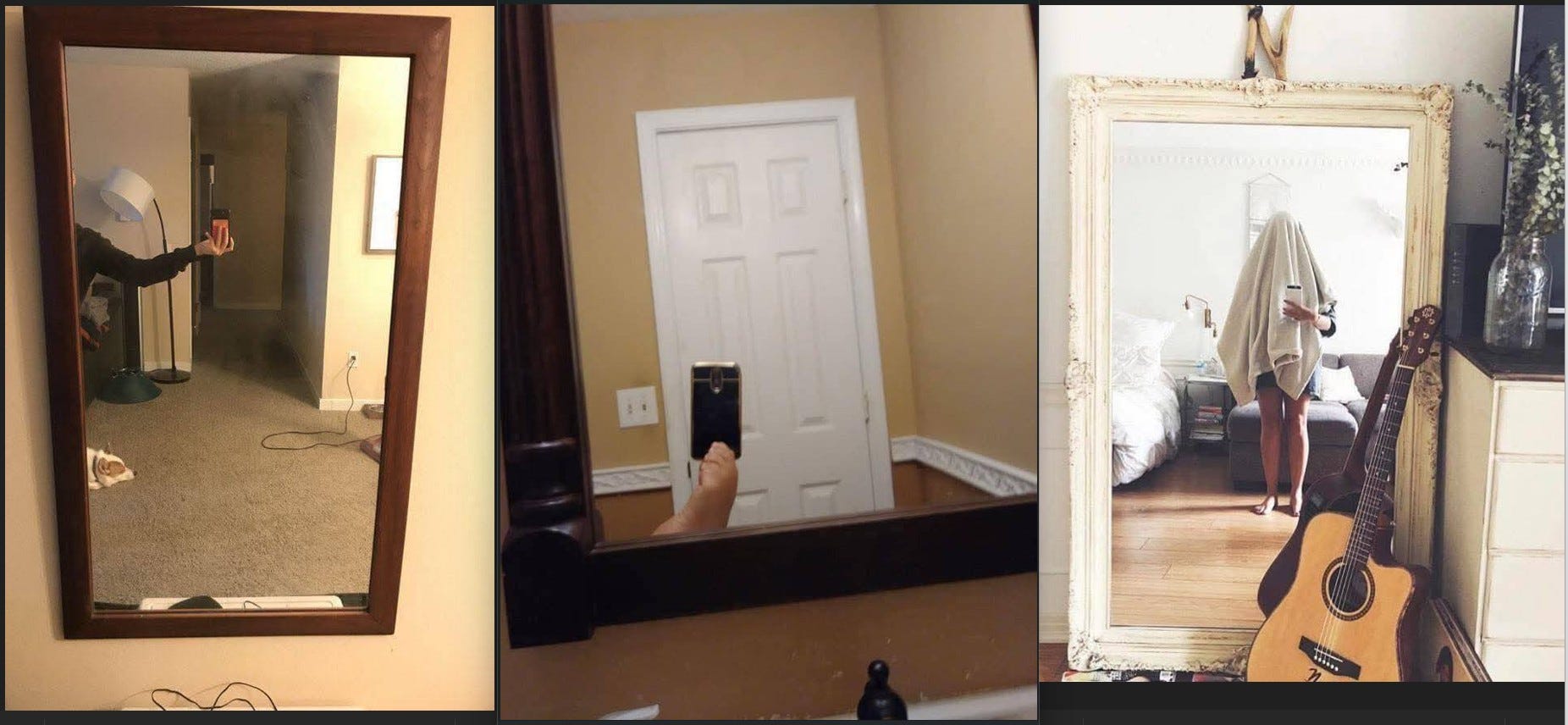
In the first picture the negated taker cannot help but include their arm and hand, and squiggles of wire exist in front of the camera and behind the camera. There is a hint of unmade bed (private realm) and a framed-within-the-frame passageway… but the great part is the head and snozzle of a sleeping dog oblivious to the procedure. The steady-state field of reflection lingers and persists.
The second picture has what appears to be a somewhat contortionistic solution to including your hand and arm by firing the lens with your foot. The resultant image is joyously skewed and reveals a giddy arrangement of off-kilter white squares, rectangles and borders like a post-Malevich abstraction. The final image breaks rank with the absolute negation of presence by offering concealment in plain sight. It is an archetypically composed mirror-selfie with the subject extinguishing their identity in an act of anti-epistemology with a cartoon ghost towel over their head.

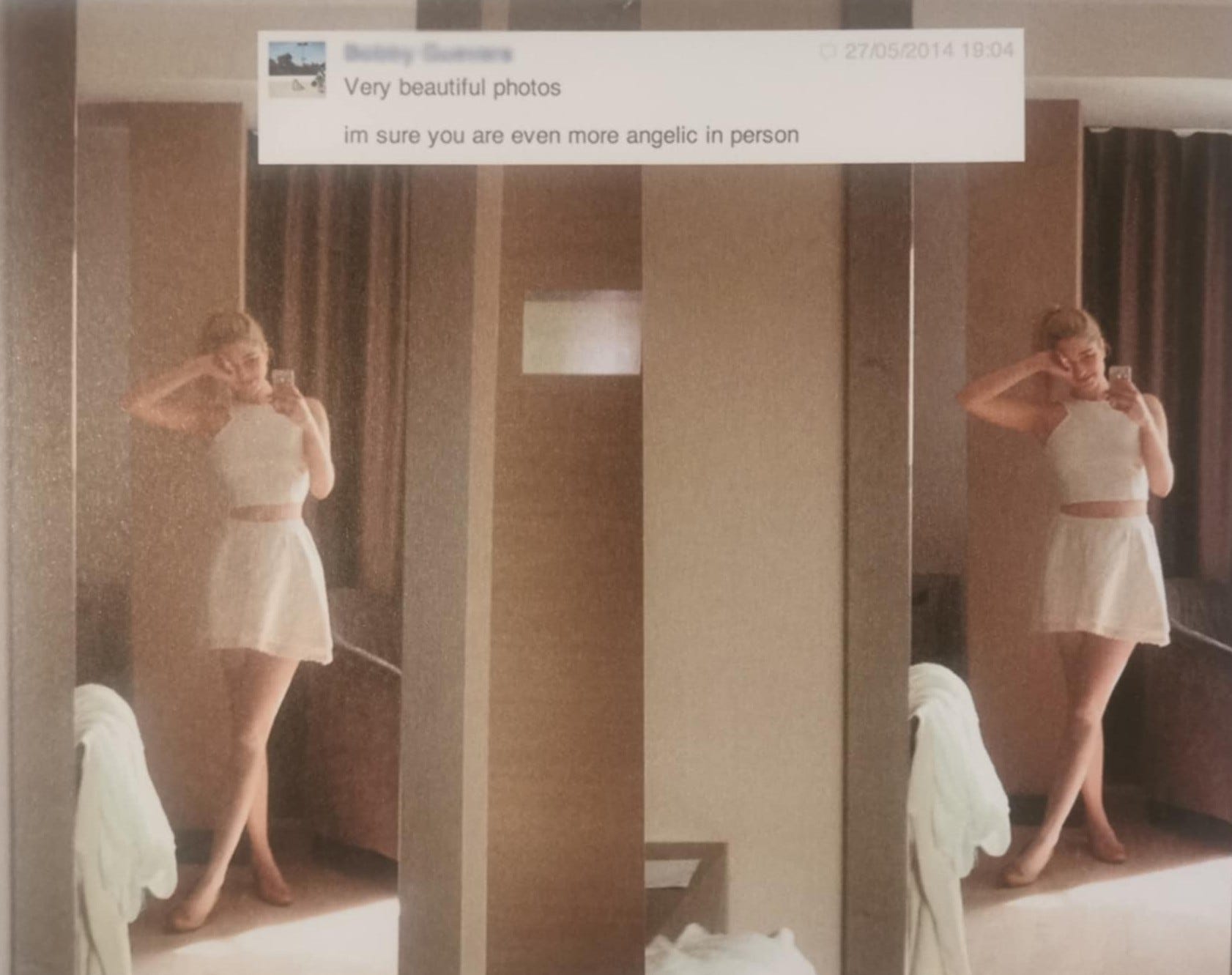
Finally, back in the art world, the artist Amalia Ulman carefully curated an Instagram project Excellences and Perfections that told the story of a fictional character undergoing a perfect relationship, then breakdown, then rebuilding, with much of the narrative driven by intimate mirror-selfies broadcast over social media. As the project was revealed as a fictional device, the large audience following of Instagram regulars inevitably took offense, as Ulman’s overriding intention was to expose and ultimately question the performativity of social media. She felt that these media structures, twinned with selfie culture, had shifted a kind of celebrity-impetus onto the average person. The reversal of the figure-ground of the black hole I suggested at the start of this essay.
The next part goes through the mirror to look at a bit more art and post-punk pop culture.
V interesting. I’ve now got Mirror Mirror by Dollar as an ear worm.
Damn, you can't half pack some stuff in your writing. Going to wrestle with this for a bit. It has been a while since I dusted off the three D's (Debord, Deleuze, and Derrida).
I do love "...being absorbed in perfecting the look of being absorbed."