
Atomised (5 of 6)
Part 5 – Mirror moves (3)

Existing between Jeff Wall’s Picture for Women and the cultural onset of the mirror-selfie, and bringing us back to a pop culture terrain, is the photograph accompanying Scritti Politti’s 1985 album, Cupid & Psyche 85 as part of the inner sleeve design. Singer Green Gartside had toyed with the look from the start of the 1980s, intellectualising the gestation of new pop whilst being desperate to carve himself a slice of it.
The band had started out in the Leeds post-punk Marxist milieu, producing a scratchy sound that celebrated its awkwardness of self-production in a kind of teeny-tiny soundsystem culture that reflected their new environment of Camden squat culture. Green suffered an illness connected with the pressure of fame and performance, went into retreat back to his home in South Wales, and emerged with a new ethos that swapped out the Gramscian Marxism and invested in a pop-curious direction.
Their 1982 debut album Songs to Remember still divides opinion – it arrived on independent label Rough Trade but abandoned any pretence to criticism or confrontation in terms of sound and context. There was something there… a kind of slick post structuralist shimmer that had seen Green sing about Jacques Derrida and affectedly slop around Marxist dictums in a glib-pop framework.
Another breakdown and Welsh retreat followed, and this time Green emerged to disband Scritti and assemble new musicians with an intent to create a hip-hop-lite sound that continued the surface shimmer and sugar-coated intellectualisms. He dreamt of a rigorous luxury pop that seemingly contradicted itself between easy and difficult listening. The bottom line required a modicum of success to nestle with the Duran Durans of the world.
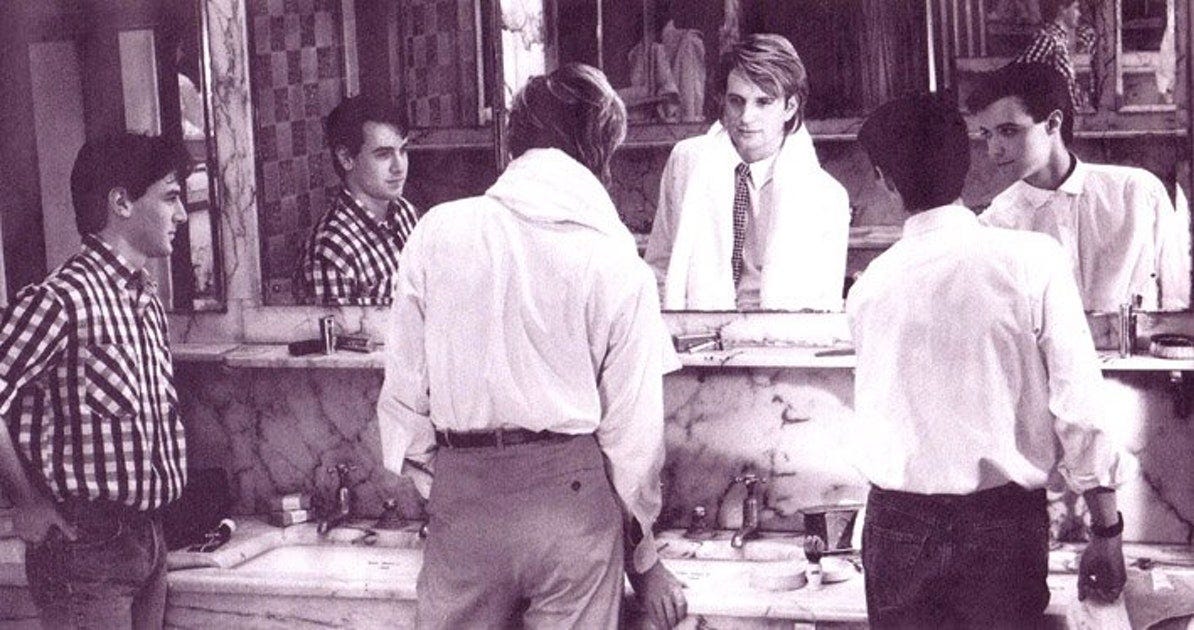
It took a while, but he got there, albeit briefly (as is the way). He celebrates the moment by staging a photograph in a luxury bathroom flanked by (new) band members David Gamson and Fred Maher. There’s a strange tripling of the Magritte mirror portrait that resides on the research portals of the internet, in a beguiling essay on mirrors and optics. It catches my attention as there’s a quirky parallel to the Scritti image.
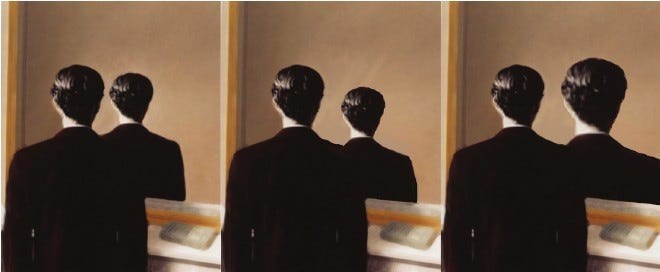
However, there’s no sight-lines in Magritte, and so we can go back to Wall’s photograph. In a similar arrangement to Picture for Women, the lines of sight are revealing between the three figures (if we consider Wall’s camera as a central third figure that photographs itself). Green admires himself; the band members admire Green admiring himself. His hair streaked and pushed into a Lady Di mullet style.
The camera/photographer is invisible, approaching the scene from an oblique angle high on the right (like a security camera image). Green stares into the mirror above the trio of marbled washbasins, but the mirror also reveals a line of washbasins and mirrors behind. Green is visible twice, from behind and from the front (in the mirror), but his colleague to the left figures a further three times in his boldly checked shirt, as the camera angle twists away from revealing a mirrored infinity. It’s a sumptuous pop image accompanying one of my favourite albums from the new-pop genre.
Finally, before we leave the world of mirrors, there’s another great post-punk photograph with the early incarnation of Siouxsie and the Banshees. It playfully conforms to the pop group photograph standard of having an ‘isocephalic’ arrangement – that is, all the heads of the figures in an approximate alignment of scale and space. But this is cleverly both resisted and achieved.
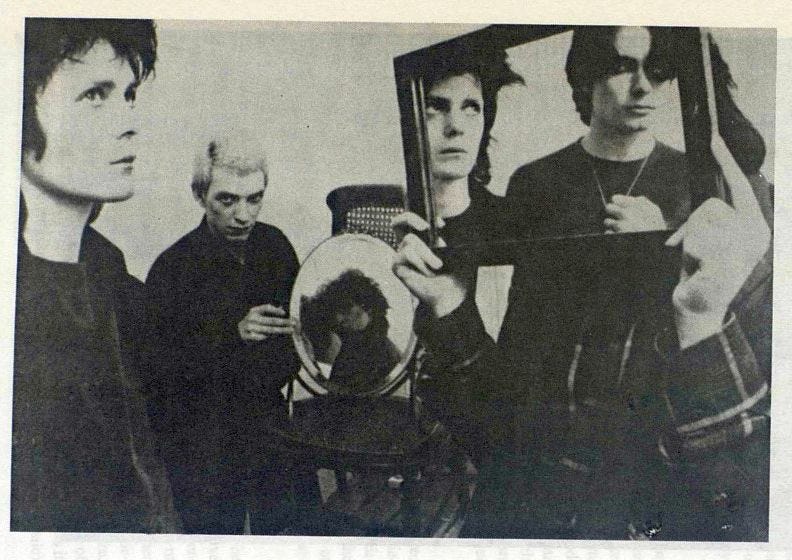
In the ‘real space’ of the photograph we have one band member (John McKay) totally absent and another band member (the all-important Siouxsie) hiding her distinctive visage behind a mirror. Her face make-up and hair normally functions as an imprimatur of the band, so it is disconcerting to have her absent.
But of course, she isn’t… parity is restored with the aid of reflections. There is a small dressing-table elliptical mirror sat in the centre of the photograph on a wooden chair. This chair is pretty much the dead centre of the photograph, and so would (in a classical sense of composition) be occupied by the subject or ‘sitter’ – presumably Siouxsie. And yet, she does occupy this centre space, by appearing in the oval mirror (clutching the square mirror) which is diligently manipulated by bassist and founder-member Steven Severin. He dips his head but stares at the photographer in a ‘proper’ manner. His hand adjusting the swivel of the dressing mirror performs a gentle touching gesture towards Siouxsie (or her reflection).
The other mirror is a traditional wooden-framed rectangular mirror, held up by Siouxsie as a device to both hide behind and allow the missing Banshee McKay to feature in the band photograph. It also allows Kenny Morris to get in on the act twice, momentarily reconfiguring the band as a five-piece.
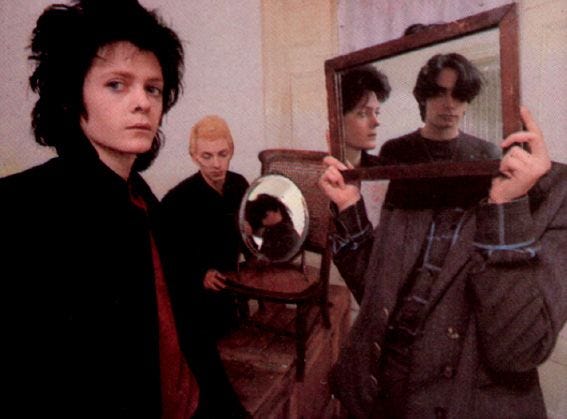
I have seen two takes of this arrangement, and both have slightly different lines of engagement from the four band members. Who is looking at who, whose reflections look at whose reflections? It’s another layer of confusion and uncertainty on an optically confusing photograph. Almost a pre-empting of how the band would acrimoniously split apart shortly after these photographs were orchestrated.