
Atomised (6 of 6)
Part 6 – Posing

If Dita Von Teese exemplifies the glamorous celebrity forever entrapped in the photographic culture of society and the image in the mirror flipping between the specular and spectacular, then Marilyn Manson briefly represented an opposite pole. At the time of the advertising campaign for Westwood he has already travelled a contested path which was about to get much worse. However, in 2005 he undoubtedly has looks, poise and styling that clearly stand out, making him a dark poster-boy for a commercial goth movement, a kind of hip commercial avatar.
His authenticity in the goth scene is conflicted, with many subcultural protagonists thinking he personifies some kind of plasticised commercial force. There is a tradition of popstars who tended to push too far with the modification of their looks, gender and body – Dead or Alive singer Pete Burns, Throbbing Gristle / Psychic TV provocateur Genesis P. Orridge. They presented a dark mirror image of the Botox obsession for prescriptive perfection in the celebrity milieu. As for Marilyn Manson – amidst all the grumbling about his commercialising of goth and industrial there is scant acknowledgement that he looks incredibly arresting, and pushes a goth archetype that many others fail to grasp with such powerful individuality, performativity and subcultural prowess.
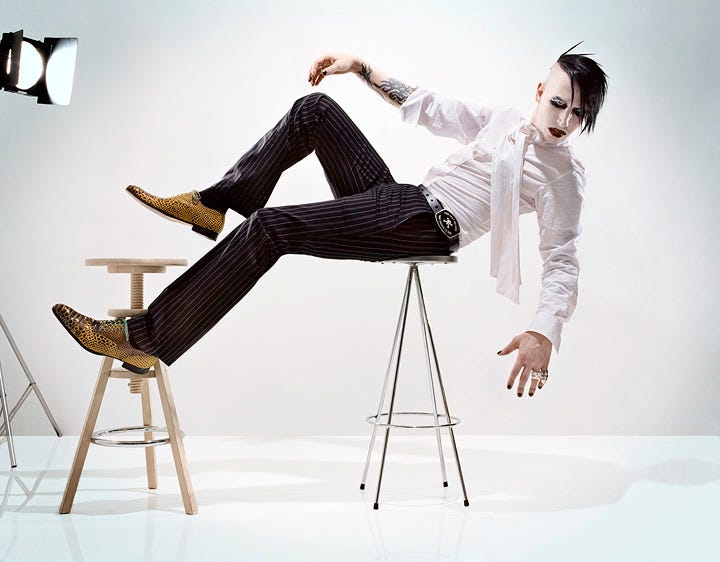
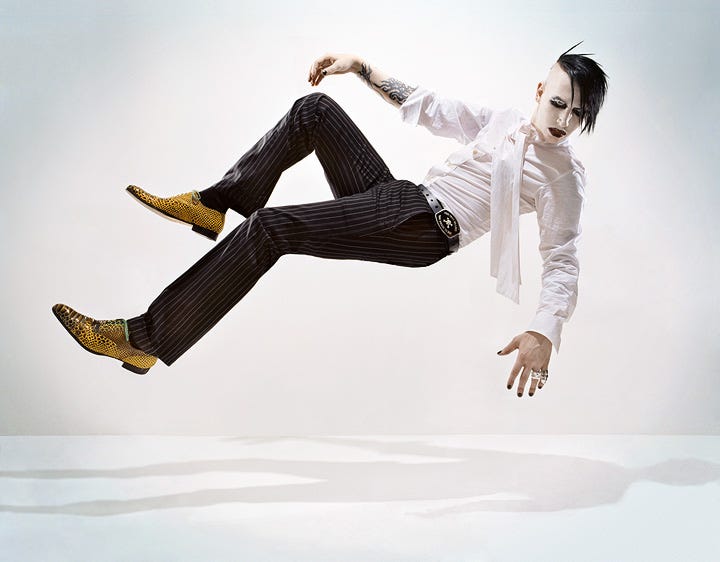
For the Westwood image included here, clipped from the double page magazine spread, Manson pivots himself horizontally on a raised barstool finished in narrow tubular steel with a highly chromed finish, achieving a quasi-impossible supine position. Another wooden barstool – what looks like an Ikea standard – is near his feet but he does not engage this for balance. To the extreme left are the visible signs of studio construction – a ladder and spotlight – to extol the manufactured nature of the scene (a Jeff Wall trope amidst his ‘heightened reality’). Interestingly he does not require the hanging wrist support used by Von Teese, and Manson is able to affect the pose using his suppleness and strength. No mean feat.
At the same time Manson embodies and celebrates the manufactured – a death white pallor of facepaint, immaculately cut, flattened and gelled Mohican hairstyle, arms and hands extended as if assisting in his impossibly floating stance, showing off tattoos, nail varnish and jewellery. This is why the decision to leave in the props works so well, to give off a grinding aura of artifice. I can see the beauty in Perou’s preference to remove all and create the Sam Taylor-Wood style unreal Matrix-style floating figure (photograph included above for comparison), but I’d edge towards Westwood’s choice for the final edit.
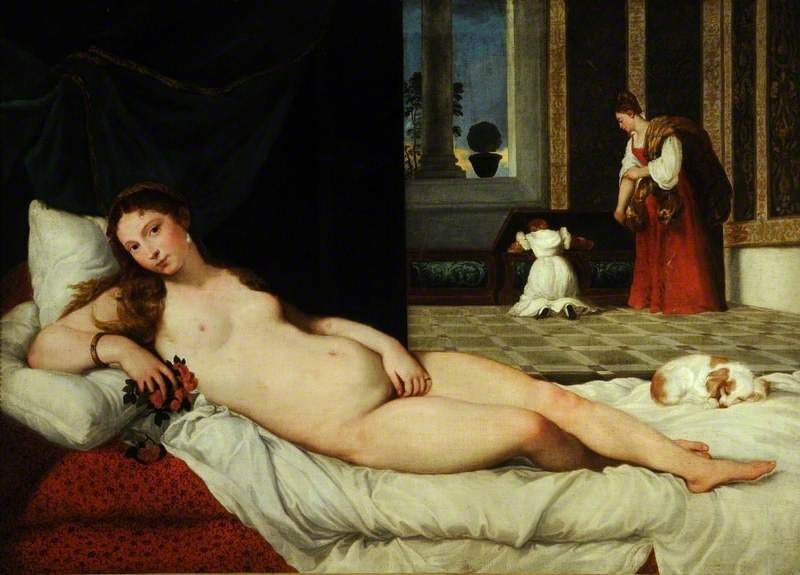
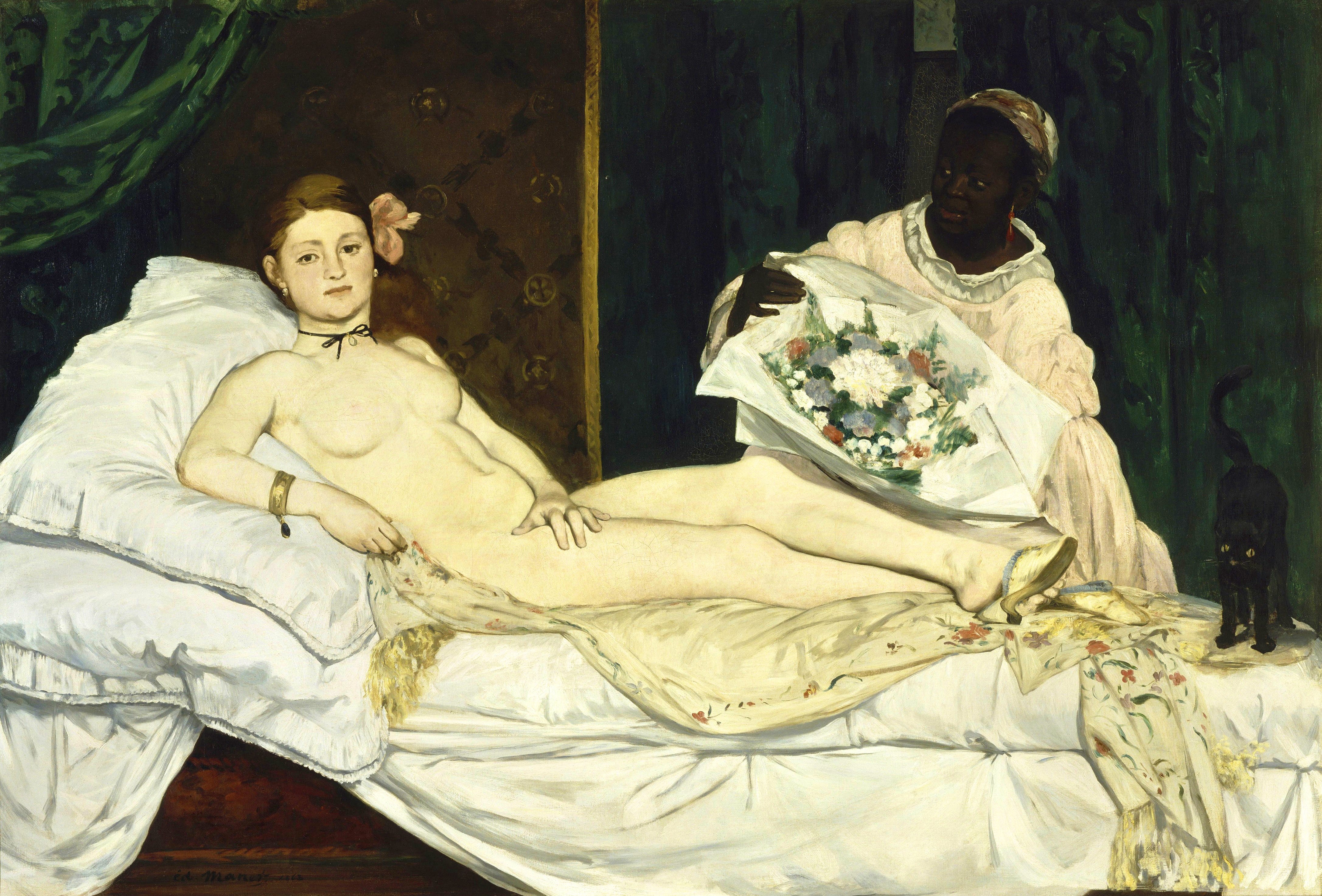
Manson’s position of an exerted and overly posed lying down – even if he remarkably achieves it in an elevated context with just the one point of support – is a pose that can be given an art historical context. Though not intentional by photographer Perou, the key work here is Édouard Manet’s Olympia (1863), itself based upon Titian’s Venus of Urbino (c1534).
Manet’s work mimics the supine submissiveness of Titian, but he dislodges the context by bringing in element of class representation and struggle. Prominent art theorist TJ Clark has written prolifically on Manet, building a strong case for his desire to represent the labouring classes as agitational and visually disruptive stand-ins for models, muses and the upper classes of life and society. It is a little like the missing-of-the-target with Owen Jones’ celebrated book Chavs – Jones expounds a lot of words and earnest handwringing trying to explain and apologise for the wearing of glib pirated Burberry checks by the legions of council estate kids and football crew hordes. He is making gestures to mop up non-existant tears when really this garish fashion is a working class assertion and identity, not something to be explained away in an apologetic manner.
Manet’s Olympia is thus re-assessed by TJ Clark and many others such as Michael Fried at a forensic level, examining gazes and positioning of hands – the work formally afforded to art critics. There is an about turn around a supposed transactionalisation of the right to view or touch the body. Titian’s subject invites; Manet’s subject blocks. Manson, meanwhile, has his arms and hands frozen in space and seemingly without any control or function. He looks unerringly like a discarded mannequin or a puppet with tangled strings. A Thunderbirds relic reimagined through a goth timeframe.
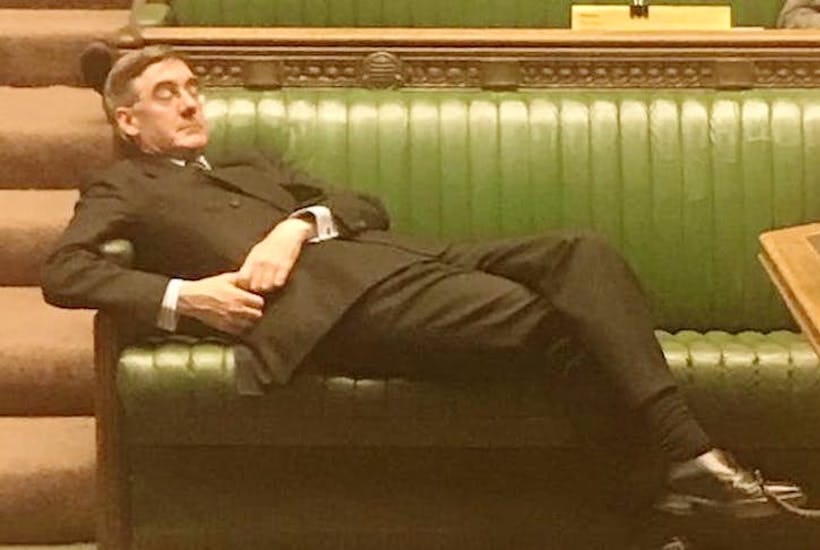
However, taking this image forward in time ascribes a haunted quality to Manson’s pose, particularly as this unusual pose has uncannily gained traction into the 2020s. Some critics argue that Olympia signals boredom and a deliberately aestheticization of the banal. This performative banality was initiated by the privileged pantomime villain Tory MP Jacob Rees-Mogg who chose to theatrically slump in a horizontal position during a September 2019 Brexit debate in the House of Commons, spreading his Victorian pencil deportment over three empty seats like a crashed-out lout coming home on the last train out of London.
Oppositional popular opinion has Rees-Mogg as someone tuned in to disaster capitalism and shock doctrine – capsizing the country through Brexit, shorting the currency, and in turn making money through shrewd contrarian investment and stock tipping. Trump (or his advisers and investors) turn a similar trick with crisis point crashing of the market with dramatic tariffs exacted and then retracted. Jacob’s father William Rees-Mogg wrote the manual on this – Blood on the Streets.
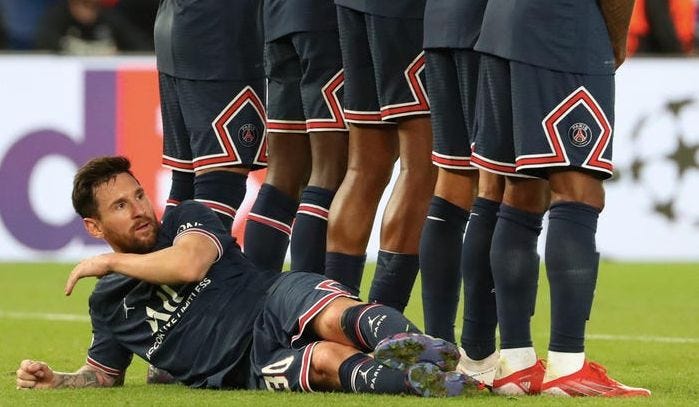
This indelible image of Rees-Mogg’s parliamentary pose also prefaced the start of lockdown, and another raft of dubious money-making mechanisms. You know how this pans out, so I won’t break it down. In cultural terms, the gradual return from lockdown saw the agreed staging of various sports and bizarrely the Rees-Mogg meme come to the fore with the return of Premiership football. In an epiphenomenal chain to block free kicks directed underneath a jumping defensive wall the defending team employs a player laying down - this was briefly referred to as the Rees-Mogg position before it took on a more mundane (and less politicised) name of draught excluder.
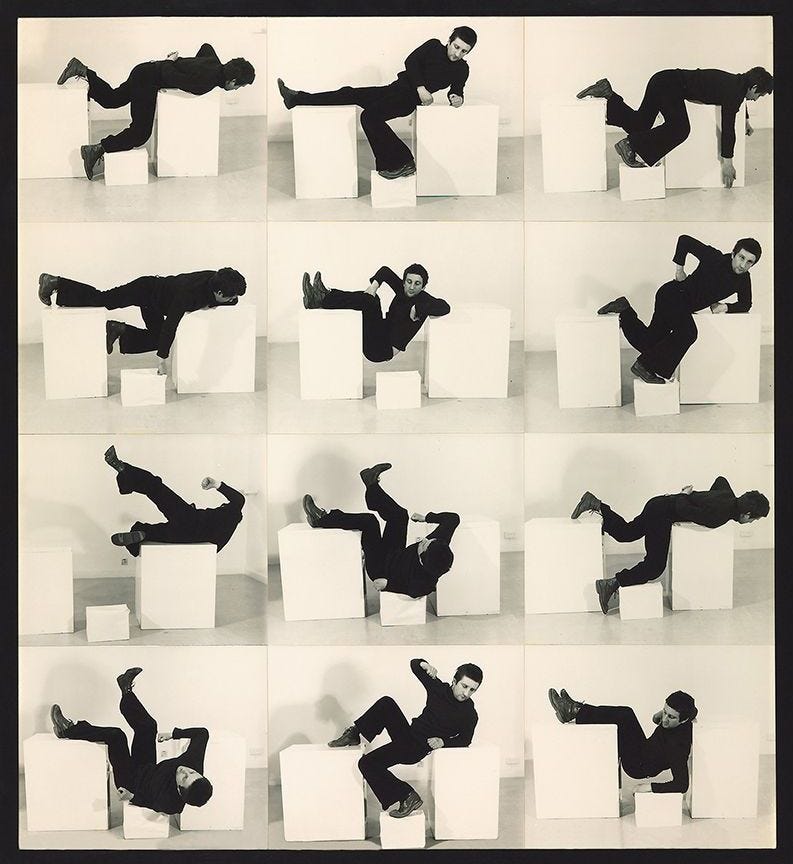
Once again returning to a more pop-cultural relevance, we can consider the artist Bruce McLean’s Nice Style period and the specific 1971 performance Pose Work for Plinths. The wider project consisted of a group of works from the start of the 1970s that saw the eccentric artist mimic what he saw as the pomposity of Henry Moore’s sculptures of a reclining female figure. McLean inserts himself into three plinths left over from an unfinished project, simultaneously trying to provoke modernist sculptor Anthony Caro’s refusal of the plinth. He pulls off 12 poses that are based around two larger plinths either side of a small chasm bottomed with a low plinth, his body (or body parts) lowering into the gap but never relinquishing torsion.
McLean is dressed in a smart mod/beatnik outfit – black trousers, long-sleeved black polo-neck sweater, and fashionable short haircut. He was clued in the subcultures and the pop music styles, wanting to draw them into his art without the obviousness of his 1960s pop art peers such as Peter Blake.
In 1971, this awkward posing routine gives birth to a new project - Nice Style, the “World’s First Pose Band”. The group performed in May as support for The Kinks at Maidstone College of Art, simply adopting a sequence of predetermined poses and holding down a nice style, with an absence of sound or music. It was like Roxy Music for deaf people. The crowd were bemused, having their expectations and acceptances of what they viewed as conformity to entertainment severely challenged.
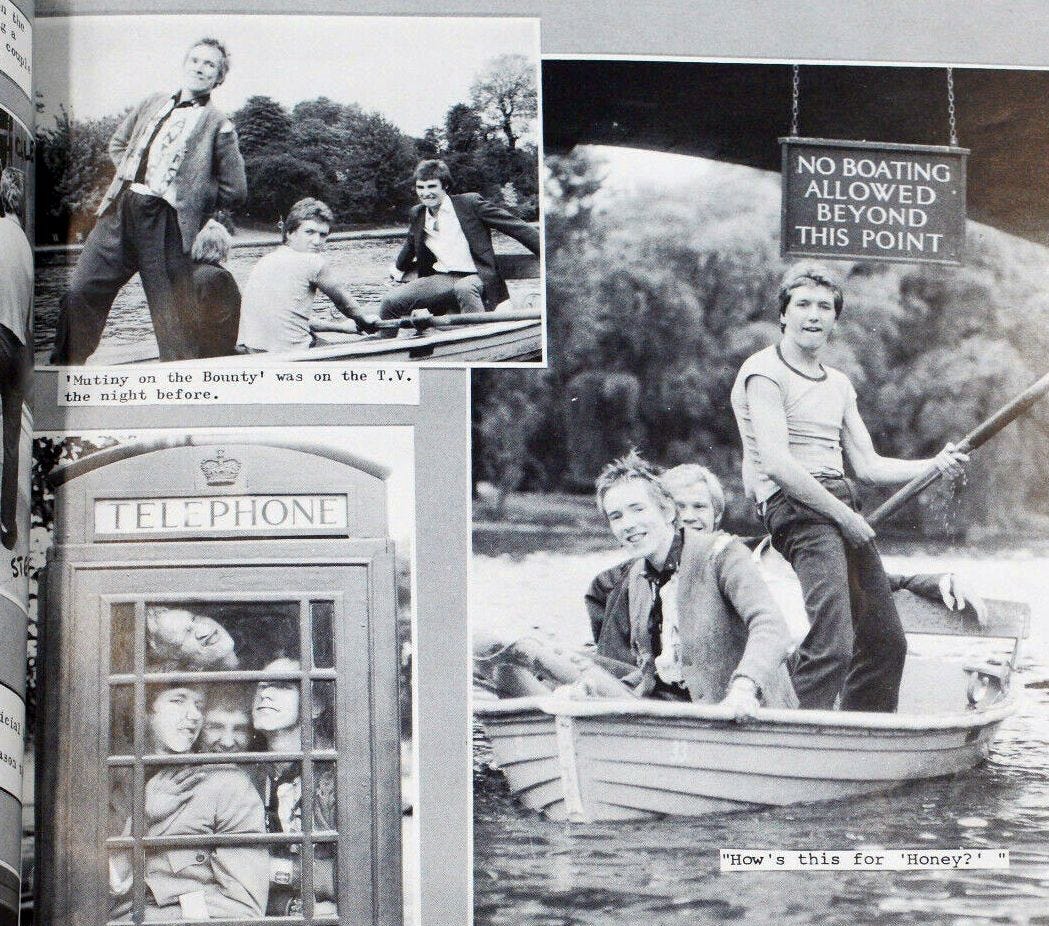
I’ve recently learnt that post-punk arch-poseur Richard Butler of the Psychedelic Furs was a student of McLean and employed in Nice Style to hold various mirrors! McLean’s combining of angular posing with subcultural suavity would see a replication in Ray Stevenson’s iconic images of the Sex Pistols in 1976, posing in and around Carnaby Street with Johnny Rotten gurning and goofing with his back twisted and elbows and knees hinged at various angles. In one photograph he is captured by Stevenson holding an incongruous pose as he steps into a rowing boat on the Serpentine Lake, and the similarity to McLean’s work is obvious. Manson’s 2005 pose for Vivienne Westwood is a natural continuation of this.
Speaking of lying down, one wonders where the 'planking' craze from the naughty oughties fits into all this stuff. The trend was nothing if not completely performative solely for the purpose of being recorded in images for distribution. It was also a rare common act employed and enjoyed by millions across the whole range of the sociocultural spectrum.
Rees-Mogg isn't planking, but he is a plank.
Interesting Ian. I never knew that about Richard Butler.