
Combat Rock
UK subcultures and military surplus (part 3)

After charting some of the military-derived looks embraced by artists (and fans) in the punk and pos-punk scenes, the final part of this essay will look at my own less-than-heroic attempts to engage military clothing in the various scenes I passed through…
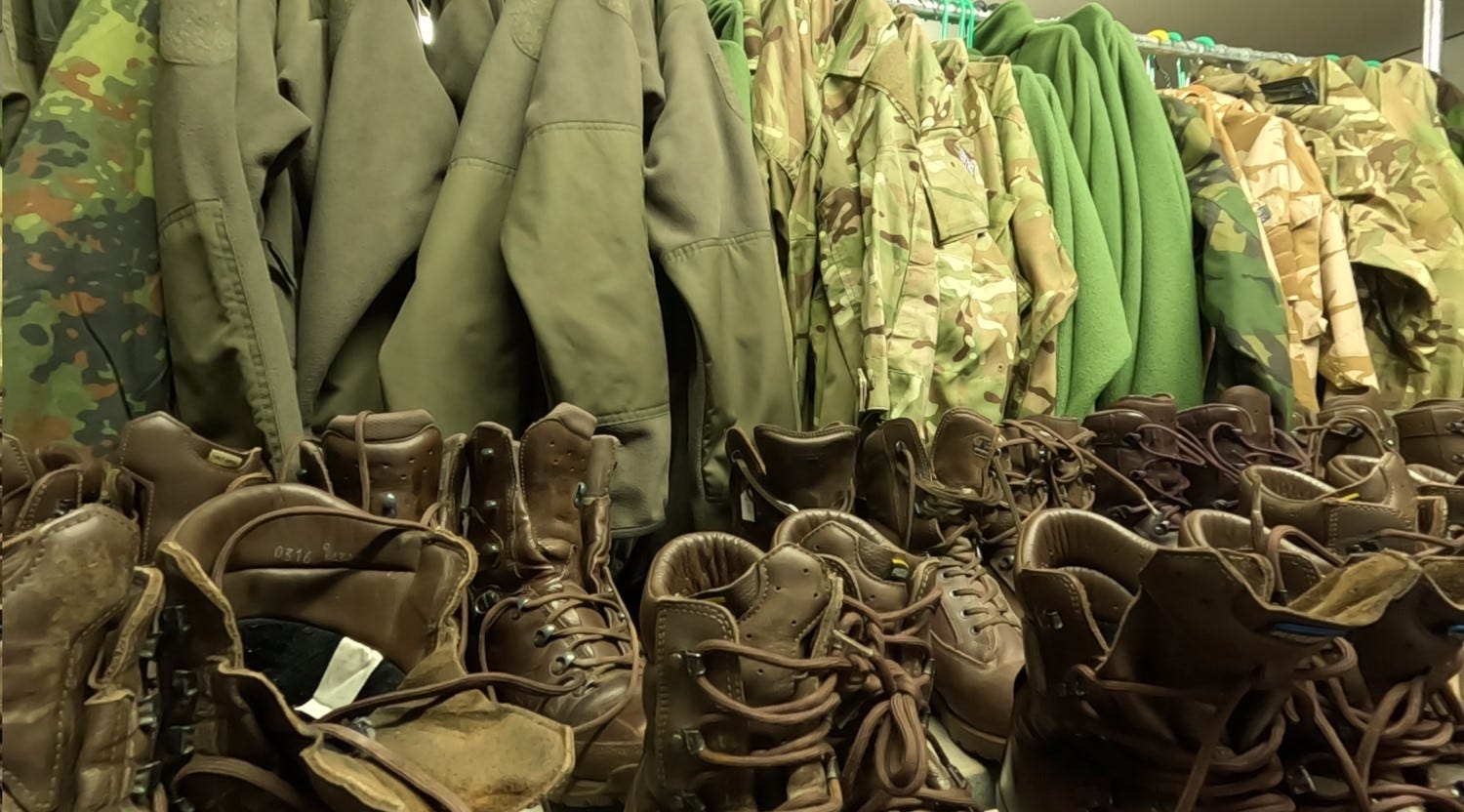
We had a military surplus outlet in Derby that served aspects of the punk community I grew up with – Quartermaster stores. It was in an area of Derby called ‘The Spot’, which is a typically unglamorous example of Derby’s sense of identity. There was also a Famous Army Stores on The Spot, where you got the hemp-canvas rucksacks and satchels that you added the names of your favourite bands to. Other cheap but essential items such as monkey boots could be purchased here.
Perhaps my memory of Quartermaster is not accurate, as there’s no evidence I can find of it on the internet. However, I recall it was a proper surplus shop with a bit of rank smell, whereas FAS generally sold new items. You could buy old vests, bullet belts, battered paratrooper boots, capacious trousers, and so on. I often got the name Quartermaster name confused with Quatermass, the fictional rocket scientist from BBC dramas who had just been revived by Nigel Kneale for a 1979 ITV four-part mini-series set in a not too far away punk dystopic UK.
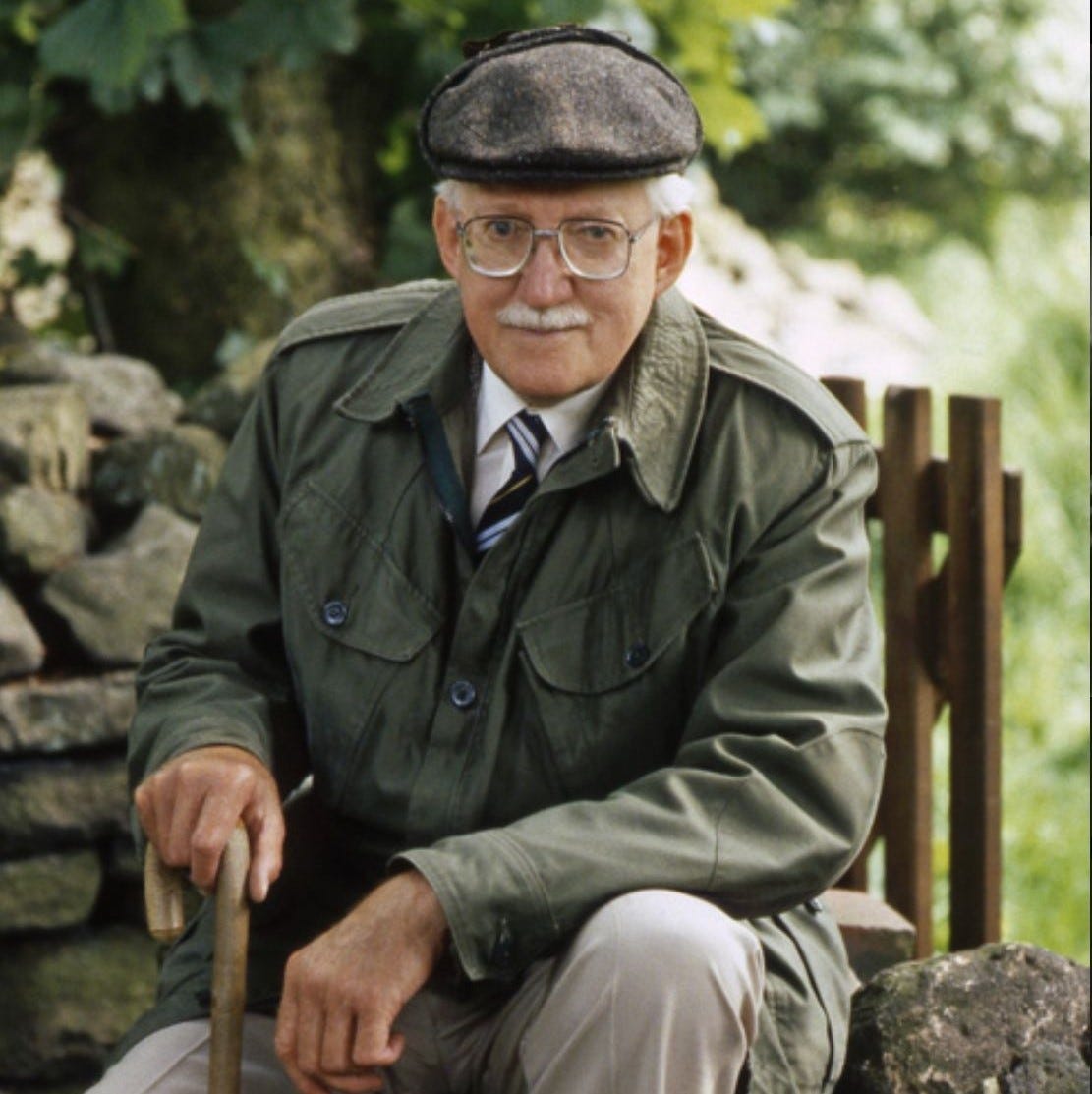
I had three army jackets in my time in Derby in the early 1980s as part of trying to fit into post-punk subcultures. I tried to find interesting camouflage patterns at the Quartermaster shop but I always ended up looking like the annoyingly boring character (Foggy) in the BBC Sunday night comedy Last of the Summer Wine. I did manage to get a fitted military smock which was a bit better, but lo-and-behold a new bit-part character in Last of the Summer Wine took on a similar look.
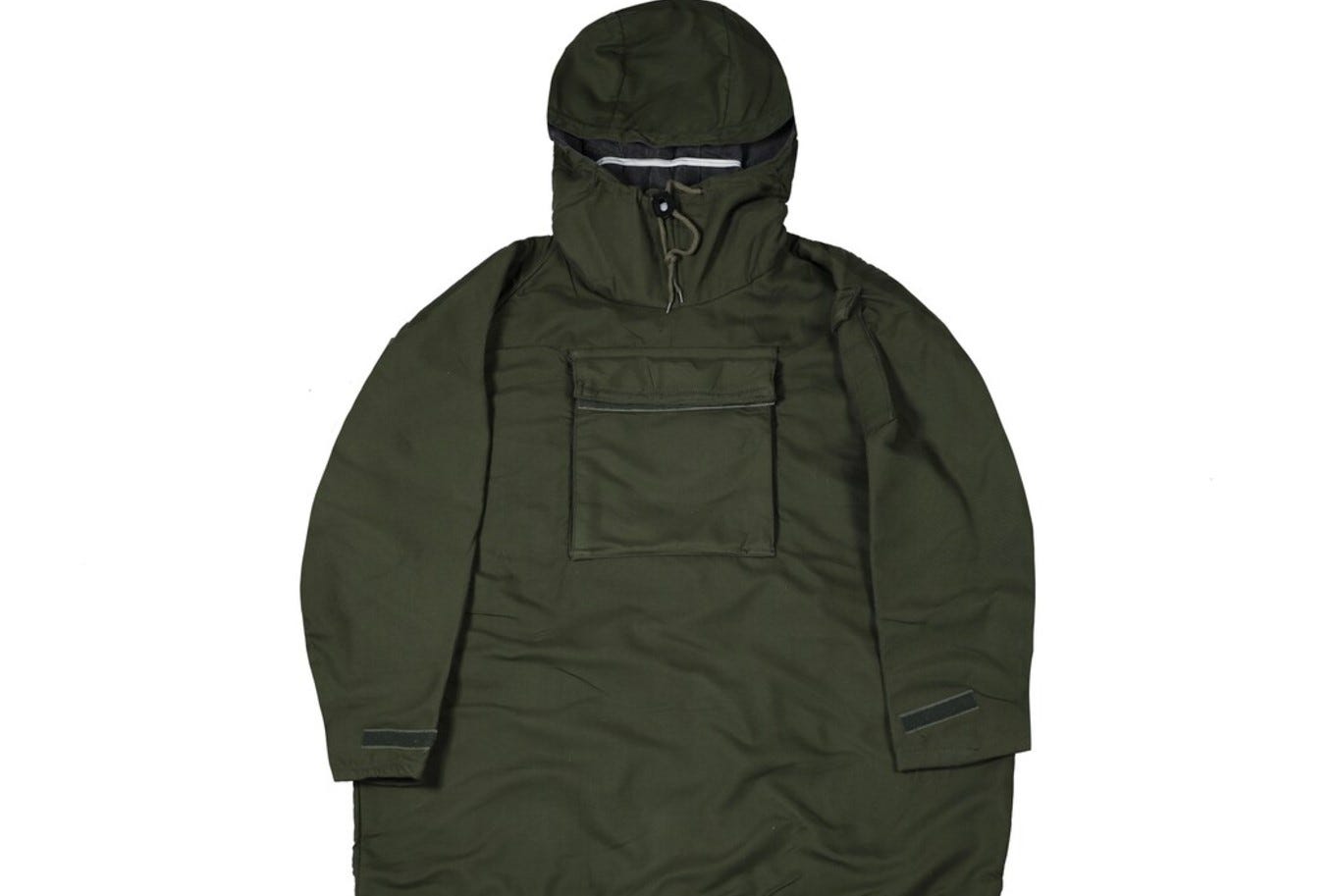
In 1985 I hit pay dirt and procured a one-off military smock that appeared to be for some kind of post-nuclear clean-up situation. It was bereft of all external functionality – no pockets, fasteners – just a blank swathe of toughened olive fabric. A tunic made of roofing felt. Research suggests it is similar to a British Army chemical warfare smock, an official garment that incorporated a charcoal layer, but this was more robust and brutal.
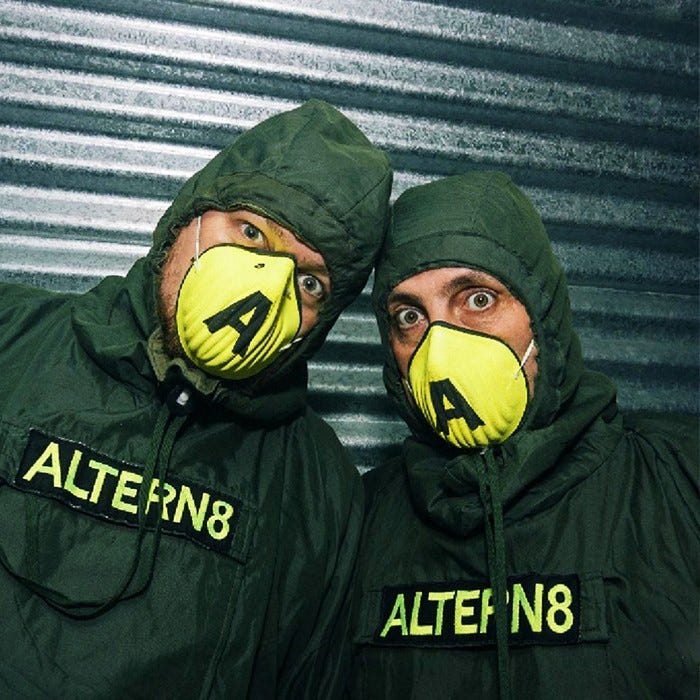
A decade later the Stafford-based rave duo Altern-8 adopted olive green Mark III NBC (Nuclear Biological Chemical Warfare) suits, pairing the smock and over-trousers with added monogram facemasks. This horror-inducing outfit was initially worn to disguise their identity as part of the illegal aesthetic of rave, but it was adopted as a fashion statement as the band burst into the UK top ten during the period when this music hit its commercial peak. Getting carried away with their success and powerful mystique behind the slightly dystopian look, one member of the band stood as a local candidate in the 1992 general election.
My purchased jacket had some kind of in-between layer that made it rigid – it felt like asbestos to make it radiation proof. It was like putting on a diver’s costume, totally constricting. Once you put it on you needed assistance from someone else to take it off. Either a companion or, if desperate, a total stranger. Anybody.
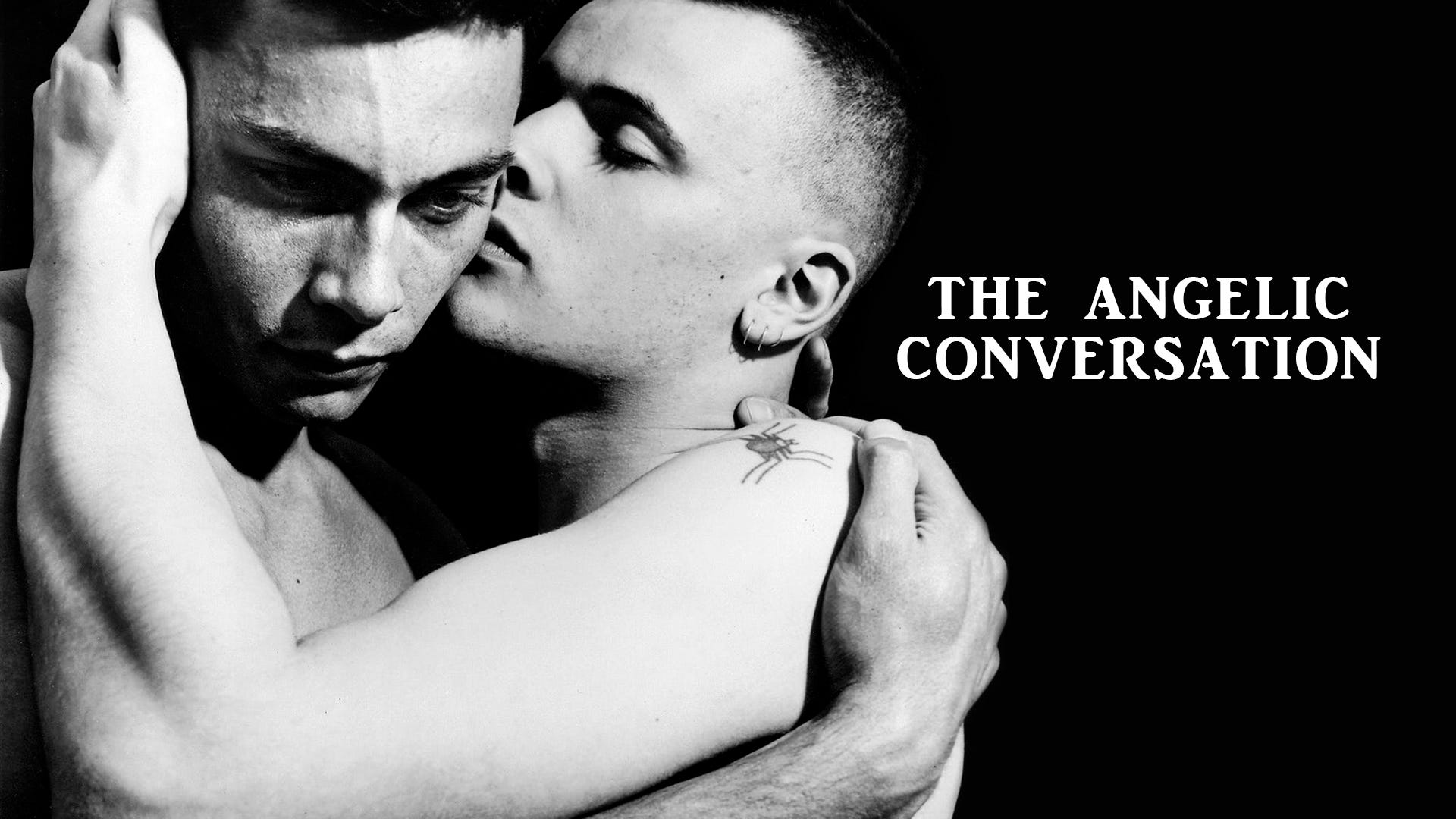
I recall wearing it to see the avant-garde filmmaker Derek Jarman speak about his new film The Angelic Conversation at Derby Green Lane Arts Cinema in October 1985. The band Coil had provided the soundtrack, and Coil (or their milieu) utilised a similar kind of bleak military look, having splintered away from Psychic TV and their forerunner band Throbbing Gristle. They were part of that wider scene of experimental post-punk that included 23 Skidoo. TG emerged from the 1960s and 1970s radical art scene, forming as a band in 1975 and running contiguous but antagonistic to UK punk. Their art credentials were to the fore, a grounding in the outer realms of shock performance art and Vienna Actionism. They adopted and adapted various punk tropes and looks to goad and confound, eventually founding and developing a new genre (and subculture) entitled industrial music. They remained a band I couldn’t get out of my system, and I eventually wrote a book about them in 2023.
A structured conflictual mentality settled around Throbbing Gristle; working under the mantra of “nothing short of a total war”, they inevitably drew upon military influences, sounds and imagery. For example, the track ‘Weapon Training’ was based on a recording designed to help soldiers identify sounds in modern day conflict. They also did military camouflage like no other, commissioning the French designer Laurence Dupree and her brand Avant Guerre to design some unique garments in 1980.
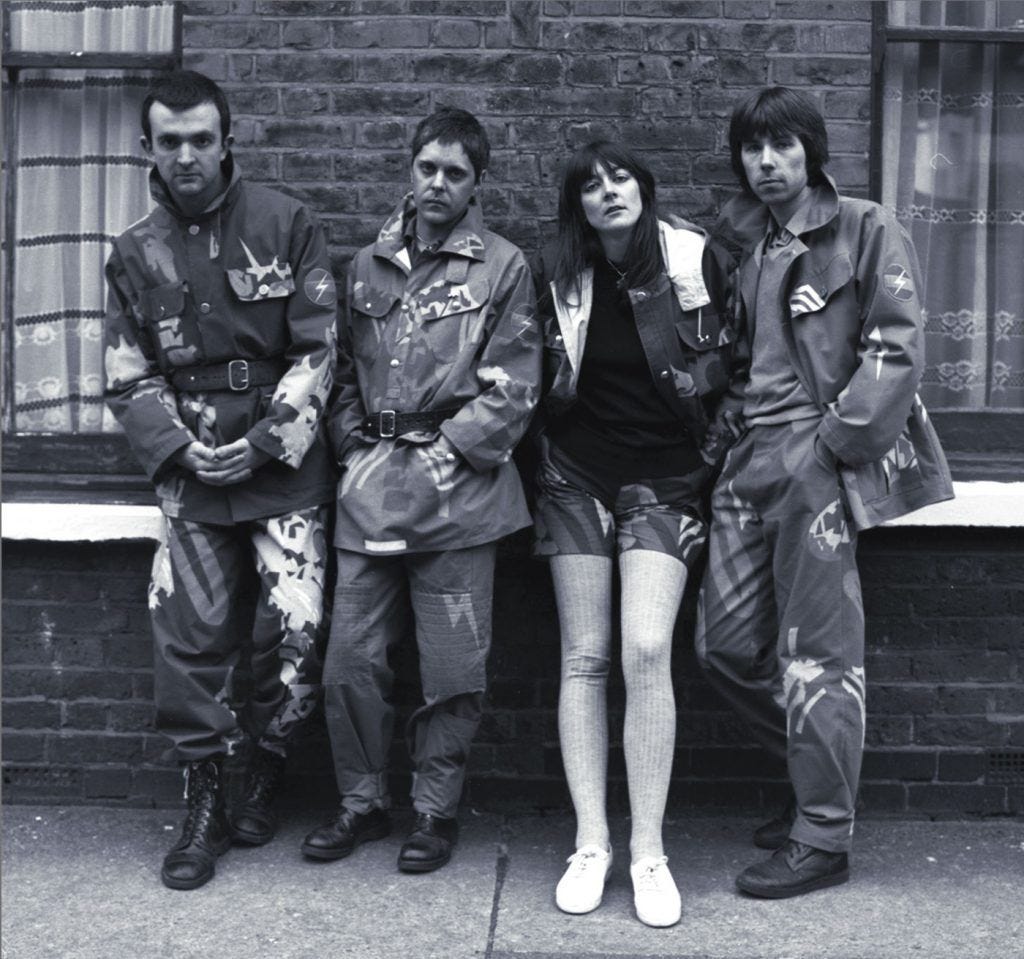
The band’s controversial ‘vocalist’ and sometimes spokesperson Genesis P-Orridge describes how he bonded over camouflage with Dupree, briefly becoming lovers. He stretches the dialectic of camouflage (to be not seen) and fashion (to be seen) by bringing them together as a designer object. On top of this, the natural habitat of camouflage (jungle or desert) is transposed to the city where ‘traditional’ camouflage would render one highly visible. This necessitates a switch, and Dupree’s camouflage brings in modern industrial motifs and forms in grey and black, the jackets further emblazoned with the provocative TG lightning bolt emblem which further instigates the “are they fascists?” discussion that dogged the industrial scene. Never mind, they look stunning, like nothing else, and to top it off bandmate Cosey wears a pair of matching shorts that amplify her scintillating female allure. I’m pretty sure the uniforms were one-offs, as I never saw any for sale or witnessed other people wearing them. The band exhibit the uniforms in the short film for the track ‘The World is a War Film’. The track is inspired by the repeated showing of the documentary series The World at War, with the band dressing up to act out a war game in the hinterlands of their Hackney neighbourhood.
Throbbing Gristle unleashed something of a dark genie when they christened the genre of industrial music, with many bands taking up the apparently even-more-DIY-than-punk opportunities of making music using extreme volume, unlistenable noises, questionable themes, cacophonies and disturbing samples. It was punk’s celebrated amateurism of three chords being replaced with no chords. It quickly morphed into newer genres such as the ominous power electronics scene.
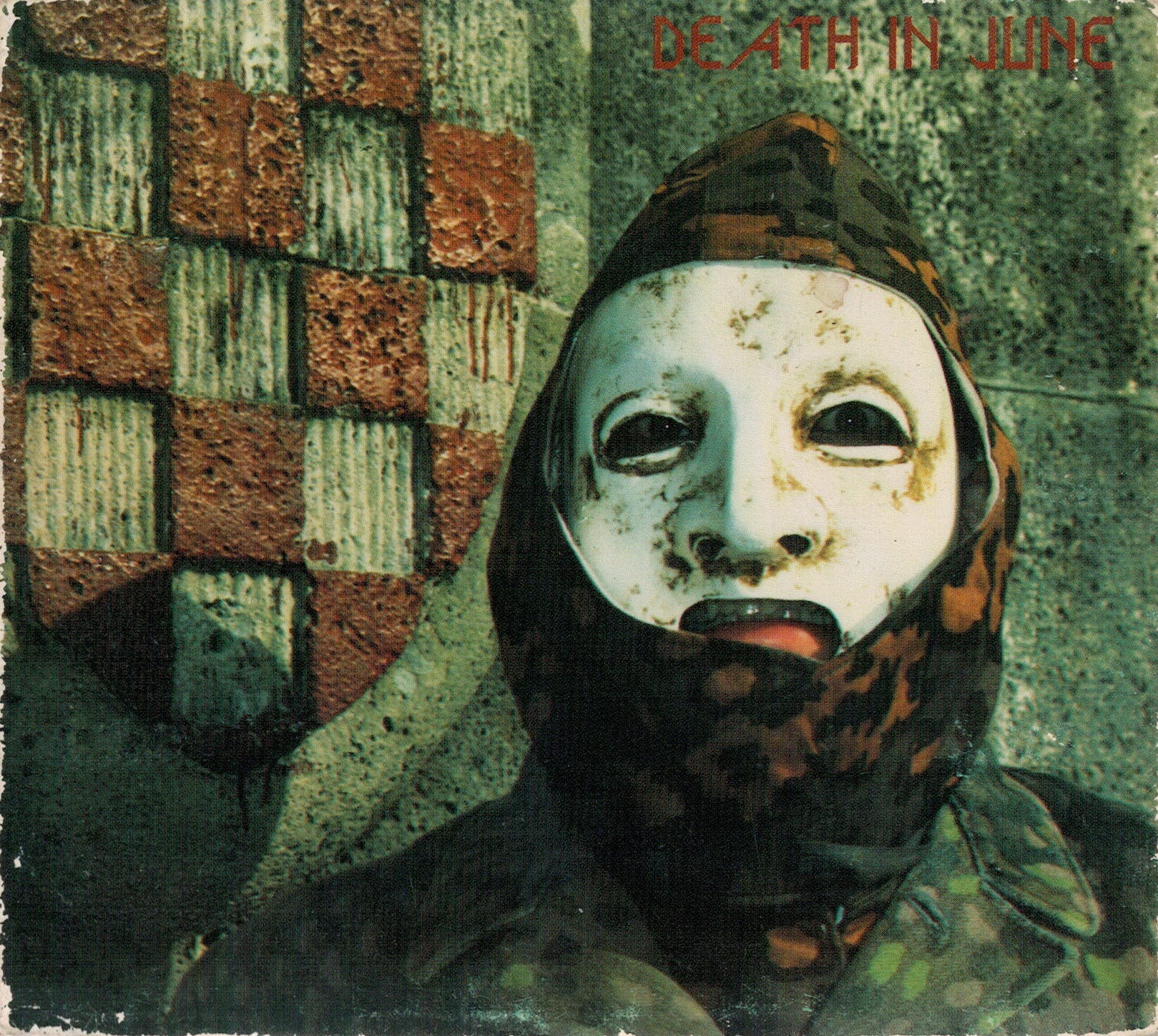
Some of these bands enforced their ‘us-against-you’ mentality by adopting a shared military look. The band Death in June formed by ex-members of the left-wing punk band Crisis had a particular fixation with historic German camouflage patterns, adding to their quickly mushrooming reputation of being part of some new ultra-right-wing tangent in 1980s music.
It’s a tricky area to discuss, and we throw around terms like right wing and left wing to indicate different concepts and contexts in culture, politics and social analysis. These days it’s easy to be labelled a fascist for eating the wrong thing, using the wrong pronoun (or using pronouns per se), tentatively agreeing with lockdowns, etc. It’s not something I feel particularly positive or energised about in bringing into my essay project here. But there is a tendency in industrial music and neo-folk to both fetishise military uniforms and insignia associated with (proper) fascism, and to dabble in some disturbing themes and lyrics. A friend made a joke about the social media products he was being ‘pushed’ after posting a few pieces about these scenes. These clothes are a LONG WAY from the Bundeswehr vests that we all wore in the 80s as fans of Theatre of Hate and Danse Society!

Music subcultures have certain facets – commitment, pride, uniqueness, identity and (perhaps) a certain amount of inbuilt albeit playful animosity to other subcultures. You stand by what you are part of (until you become part of something else). It’s a VERY long way from the true fascism of master race politics that we are unfortunately seeing on the rise again around the world, but there are vague structural links. Bands and scenes develop a look that indicates a strength of participation – but it’s a big step to symbolise that participation as ‘participation-in-itself’ which is the basis of a uniform. A band may be genuinely right wing in their views and feel a need to put this across through themes, lyrics, iconography and looks. They may also adopt this as either an ironic stance to raise thinking and dialogue, or to reflect a saddening way of the world. I recall TG offered all of these reasons for their uncomfortable aura. And then, a look could be claimed and deconstructed to repurpose it in another direction. If a strong uniform represents commitment and singularity of belief, then it could be argued that such a look could be claimed for its denotations of identity whilst shedding off the connotations of where that sense of identity has travelled in a previous life. It’s a sketchy argument.
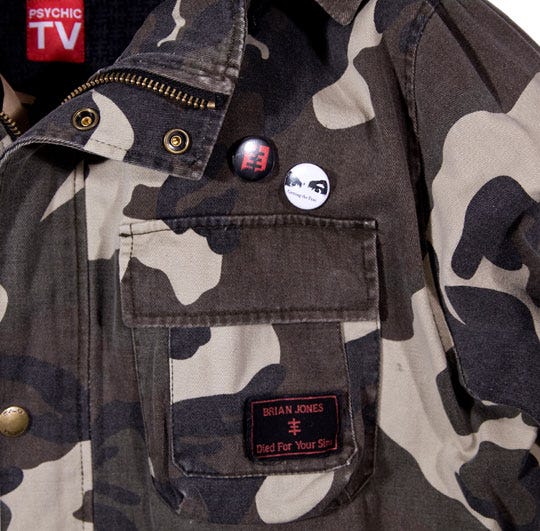
Meanwhile, ex-TG frontman P-Orridge’s final band Psychic TV toyed with a variety of looks and styles, having a prolonged period of creating a loyal subculture who wore Jesus Army style combat gear customised with psychedelic patches and occult symbols. Opinion is split regarding the motivations of this militarised disciple look encouraged by P-Orridge, with many onlookers suspecting his rationale of experimenting with cult figures having flipped over to the point where he saw himself as a cult leader. In his otherwise factually-dubious posthumously published autobiography, P-Orridge recalls how military surplus initially fulfilled his mantra of “function before fashion”, with the uniforms evolving to include pockets and pouches to facilitate a “walking warrior”.
Back to 1985 Derby, and Derek Jarman at Green Lane Cinema. In the end, the audience consisted of just seven people, and Jarman did his talk, fielded some questions, and quickly exited. I made my way into to foyer and asked one of the cinema workers to help me get my bloody jacket off, and then made my way into the fresh air.
I lived on Beck Rd E8 where GPO had once stayed ( and where it looks like the band pic was made) He had long gone. Apocryphally there was once a call to the police about an unexploded bomb in the cellar.
‘Metro Cinema’ that is…