
Last Words
A commercial / break (part 2)

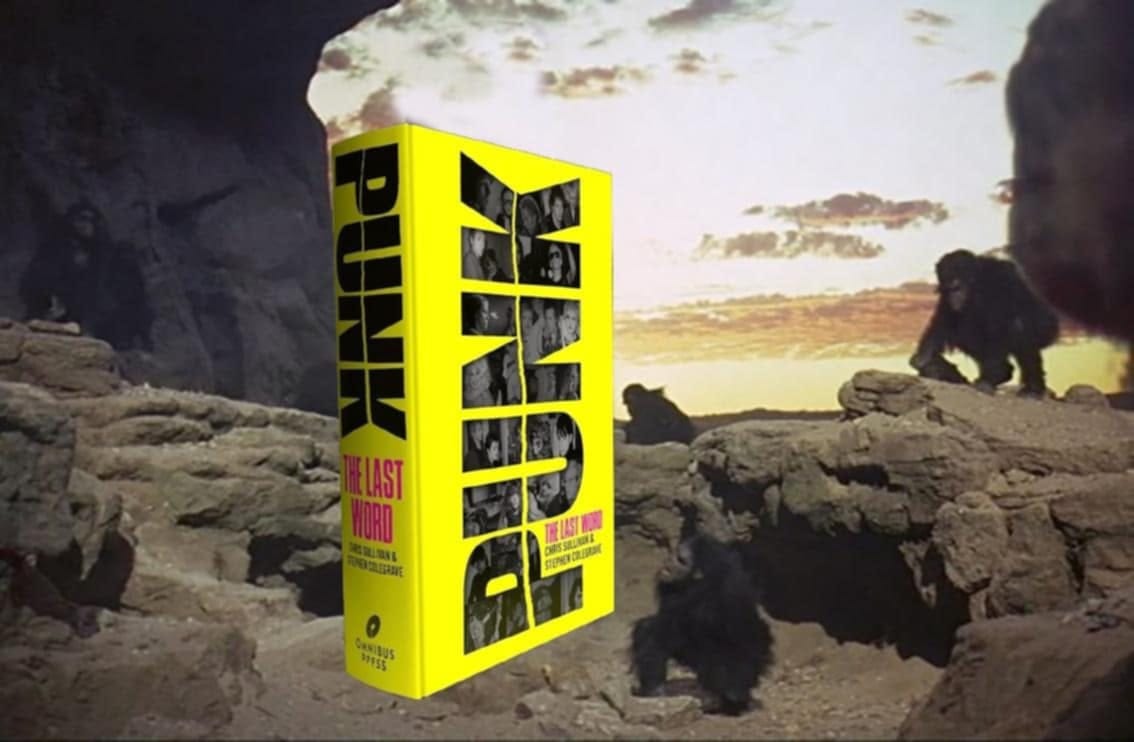
I’ve done this the wrong way round. Before the round table on Punk’s “Last Word” I should have read the book, but the price of thirty quid was putting me off. Plus, a couple of people had said that the book is not great. As flagged in part 1, the book was ordered, it arrived (a day early), and I cracked on with it over the past three days to make it to the halfway point of the 600 pages (we had snow, so nothing else was happening).
I’m confident enough to call it from this halfway point, that the book is not going to improve – its structure (and so ‘pitfalls’) are hard-wired. In fact, the book is so bad that if I’d have read it prior to Louder Than Words I’d have probably given the discussion a swerve, and we wouldn’t be here with me writing this and you reading this at all. I’m not wanting to get in the habit of calling things up for review to criticise them, but I will make an exception here.
The entirety of the work can be bookended by two punk phrases:
This is a quote, this is another, this is a fourthousandsixhundredandseventyeighth… now publish a book
Ever get the feeling you’ve been cheated?
I’m aware that the book is a revisiting of their earlier work which marked the 25th tidemark of punk. That book – I understand – was something of a coffee table format driven by powerful images, albeit images that are fairly ubiquitous. This new edition, bringing things forward another quarter of a century, has all the pictures compressed into three clusters. By the time you come across them your brain and eyes are blitzed by the relentless onslaught of text, or what passes for text.
It feels as if the basis of the book is a version of the first book languishing on an unrenderable WordPerfect file. Someone maybe knew someone who had a friend who could ‘crack it’, though cracking it appears to be migrating it into a bare text handler and then outputting it into whatever publishing format was used. The problem is that the formatting is non-existent, and that the book is predominantly a series of quotes or interview snippets (it seldom distinguishes between them) and so it merges into a glorious sprawling mess.
There is zero editing in this regard. And zero proofing to boot. Self-aggrandising vox pop quotes are generally meaningless and offer neither veracity nor usefulness. And we seem to have Bobby Gillespie on speed-dial to offer the same quote as to how each of the pre-punk canon of albums and artists (Stooges, Velvets, Bowie, MC5, New York Dolls) played a major part in his life-to-be in music. Other quotes – possibly new material – seem to be parsed through a voice-to-text software downloaded for free. There’s some clunking errors like the discussion on potential alternative inaugural names to punk with what I presume is “dole queue rock” but now sounding like a cartoon Italian gangster / pool-shark named “Don Cue rock”.
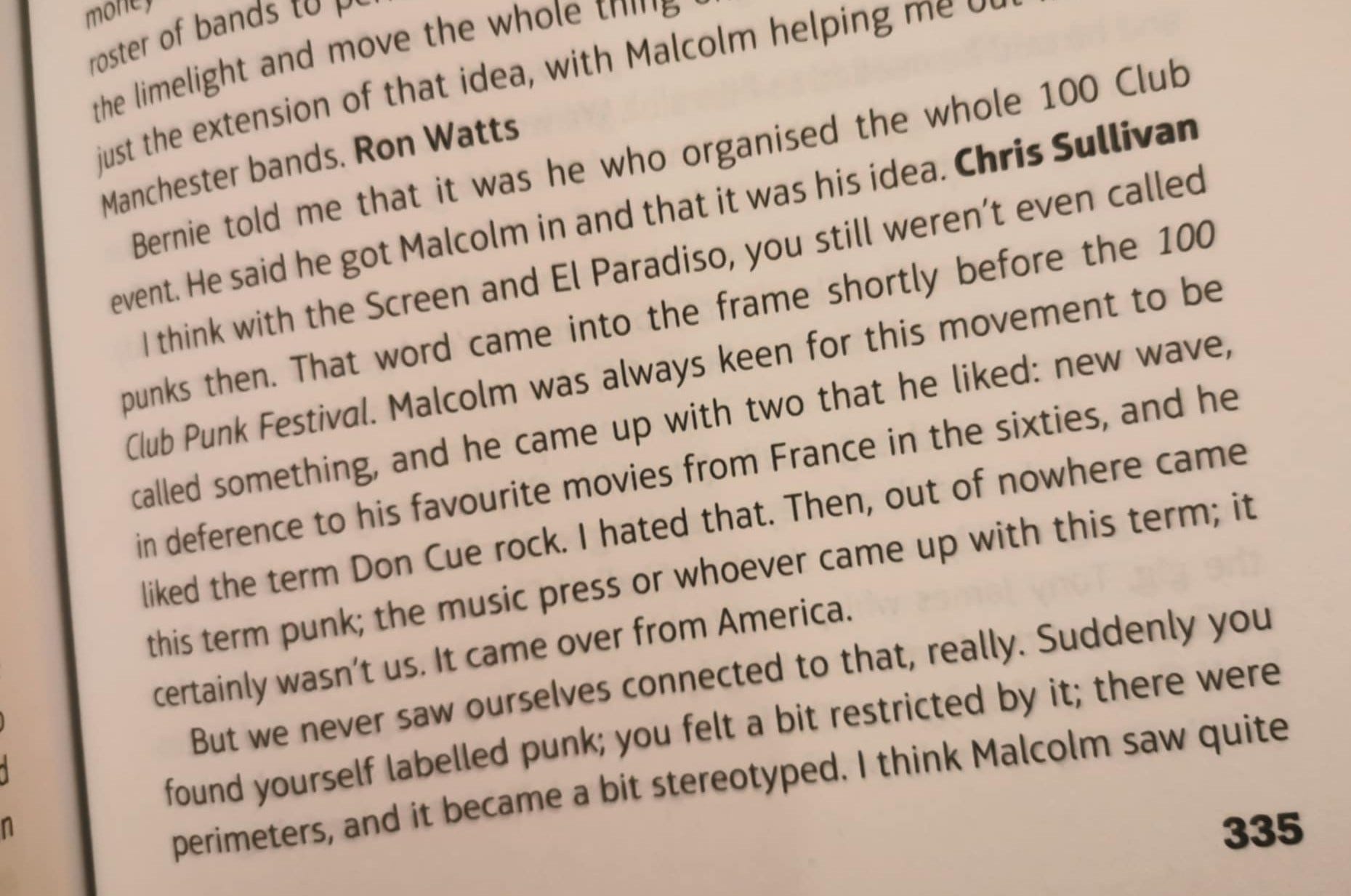
I knew from the round table that Chris Sullivan had tried to be creative with the flow of time, but the book flows both backwards and forwards in terms of chains of influences to the point of making zero sense. Maybe an index might have helped…. nope, it’s not very punk having an index. Perhaps the cut and paste of quotes and disregard to temporal logic is a bonafide punk methodology. It worked for Debord and he’s a situationist (who are part of the punk canon – I think). Dylan Jones tried to make it work for his Sweet Dreams book on the new romantic scene, and that should have been warning enough for how it can come out as a shallow meander padding out the page count. Like that book, Punk: The Last Word feels as if is a time-loop of a particularly challenging Beckett play. You are willing on the last word, of both the book itself and all damn books on this subject. So congratulations, it does what it says on the tin.
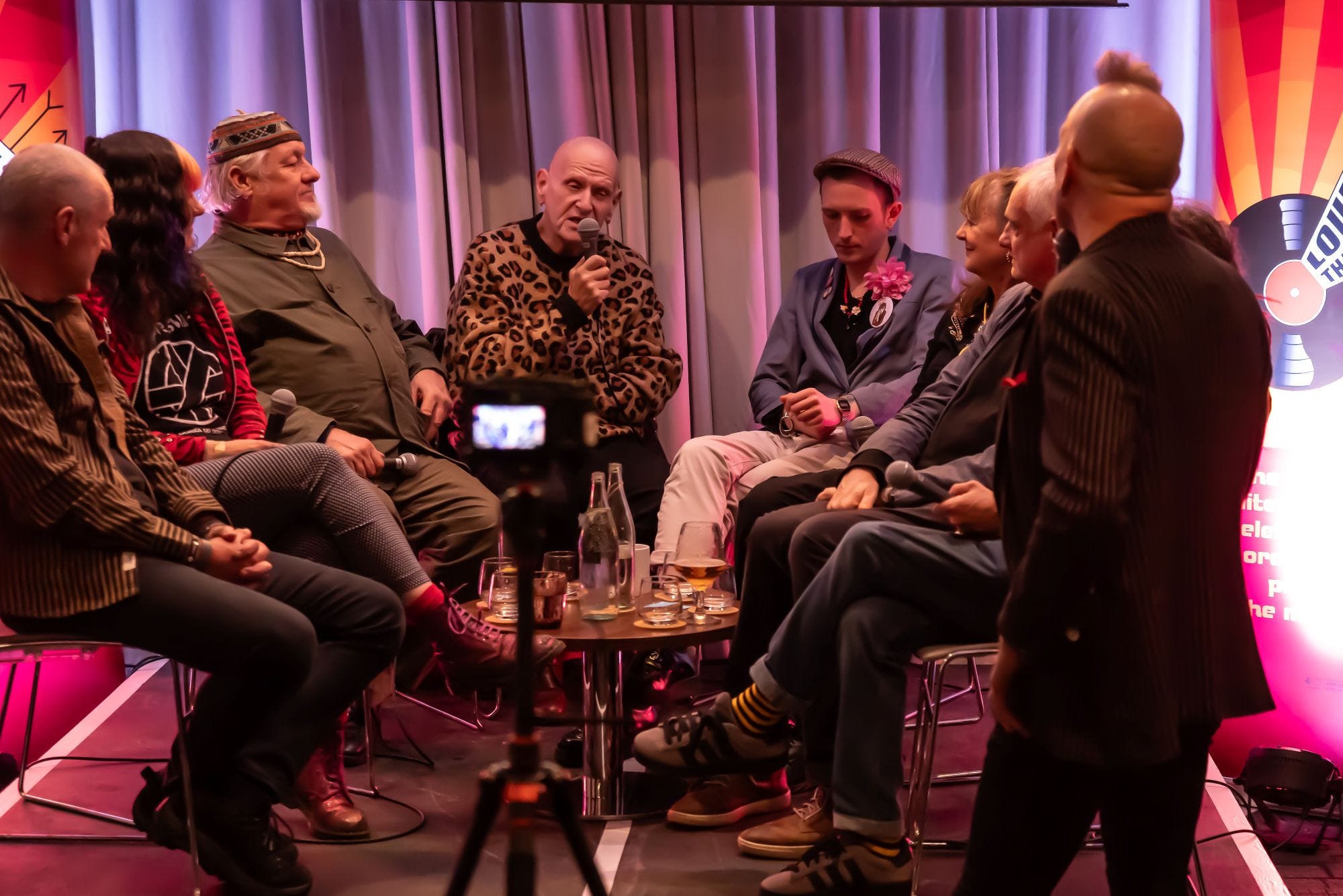
Let’s move on to the discussion from last weekend. My first observation was the comical arrangement with a burgeoning dramatis personae cramped onto a tiny stage in a horseshoe arrangement, with John Robb standing in front and to the side to try and steer a direction.
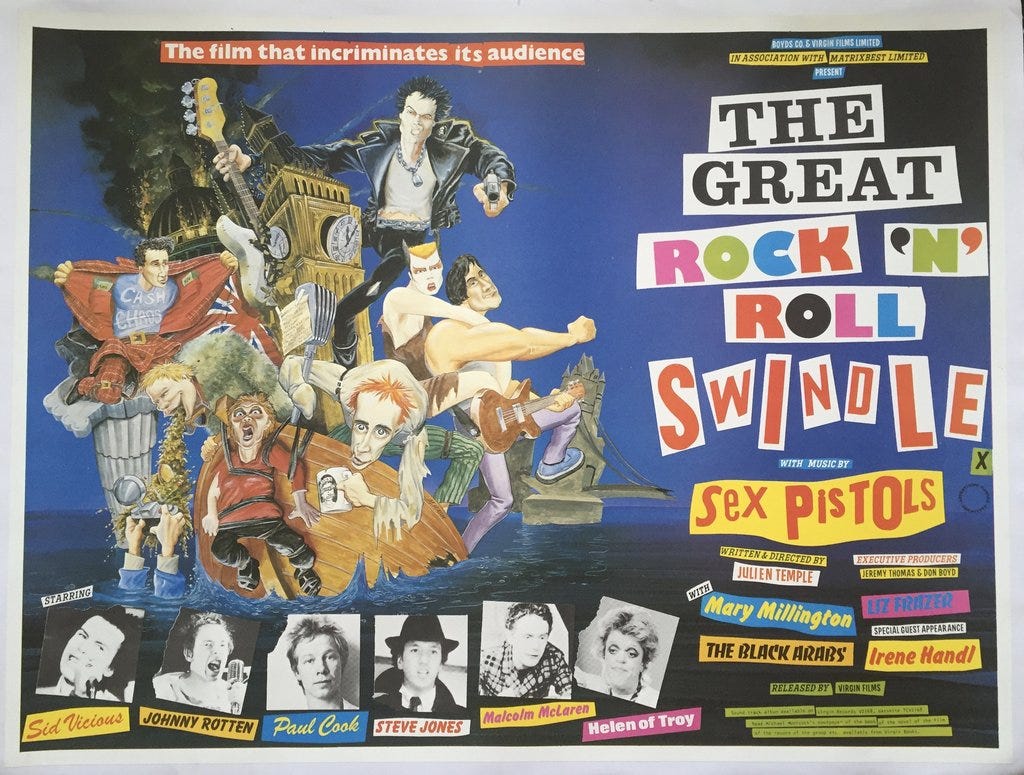
It offered up a desperate boat analogy – maybe not the obvious image of the overcrowded dinghy, but a scenario involving a punk rock pleasure boat suddenly taken over by a corporate brand and a jettisoned life raft where the refusenik passengers are arguing amongst themselves as to why they abandoned ship and gradually discovering that none of them can share common ground. Or we could simply use the great poster image from McLaren’s 1980 film The Great Rock ’n’ Roll Swindle with its cast clinging to the flotsam of a rickety vessel sinking under the weight of various London landmarks.
The round table included the two authors of the book, Russ Bestley and Mike Dines from the Punk Scholars Network, original punk protagonist Marco Pirroni, Helen McCookerybook from a number of year-zero genuine DIY/feminist punk bands, current journalist and musician Ryan Walker, and relative youngster Carol Hodge who shares vocal duties on Steve Ignorant’s Crass continuation live act.
The conversation was dominated by Sullivan and Colegrave, who seemed fixated on two strands of direction without ever actually offering some ground as to what punk, or punk rock, was. In my eyes, for the purpose of all this history, it would simply be a subcultural moment (or notch) based around music and style (plus associated argot, way of being, etc) that had a particular relationship to previous subcultures (as is the way). Such was the nature of the time, and the iterative state of subcultures, that punk quickly acquired a hardline identity of look and sound and attitude.
Apparently attaining such a formulation was anathema to the conversation, and instead we went with tangential, epiphenomenal and (at times) nebulous ideas. Inevitably, there was no agreement on the strands or the importance of the strands. It felt as though Sullivan had had a strange idea dreamt up in a moment of drunken groping, submitted it to paper, and was now defending it to the hilt.
Their principal argument was the persistence of some kind of rebellious and antagonistic spirit that was present in punk during its initial time, similar to Raoul Vaneigem’s Movement of the Free Spirit treatise from 1986. But poor logic (punk logic?) allows them to name the spirit as punk and so pass it backwards and forwards and christen Greek philosophers as punk. Helen McCookerybook steadfastly argued that this spirit was implicit in the subculture as it needed to wipe clean so much baggage of music (prog), style and ideology (sexism etc). To challenge a status quo that was grim, sexist, chauvinist and overblown – it couldn’t just be a change of clothes and a change of tempo or rhythm.
Russ Bestley, one of the punk scholars, was partly aghast and partly up to challenge this idea. Mike Dines, the other punk scholar, tried to go with the flow and talked about his research in contemporary post-anarcho-punk communities. Building on Helen’s point about punk being born by necessity of subcultural struggle, it thus accrued intensified positions and opened itself up to such things as politicised affiliations. As Russ (and others) have argued elsewhere, such political positions are not always coherent or in agreement – it was the confrontational intensity of the subculture that attracted certain types.
It could be argued that moral, ethical, political aggregations exceeded the bounds of a subculture to form a movement. For some people this was punk, and it is this commitment that is taken forward. However, for Sullivan and Colegrave it is a passing spirit (now called punk after landing on punk) that informs new musics such as hip-hop and grime. This ‘spirit argument’ suggests these music scenes are more punk than continued punk by the likes of Green Day.
The other argument concerned the etymology of the term – which is always a never-ending and often pointless argument. It brings out competitive back-mining (Shakespeare etc) which then creates a fatberg of etymological baggage clogging up the pipes of semantic clarity. Gradual application of the term punk to subcultural, youth cultural or countercultural scenes in 20th century meandered through its definition as a worthless gay prostitutes in a prison environment, giving the term a more immediate frisson of trash and taboo. Following its more overgrounded application to the punk scene (in the US and UK) it has now mainstreamed and become etymologically verbose and so effectively redundant. Punk politicians, punk products, and so on. It has created the last word in this instance, divesting itself of meaning and sense.
Alternatively, if punk was a subcultural moment with various degrees of intensity and mutational (or replicative) continuity, then punk scholarship is still to search the last word. As a side note - ‘Punk scholar’ is a tricky object/subject word; punks who take up in academia, or punk as the focus of research (it is normally both at the same time)… or perhaps a punk way of doing research like a ‘discursive turn’ where you call on punk’s fast-and-loose zerox machine methodology.
Is there a last word in punk scholarship? All discursive frameworks become unfashionable and seemingly exhausted, and you find yourself picking over a subcultural carcass. Alternatively, if the argument stands that punk, having exceeded the subcultural bounds, continues to provoke politics then there is still work to do. But don’t be upset when the likes of Trump and Farage are labelled punks.
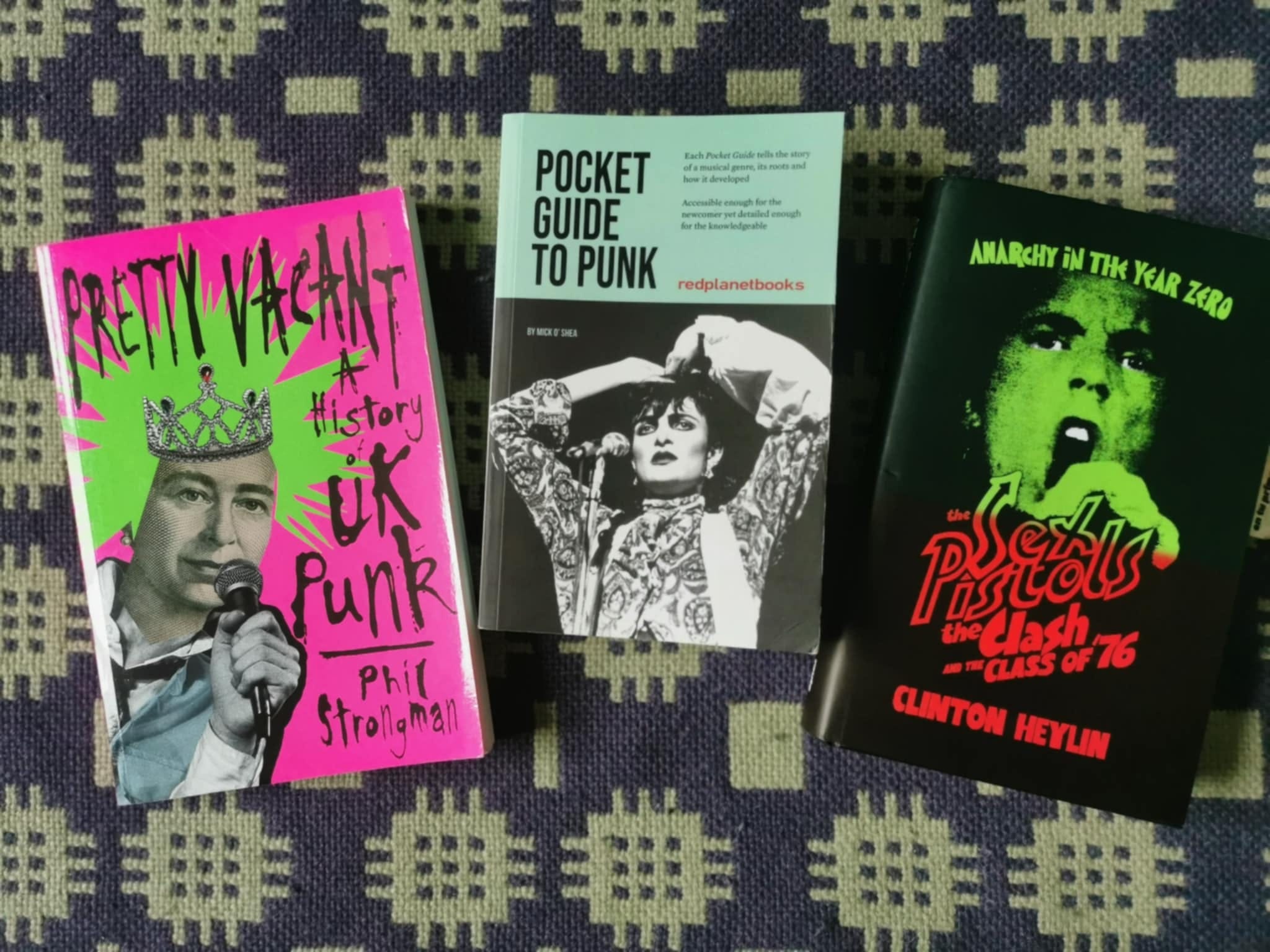
Elsewhere outside of the academy punk possibly thrives like a virus. This is where Sullivan and Colegrave are summoning the last word. It’s not a new word, but just a bludgeoning repetition of the same (oftentimes wrong) words. This desire to recall by old punks brings bullish, misremembering and a back-projected fomo into print form. Old sores are folded into recollections to eradicate people from the story. Granularity increases but voracity diminishes, a fateful combination leading to growing caucus of waste matter. Cue Sullivan and Colegrave to bring on the punk equivalent of Cillit Bang.
You Need Hans

The artist Hans Haacke proposed an artwork entitled Norbert: ‘All Systems Go’ (1970–1). It included a caged mynah bird called Norbert taught to repeat the phrase “all systems go” – summoning systems theorist Norbert Weiner and the inevitability of entropy. Sullivan and Colegrave inadvertently offer the same here. They cage themselves and parrot the phrase, beckoning punk entropy (for a final thirty quid fling).
Of course, Malcolm McLaren already knew this…
Hanging out at Raoul's or Club Foot in Austin, later around CBGB's in NY, I always saw a sharp divide between those with day jobs and those who somehow were able to make themselves unemployable with costume, attitude and mosh pit. Women were a rarity with the latter group, they were sort of like biker girls. I thought Green Day's debut marked the end of the Punk era. Singing in tune was unacceptable to my ear. So much had to do with what level you had to conform at to get by at work, away from the scene. The music and its development were always the constants tho
Surely the last word was written by Jon Savage in England’s Dreaming?