
Pivot
Street semantics, subcultures under erasure and the death of the 80s (part 1)

Premise
A personal embrace of quotidian and utilitarian hiking and climbing clothing at the start of the 1990s signalled – after the brief craze for wearing surf and skateboard garments – an end to any subcultural affiliation or ambition. A pipe and slippers moment. We know that outdoor wear had infiltrated casual culture through the 1980s, with backdated claims from regionalised fans in the contemporary moment saying they were first with Peter Storm, Berghaus, etc etc. Ontologically, the football casual scene existed in a ‘zone of indiscernibility’, neither mainstream nor streetstyle, and I wouldn’t try to untangle it here. As we also know, hiking and climbing gear then stepped up and emerged as a packaged niche fashion under the name ‘gorpcore’ in the 2010s. This is very much not a zone of indiscernibility. As John Lydon’s PiL might say, it entered a ‘Commercial Zone’.
I’m going to take a slightly different tack and avoid the trajectory of branded outdoor wear. Instead, it is my argument that the affordances offered by surfing-via-skateboarding fashion, with some key manipulators at work, that set up a new fashion ecology such that packaged trends gorpcore could arrive fully formed and take rapid root. It represented a semantic shift from streetstyle to streetwear.
Recap
Sidestepping their self-indulgence, the previous pair of cursory explorations of my rather damp squib sartorial ‘becomings’ in the skateboarding and rock-climbing scenes can now serve a wider purpose. There is an argument that later 1980s subcultures (and beyond) were more about appearing to be something (or part of something) rather than the real, immersive and commitment-demanding thing itself. Blame it on Jean Baudrillard and his theory of simulacra. So, I pulled off the look of a skateboarder and dropout climber, but not necessarily the requirements and sacrifices to be one. I did try, honestly, but it was so difficult. And the clothing felt good (briefly).
This is no great revelation in the already heavily theorised ‘Society of the Spectacle’ – being and doing replaced by having, only to be further replaced by appearing. Technical outdoor clothing and fashionable skate labels are currently big business in fashion and lifestyle promotion. Gorpcore is a major thing whereby people dress up in ridiculously over-technical outdoor clothing to take photographs in their bedrooms for Instagram. They might venture out to dwell momentarily amidst some brutalist architecture for a quick photograph, or indoor shower-test an expensive waterproof like a segment of niche porn. Something has clearly gone wrong there.
And, as stated somewhere in the previous essay, skateboarding – initially through the brand Stussy - instigated a major change in fashion cultures from an ad-hoc post-punk understanding of streetstyle, towards a more prescriptive and brand-focussed regime of streetwear. This streetwear regime, which swelled through the 1990s, now presides as a normality. How can we gain a conceptual grip on this?
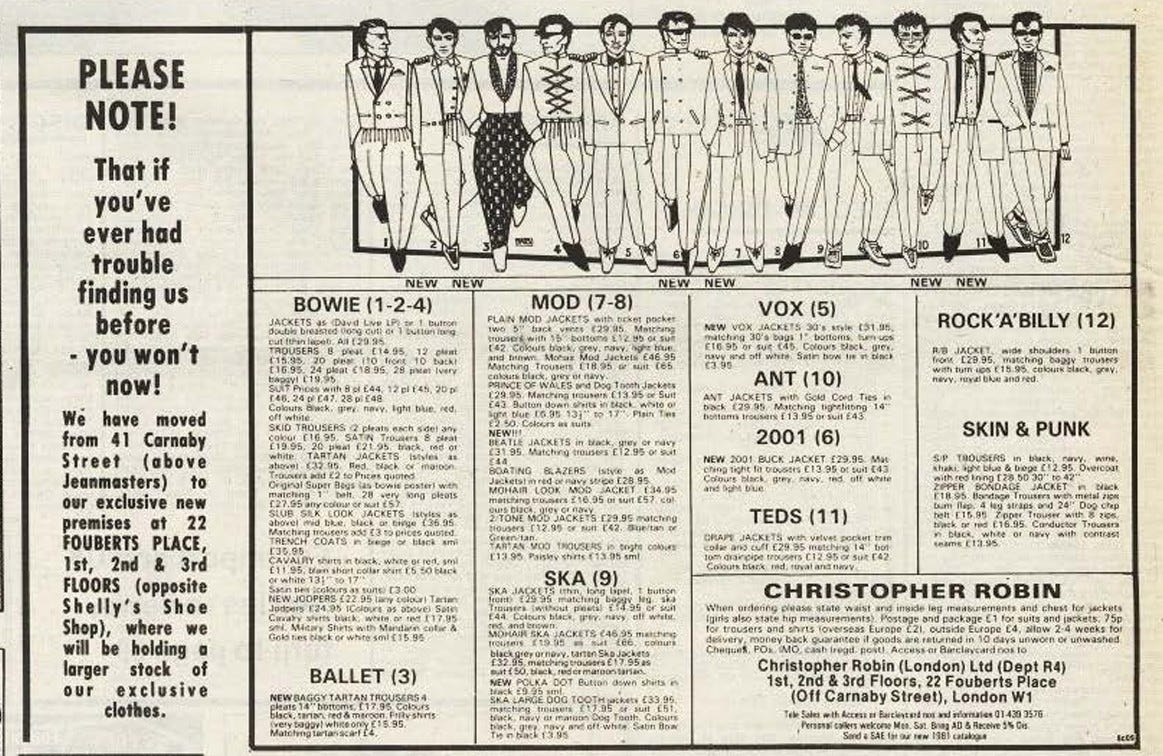
Let’s go back to get our start point, the early 1980s. We can again revisit our Christopher Robin advertisement to confirm that, even with its third-rate knock-off clobber, it was an exciting time with clothing-code driven style tribes. As the decade commenced there was a critical mass of niche but clearly demarcated subcultures in the UK. Equally important, there was also a strand of dressing-up ‘from below’ so to speak, with style-led elements of post-punk ingenuity and new romantic (or whatever we wish to call it) defining new looks at gigs and clubs. This has been the mainstay of my SUB>SUMED writing so far.
Subculture, fashion, street clothing and style were distinct ontologies and forces that impacted upon each other and pulled each other in different directions. Subcultural dressing was admittedly in the form of a more prescriptive uniform, but it may also have involved elements and experimentation within a particular subcultural niche, cross-pollination between subcultures, or it may have existed outside of specific subcultures and celebrate a weird dressing up that still inhabits the subcultural world. An outlier on the inside so to speak, what writer Adrian Dannatt gloriously labels as “sartorial stuttering” in his introduction to the photography of Jane England.
Hyphenated, compounded or separated - streetstyle was (retrospectively) broadly defined in this mix, as recently celebrated in the informative book Rebel Stylist which covers the career of Caroline Baker as she moves through the 1970s and a raft of underground fashion magazines to briefly steer a direction for i-D magazine in 1980. Streetstyle is (or was) subcultural with added oomph – dressing up, mixing and sampling, bringing in a bit of charity shop vintage or army surplus or a random accessory from a chef’s outfit. Bricolage in the purest sense; innovative, detached and resolutely stylish amongst your peers.
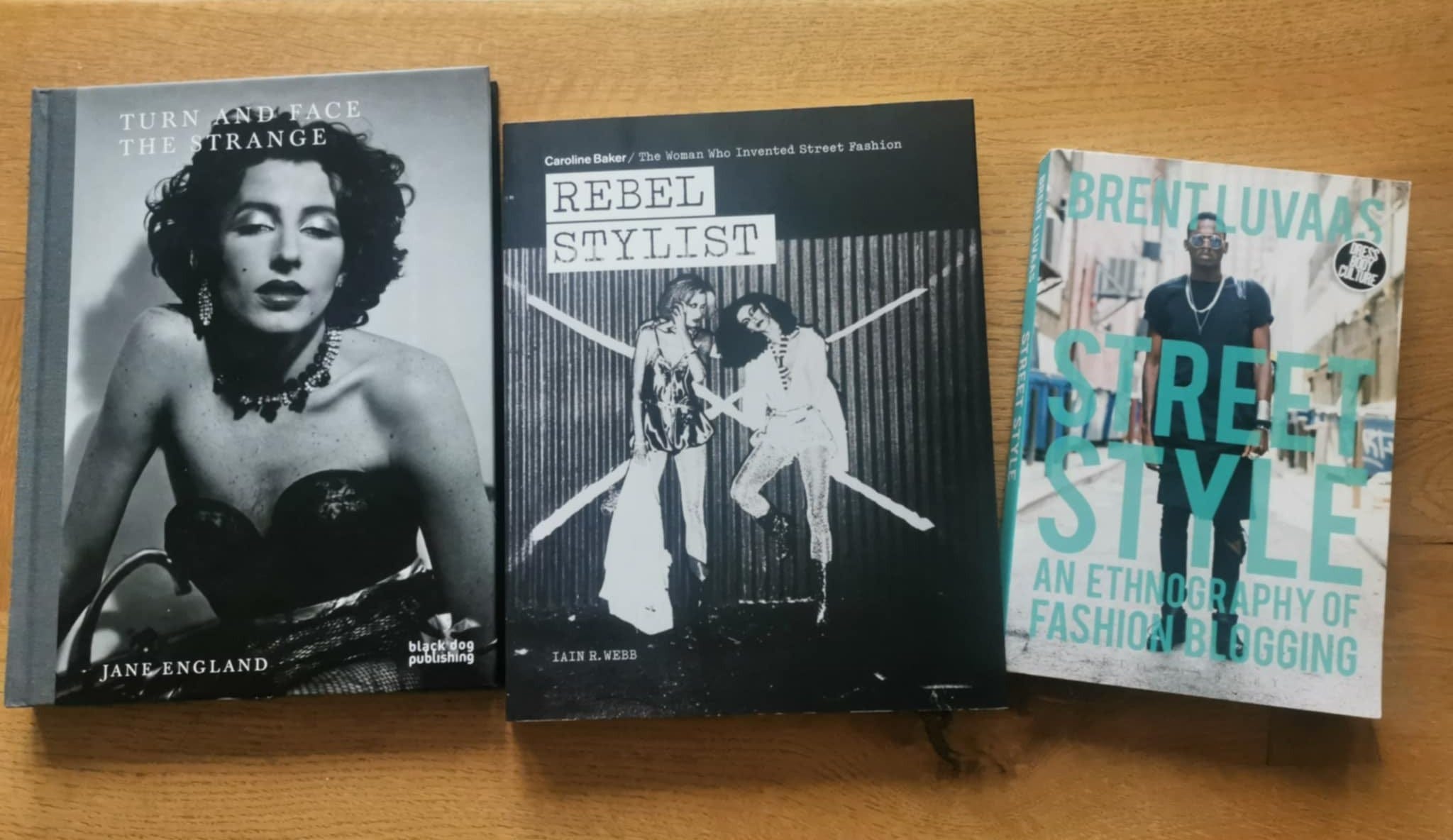
If the term fashion perplexes in finding an agreed and apposite definition then streetwear and streetstyle are equally dissensual. The term streetstyle was not in common use at the time of the Sounds back page advertisement from Christopher Robin. According to Brent Luvaas, in his 2016 ethnography of streetstyle bloggers entitled Street Style, it is said to originate with Ted Polhemus in 1994.
Polhemus (pro)claiming it in 1994 is an important moment, but it was certainly in use before then – for example with Catherine McDermott’s 1987 book Street Style written for the Design Council (more on this below). 1987, 1994, or Luvaas’ very different understanding and reclaiming of it in 2017, by the time the term is coined it has changed very much from its possible meaning in the period we project it backwards to cover. The disparity in writing about streetstyle importantly hinges upon an author’s ability to understand the nature of this back projection of the term.
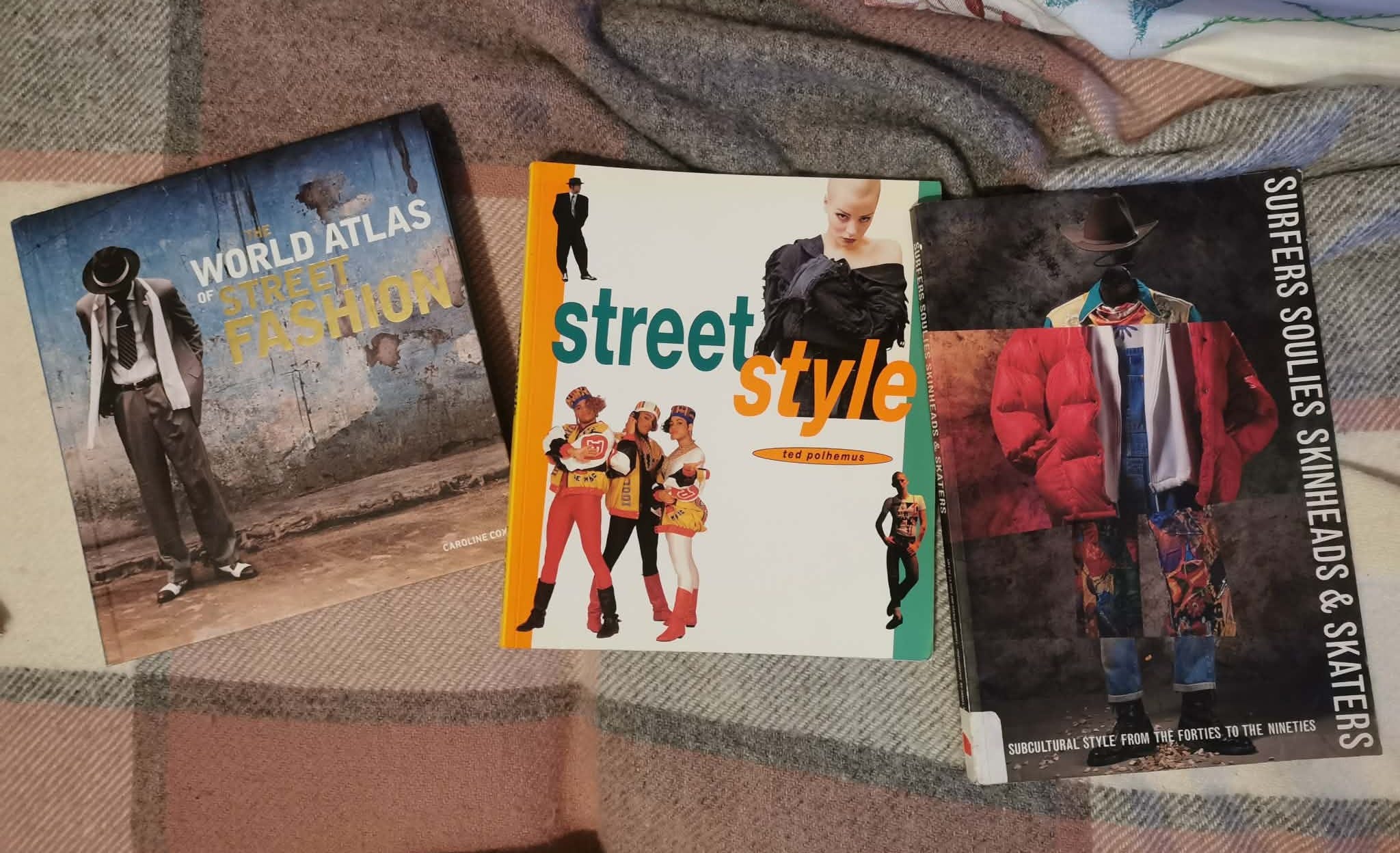
Staying in the near present, Caroline Cox’s bumper summary from 2017 titled The World Atlas of Street Fashion argues simply that the term street signifies where things are worn. Furthermore, her work is geographically driven, allowing her to focus on relatively anachronistic scenes in obscure places and use the old anthropological argument of the coeval.
The V&A publication Surfers Soulies Skinheads & Skaters from 1996 is interesting in that it situates the pluralistic 1990s very well but misremembers the 1980s (I briefly flagged this up with their reference to skateboarding fashion history). From its 1990s post-subcultural vantage point the book at times overlooks the self-directed creativity necessary in the 1980s and now supplanted by label-driven consumption under the guise of ‘street’.
The V&A book is an example of the common tactic of seeking a definition by expressing what it isn’t - that is, clothing associated with neither high street fashion nor catwalk fashion. We can then easily map this exogenous definition to the time of the late 1970s and early 1980s, such that high (catwalk) fashion was solely luxury brands for a cheesy James Bond type fantasy world, whilst high street fashion was a grey and brown spectrum of nonexistence with the odd ski-jumper thrown in. This gives the impression that there is an intuitive and simplistic continuity between early 1980s streetstyle and the plethora of looks in the 1990s…
It is not so simple. Streetstyle, or at least the something we now know as streetstyle projected back to the 1980s, could flourish away from this… in fact, it was a necessity. Early 1980s streetstyle was worked at through taking a chance, exploring clothes, following links and clues, observing and copying (or ‘sampling’). It existed in crevices and interstices that had to be sought out through exploration and observation, and the wearer would put themselves in the direct firing line with their “sartorial stuttering”.
The counter argument to a 1980s-into-1990s frictionless semantic transition suggests that streetstyle has passed through the eye of a needle and been thoroughly incorporated into both high fashion and the high street, making it effectively meaningless as a movement ‘owned’ by its activists and participants. As the 1980s concluded, the hybrid dressing up that blended or extended subcultural codes with extraneous bizarreness gave way to new both new designer labels AND also the first inklings of surf/skate/sportswear brands.
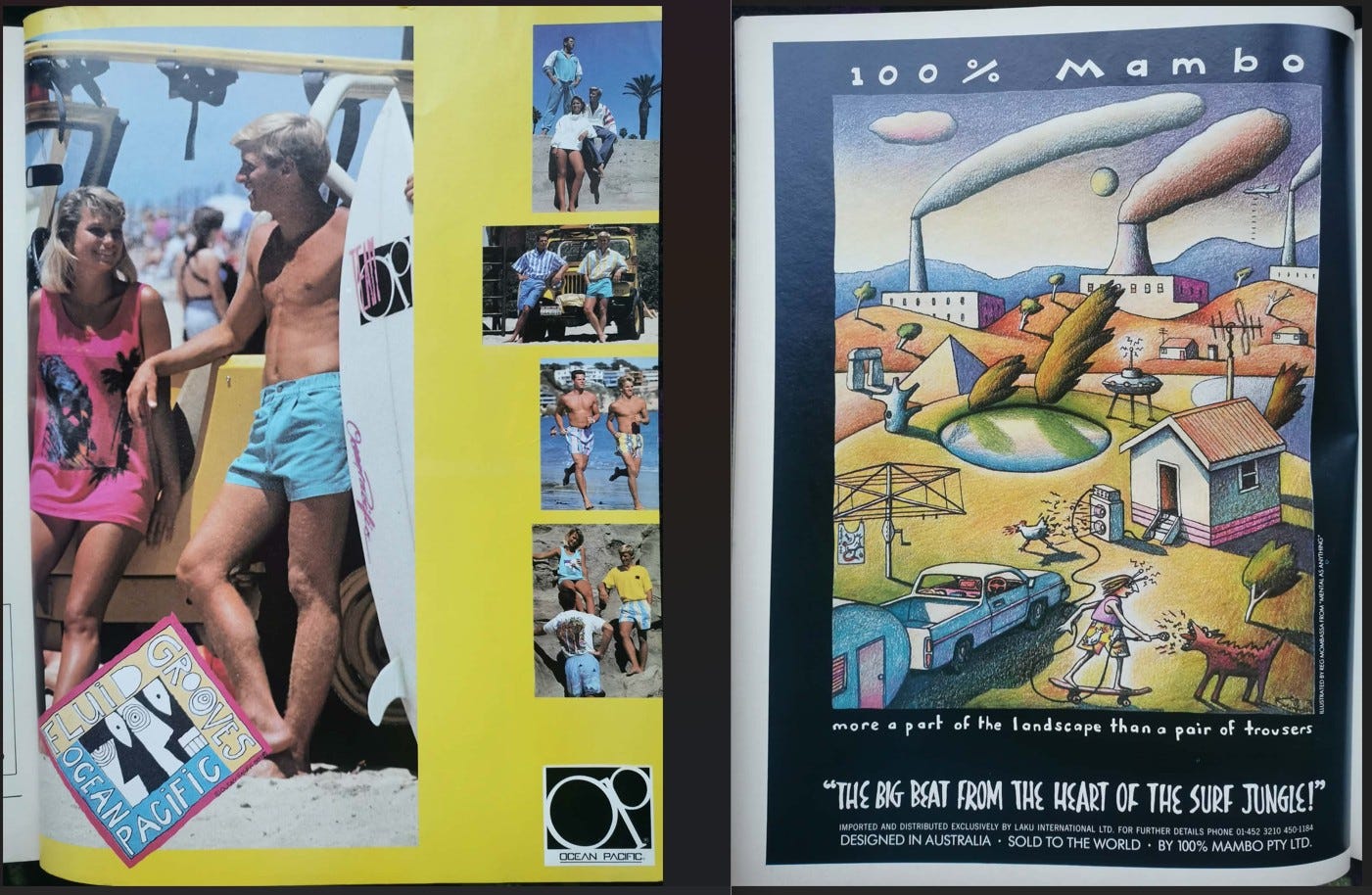
Avant-garde advertisements for Comme des Garcons rubbed up against cheesy beach-smile ads for Ocean Pacific and Haring-lite ads for 100% Mambo in the pages of The Face. Over in i-D, regular advertisers Flex promoted Life’s A Beach shorts for their summer 1986 fits. At the same time there is a movement from King’s Road and Kensington Market to Hyper Hyper and Dover Street and South Molton Street (Crolla and Yohji were the first brands from this new world to take root here).
Anarchic innovation and ingenuity gave way to a more prescriptive method, meaning that quirkiness and the ability to stand out could be purchased by those both in the know and flush with cash. In the 100th issue of The Face from September 1988, closing out the first chapter of the magazine’s existence, we get a mournful look back in which street fashion derived from “Flip, Oxfam, and Blitz improvisation with curtains” has now been poached by South Molton Street, with (according to the author) only the customised MA-1 jackets and DMs holding the old ground.
I’m struggling to articulate this messy mix of scenes and post-hoc reflections and interpretations without it coming across as a sixth former’s cultural studies essay, so I will pause for a break before looking in more detail at the crucial role of Stussy in defining the shift from streetstyle to streetwear.
Great stuff, Ian.
Although I believe we experienced similar cultural trajectories, contemporaneous timelines, and the movements and trends that coloured them, I am always struck to find in your writing on fashion that our basic approach to trend was very different. For you, clothes appear to serve as first principle; for me the clothes were always a consequence of the music and art in which I immersed myself at any given time.
I enjoyed musing on this: "being and doing replaced by having, only to be further replaced by appearing." Whether trendy Gramicci-festooned rock climber (mock climber?) or a "weekend rockstar in the toilets practicing their lines" in skinny jeans and biker jacket, the simulacrum has always been more fun and more immediately gratifying than schlepping up a massive boulder or living out of a transit van with 3 other foul-smelling idiots. And I have done both.
I have always unapologetically embraced the pose, and while there are a few subs I've avoided (metal, skate, skin etc.) I have successfully managed a 5-decade cultural career, prompted primarily by music, that has gone from pretending to be Bay City Rollers and Showaddywaddy, to Bowie and Roxy Music, to all subsequent things punk, post-punk, goth, indie, and beyond.
At 61, I'm still feeling the need to morph and style up myself. Plenty of pose left in my posturing.
Another wonderful read - exploding myths and adding clarity.