
Polychronic Birmingham (leaving the 20th century)
Part 1 – John Davies and the ‘new topographics’

Birmingham New Street is fixed as a submerged train station; an endless array of narrow platforms like ploughed furrows, claustrophobic and bereft of a welcome down on the platform. Meanwhile, on the top sits an excessive and glitzy upper serving as a beacon of mindless consumerism. Above ground or below, it is not a place I cherish spending time. You feel either not wanted or not wanting to be wanted. Topographically it is a six-point junction, connecting a tight chiasmus of north-south lines, intersected by a cross-country line that splits England through its approximate middle. These six lines immediately fracture further as they weave their way out of the city.
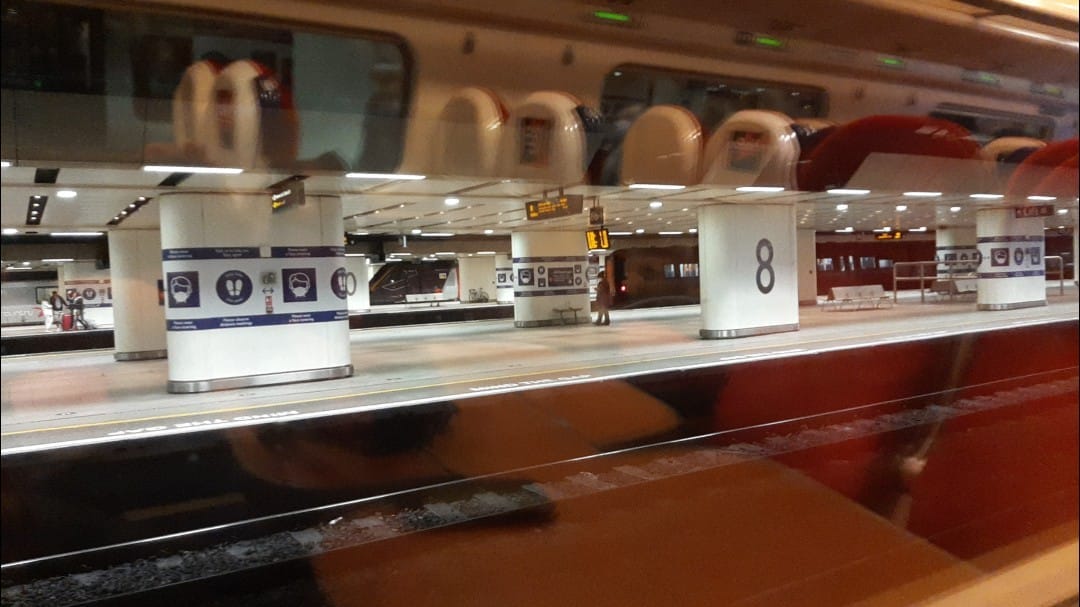
Wherever I have lived, I have always undertaken train journeys that pass through this station, often having to change trains here. Stumbling around on the narrow, dark and airless platforms. The only moment of inspiration I have seen connected to New Street is an incredible photograph by John Davies, part of his seminal 2006 book The British Landscape which questioned how we contemplate industrialisation. I’ll come to that photograph in a minute, but first a diversion through my adopted home town of Sheffield where Davies spent time creating a set of prints in his New Topographics series.
Davies’ photographs of a Britain in the final quarter of the twentieth century have a haunting and beguiling quality. He multiplies temporality in the photograph: as well as the present, he captures vestiges of the past and to-be-unrealised hopes for the future. His work goes against the formulation of photographic understanding by Barthes – the studium that represents the entirety of the photograph as it draws on your attention and structures the cognitive engagement, and the punctum that reveals a tiny rupture or imperfection that snatches and holds your attention in a different register. Davies’ photographs of known (or certainly knowable) working-class places and non-places (to borrow Marc Augé’s fashionable term) have an unsettling aura that blurs between an ambient mundanity and scintillating suspicion, disrupting the practice of seeing without noticing. There is no work undertaken to discover the punctum, you are unsettled from the get-go. A sense of change is always-already underway, change from the past, change towards a future.
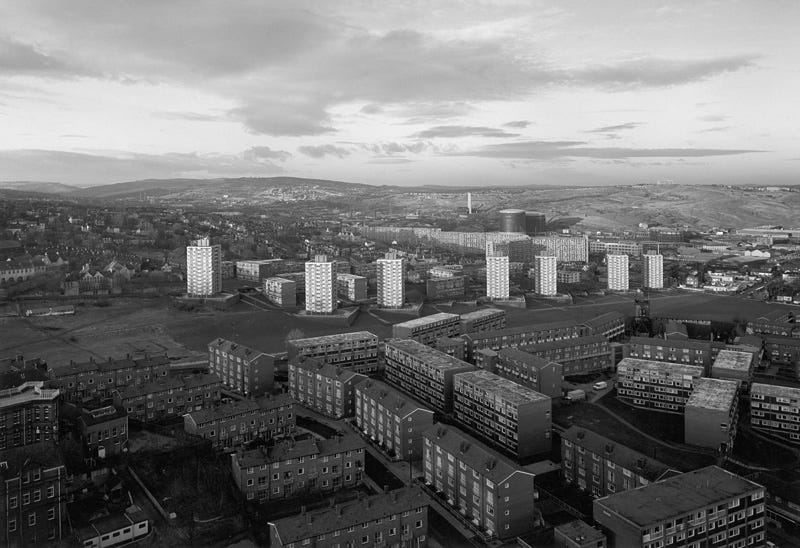
When I look at Davies’ work in this series, there are many places I am familiar with – overviews of cities I have spent time in depicted from vantage points that are a common currency in the visual economy. A number of his photographs pan out over Sheffield utilising the famous seven hills as vantage points. These high spots are (or were) generally exaggerated with high-rise mass dwellings or buildings - Hyde Park Flats and Skye Edge, and a panorama of the Netherthorpe (and Upperthorpe) areas taken from the University of Sheffield Arts Tower.
Davies spent time here in this city. Sheffield and its harsh undulations perpetually affords such views and subsequent presentation of compositional representation. This sets a challenge to Davies’ work to avoid the obvious picturesque and vista-driven ambience. I spent five years in an office in the Arts Tower, and returned years later when I did my PhD, giving me an unusually intimate connection with the Netherthorpe photograph. Davies’ photograph, composed in 1981, is deceptively tranquil in that way he seems to attain with consistency.
The foreground consists of a disjointed grid of low-rise council flats with seven high-rise blocks – catching the sunlight - running down the horizontal centre with a regimented symmetry. The background collapses numerous facets including the compressed curves of Kelvin Flats (demolished in 1995), the twin gasometers and the rising hill of Parkwood Springs (actually reclaimed industrial land), before opening out to a wide sky that fills the upper third of the photograph. Every day I walked through the area in the foreground on the way to work, navigating the obvious vestiges of deprivation and illegitimate activity – drug trade, petty crime, boredom, the detritus of fly-tipping blowing and circling into low-lying concrete endpoints. Davies holds this in check in his photograph.
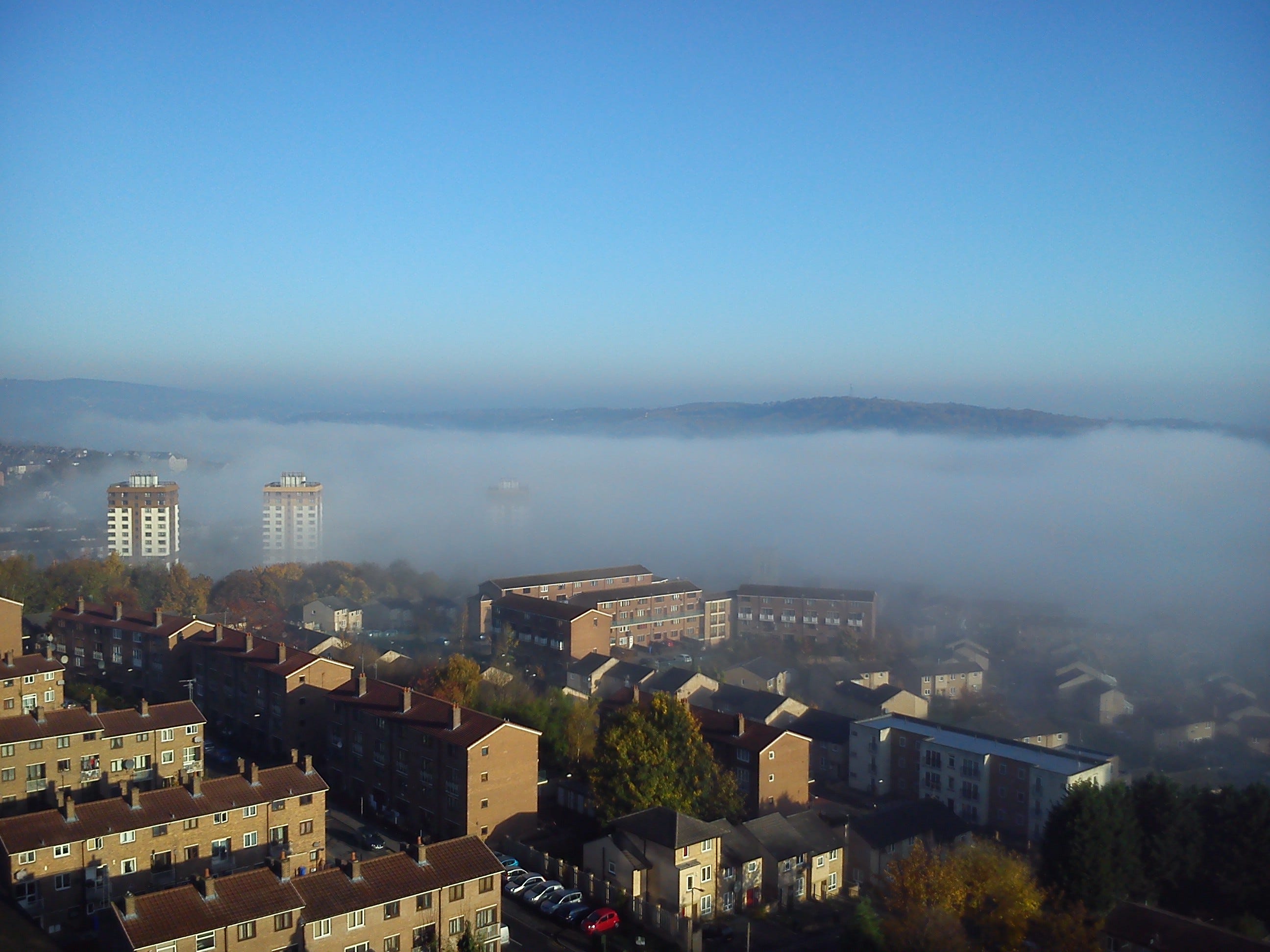
Maybe it is my situated knowledge that confers this aura onto the photograph, but you feel that Davies choses his view not simply for its composition and sweeping vista, but to silently and invisibly document the nuances of life going on in whatever form it takes. In fact, his work is doubly deceptive in that he makes it look effortless, like a view you could capture yourself. Before seeing Davies’ work I more than once stuck my camera out of the window to try and capture the view. The only picture that survives is this somewhat over-aestheticized take capturing the early morning mists and immediately imbuing the scene with a sense of something it clearly is not.
Okay, we have diverted to Sheffield and this essay is about Birmingham, so let’s get back on track. As with his Sheffield photograph, Davies’ image of Birmingham New Street resonates with a sense (to me) of having already seen what it depicts. A muted familiarity. Composed and captured in 2000, it is, however, instigated from a viewpoint I have struggled to find. Here it is so we can take a proper look at it…
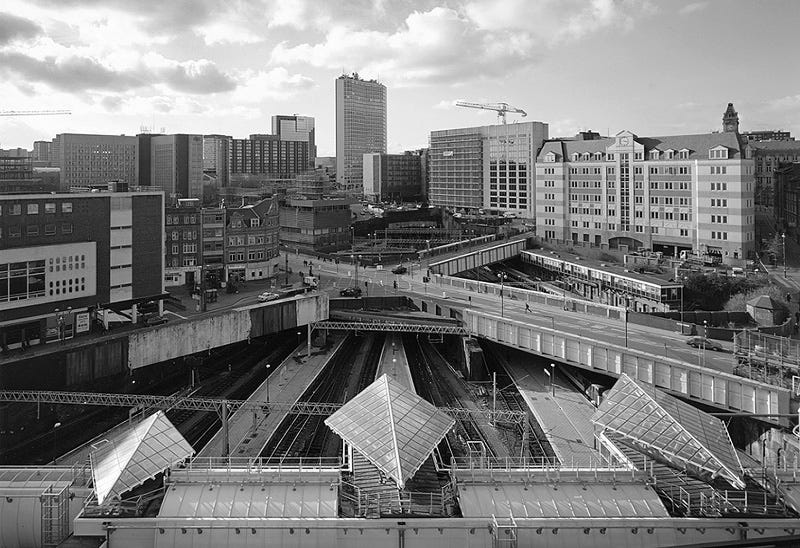
This gives me a slightly different relationship to the image as opposed to my familiarity with the Sheffield view. As the years have passed the possibility of reproducibility of the photograph, the finding of the view, becomes subsumed under the restless change of the city centre. For some strange reason this irks me – he plucks out an impossible beauty of New Street that I strive to cherish in the now and the future, but it is slipping away from the instant of the photograph.
You almost feel as if it was never there, that Davies is performing some kind of visual conjuring act, prestidigitation at the developing process well before the days of post-photographic digital manipulation. Davies pinpoints (or stumbles upon?) a quiet symmetry, a choreography of roads, buildings and railway lines. The near-ground fixes on a trio of bland Perspex conjoined delta structures, their function seems uncertain but they attain the aura of a fleet of cheap-special-effects spaceships launching from the bowels of the train station.
The far-ground is dramatically cut off separating the skyline and a sequence of unspectacular city centre offices. Near-ground, far-ground, and a whomping great ‘X’ that sits in the dead centre of the photograph… everything is in a kind of subverted harmony. The massing of railway lines sitting underneath the photographer, splayed across the 15 or so platforms of the station, emerge on the southwards facing side to plummet under the X and then twist slightly to the right, converging to form the perspectival vanishing point. All points head to Redditch, Gloucester, Great Malvern and the ‘English Riviera’ so remote from Birmingham. It is a photograph of Birmingham that is not quite real, and at the same time a photograph of other realities at increasing distances from Birmingham. Always something else a bit further away, a bit more exotic, an escape. Like the open sky in the Sheffield image, the solace in the vista is illusory.
But what has this got to do with Birmingham, subcultures, fashion and time-travel? I will try and explain that in part 2.