
Punk fragment #2 – Sid Sings

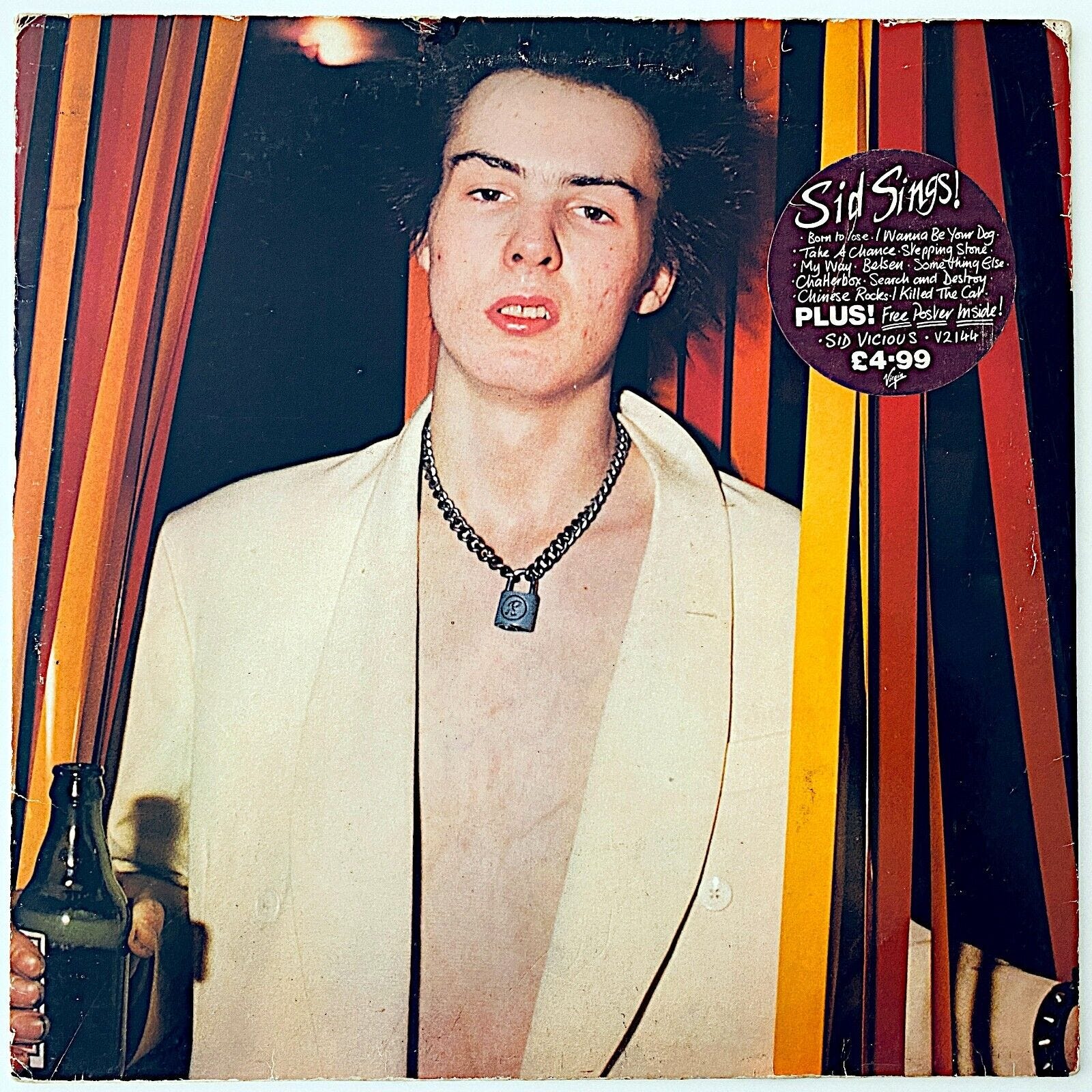
The Winter of Discontent grew through the final few months of 1978 and first months of 1979, a culmination of British politics and trade unionism dovetailing and conflicting with a power play and series of bluffs to concoct a nadir of economic and social conditions. Strikes began in late September and quickly escalated, the climate of unrest fused with a period of freezing temperatures that gripped the country throughout December and again into the months following the New Year. Lorry drivers joined the strike in December, intensifying the social and material extent of the battle into everyday life such that supply lines were threatened with being cut off resulting in shortages and panic buying. The recruitment of gravediggers and waste collectors to the striking sectors in early January gave the period a defining and long-lasting visual and mythical legacy, a glib metonym to catalyse and freeze-frame impact and imprint.
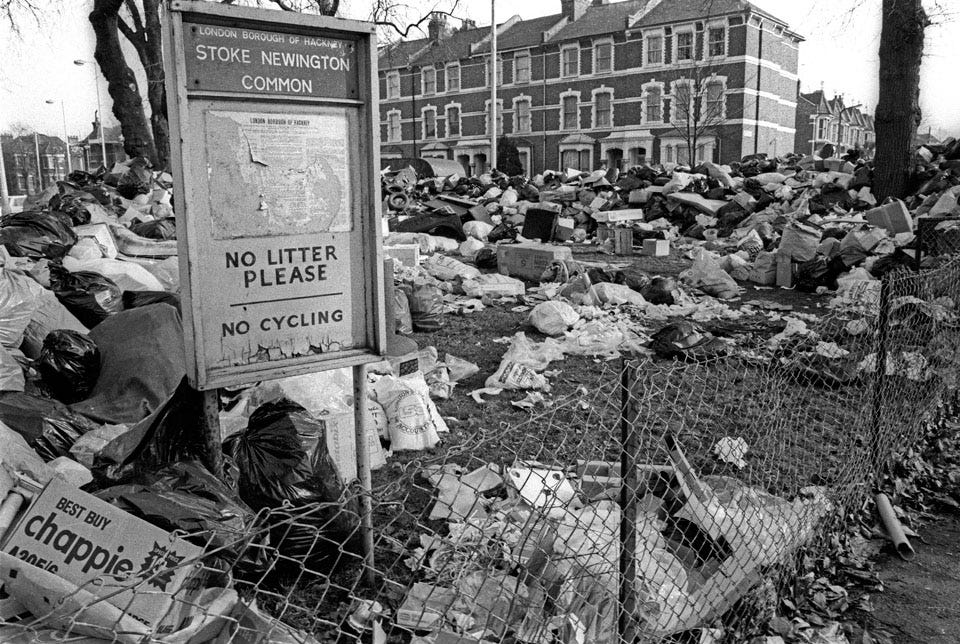
The term Winter of Discontent, taken from Shakespeare’s Richard III, was not used until the day of the general election in early May 1979 – coined by the editor of The Sun as a post-hoc description in anticipation of a new dawn of politics. The Labour and Conservative parties had taken turns through the 1970s to steer the country, but neither could get to grips with the complexity and rootedness of the ‘problems’. Margaret Thatcher had taken leadership of the Conservatives in early 1975, following Edward Heath’s failure to defeat Harold Wilson in the 1974 general election. Wilson had subsequently handed over the leadership of the Labour party to James Callaghan, a poisoned chalice if ever there was, and Thatcher was waiting to pounce with an aggressive agenda that would go on to define the next decade and beyond.
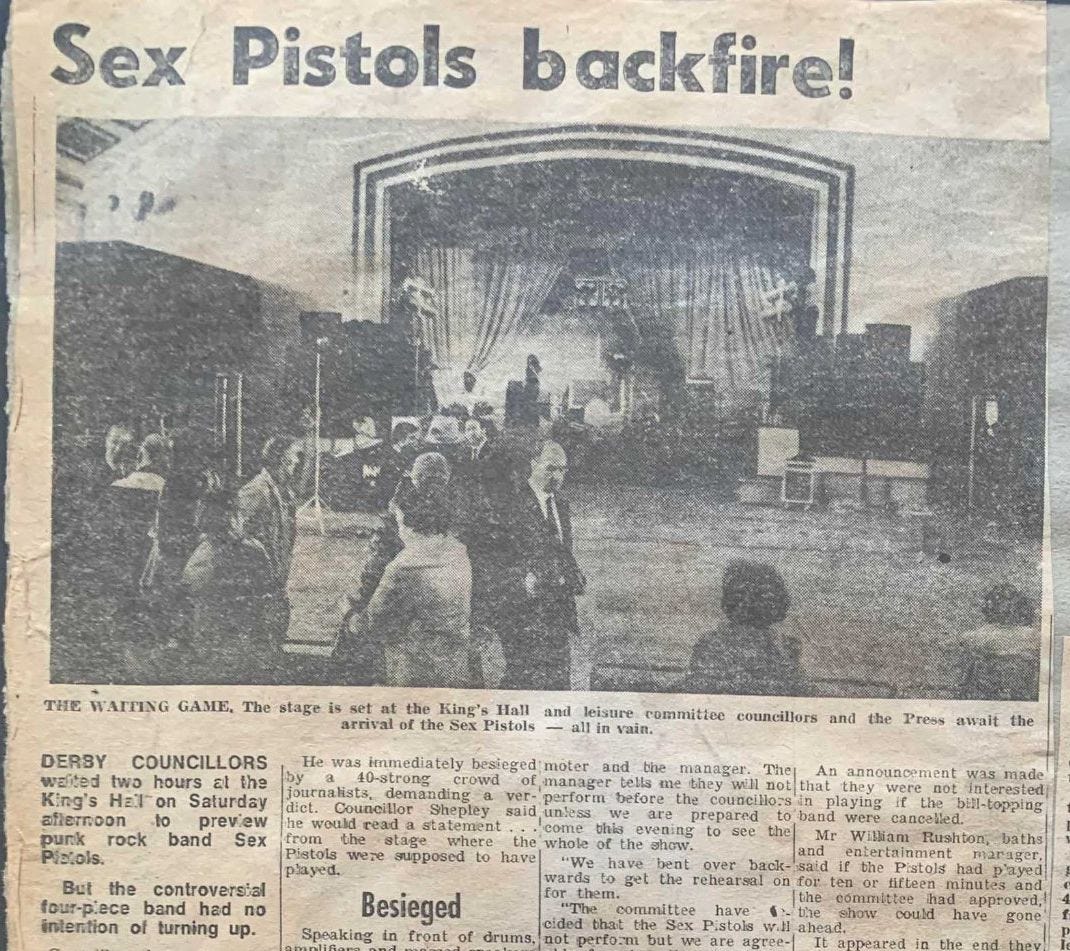
My home town of Derby, declared a city in the jubilee year of 1977 (after hastily de-implicating itself in the Sex Pistols scandal of the ‘Anarchy in the UK’ tour of December 1976), was a strong engineering base with a healthy economy of employment. Though much of the city’s industry was through engineering – British Railways, Rolls Royce, and Celanese (where my father worked) – it was relatively unaffected by the wider negative climate of the strikes.
On Thursday 12 April 1979 parliament had been dissolved for five days and campaigning for the general election, to be held on 3 May, was underway. My interests on this Thursday, as with every Thursday, would certainly have been with Top of the Pops, a staple part of viewing and a guaranteed subject of conversation in the school playground the next morning. I was 13 years old, and totally enraptured with punk, buying 7-inch singles with vivid picture sleeves and luminous coloured vinyl, constructing a look of home-made clothes and tee-shirts bought from the back pages of NME and Sounds. I would be on the cusp of going to gigs, but not quite yet, so Top of the Pops was one gateway to some form of punk contact or communication, a mediated sense of kinship.
The following was on offer for Top of the Pops in a 35-minute transmission hosted by a predictably excitable Peter Powell: The Three Degrees ‘The Runner’, Light Of The World ‘Swingin’’, Kate Bush ‘Wow’, Showaddywaddy ‘Remember When’, Sex Pistols ‘Silly Thing’ (danced by Legs & Co.), Neil Diamond ‘Forever In Blue Jeans’, Racey ‘Some Girls’, Supertramp ‘The Logical Song’, Sham 69 ‘Questions and Answers’, Kandidate ‘I Don't Wanna Lose You’, Sister Sledge ‘He’s The Greatest Dancer’, Art Garfunkel ‘Bright Eyes’ (occupying the number one spot for the week).
Obviously, the stand out moments for me were Sham 69 and the Sex Pistols - the latter at the time well advanced in their disintegration. They would not appear live, instead having ‘Silly Thing’ interpreted and danced by the resident troupe Legs & Co. This all-girl dance ensemble gave the continuity from the long-running Pan’s People and short-lived Ruby Flipper, taking over the role from 1976 to 1981, and so being saddled with having to find dance routines to the heyday of British punk and new wave which dominated the charts in 1979. Their name reflected their soft-porn approach, part of the casual sexism of the times, suggesting that a redeeming and singular feature was an attractive pair of legs.
The Sex Pistols had witnessed a rapid turnover of fortunes since their breakdown tour of America barely a year before, in January 1978. Sid Vicious had been catapulted to front of house duties and happily obliged to record a slew of cover versions through the summer of 1978, willingly playing the fool. As the academic Stan Hawkins surmises, in his 2009 study The British Pop Dandy, Vicious “negotiates a performance strategy never witnessed before”. Heading to New York in autumn 1978, he hits a precipitous downwards spiral as he lives out his cartoon character punk persona, commencing with his partner Nancy Spungen dying in a drug-related incident that was never resolved but initially saw the hapless junkie Vicious arrested and jailed. He was bailed, and then re-arrested for a drunken rock’n’roll brawl to spend a further 55 days in jail and undergo enforced detox. On release in February 1979, with the help of his addict mother he acquired a large amount of heroin and died on the same night through an overdose. If the Winter of Discontent drew from a Shakespearian history play, then Sid’s demise was part tragedy, part comedy. Like a turd that refuses to be flushed, it was crowned with the album Sid Sings at the end of 1979.
Whereas Johnny Rotten, now returned to Lydon, disconnected himself from the crawling chaos of the punk wreckage to go into a period of productive creativity with Public Image Ltd, Malcolm McLaren picks over the bones of the Sex Pistols. Throughout the latter part of 1978 and the following two years, the Flogging a Dead Horse strategy of music marketing went into overdrive, with hit singles twinned with raunchy or novelty b-sides, wrapped in parodic commodity sleeves by designer and artist Jamie Reid. The Sex Pistols shifted from being society’s bete noire, to a household name akin to the Bay City Rollers – quite possibly the culmination of McLaren’s intent. Their smuttiness and foul-mouthing gripped the adolescent record-buying market; playground chatter hinged around the band and the de rigueur hemp military-style school rucksacks were painted with extracts from the band’s artwork.
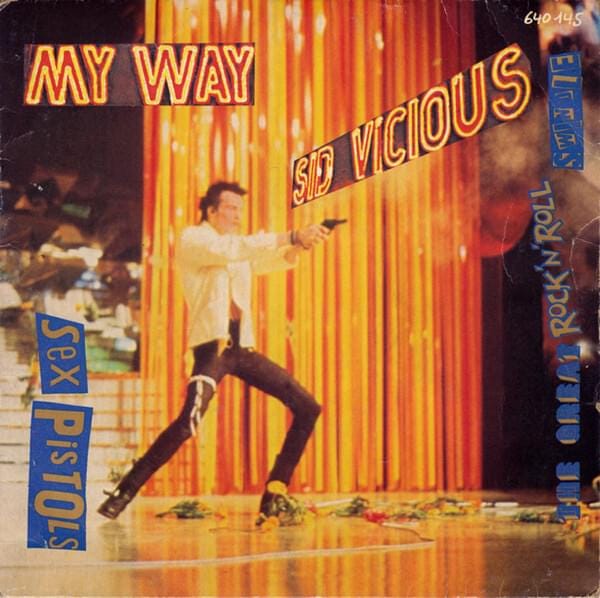
I have a persisting vivid memory from summer 1978 of going out one evening to play in the park as my parents had a couple of uncles and aunties round, and then nipping back unannounced into the house to be met with a scene that horrified me. My dad had taken a small crowd into my bedroom to play them – purely for amusement purposes – some of the punk music that caused such tension between us. If this wasn’t bad enough, a blatant intrusion of my privacy in both physical and cultural space, he was playing them the Sid Vicious cover of ‘My Way’. The song formed the b-side to the clumsy Sex Pistols single ‘No One is Innocent’, which in turn drafted in retired criminal Ronnie Biggs to add punk novelty notoriety, a moment which was effectively the start of the bottom-of-the-barrel commercial dash by the remnants of the band and the record label.
The singing on ‘My Way’ starts with Sid crooning in time with the original, to a background of atmospheric orchestral strings, drawling and hiccupping his delivery with his goofy persona and upward-punching irony. In his discussion of cover versions, the academic Mosser Kurt picks out this section of the song as deliberately lugubrious with drawn out syllables, sounding like a “stereotypical drunken guest at a wedding”. The record comes to life at the first chorus when the whole thing speeds up and Vicious exhorts his punk patter. However, my dad had expected the sped-up punk singing from the start and so had impatiently flicked the speed to 78 rpm after the first lines were uttered. By the time the punk section started in earnest, the singing was at such a pitch that it had a children’s cartoon quality – something like Pinky and Perky or The Smurfs. Walking in on what was the equivalent of a Freudian ‘primal scene’, the transvaluation of a punk trope - of taking of punk singing and pushing it beyond its rationale - filled me with horror and stuck with me to this day.
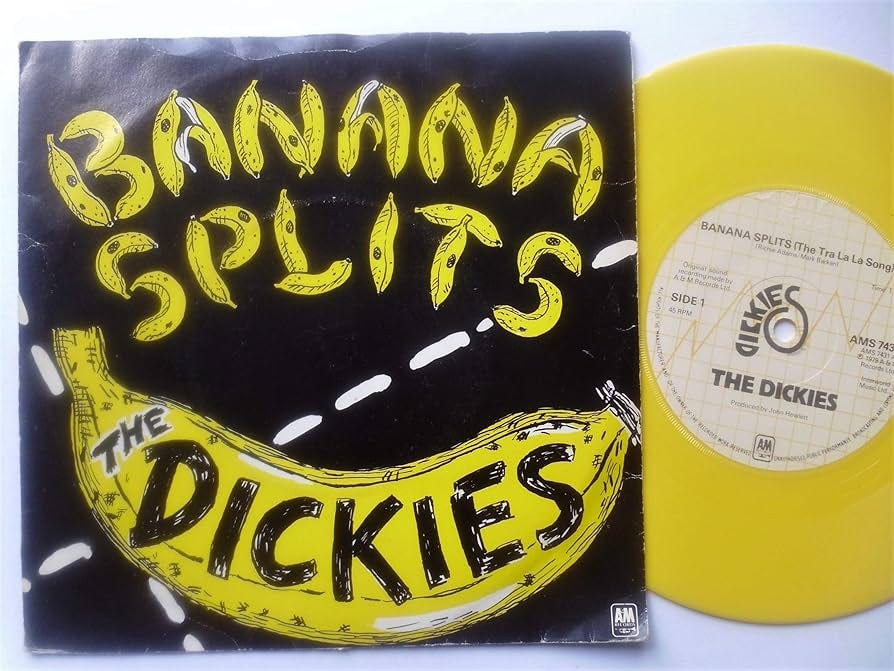
The year 1979, particularly the first half, exemplifies the commercial success of punk and new wave as an amorphous mix, a substantial distance away from the hip and happening beginnings of the scene in London and its distillation into the provinces through a cool and connected network. It was the high point for punk’s commercial exposure, boosted by large numbers of school kids looking for the next (or first) exciting thing. As noted, Sham 69 and Sex Pistols stand out on a Top of the Pops devoid of any other serious or forward-looking subculture. The previous week had even more to offer with five punk and new wave bands - The Jam, Generation X, The Members, Siouxsie and the Banshees and Squeeze – for all intents and purposes a majority. A couple of weeks later you had The Dickies performing a vaguely punk and sped-up version of the ‘Banana Splits (Tra La La)’ theme (pressed in banana yellow vinyl, naturally, and having the delight of two silly tracks on the b-side – ‘Hideous’ and ‘Got it at the Store’). Juvenile punk records in novelty packaging came thick and fast – The Undertones twinned ‘Jimmy Jimmy’ with ‘Mars Bars’ (with a limited-edition clear sleeve and translucent green vinyl), whilst Skids offered ‘T.V. Stars’ as the b-side to ‘Into the Valley’ creating a terrace and playground chant that reeled off the names of Coronation Street actors.
In this period the Sex Pistols enjoyed three quick-fire hit singles with ‘Something Else’, ‘Silly Thing’ and ‘C’mon Everybody’ all scoring high in the top ten and, perhaps more importantly, having childish but scurrilous b-sides. ‘Something Else’ was twinned with ‘Friggin’ in the Riggin’’, a clarion call for rebellious school-aged fans with the song containing an “ass”, a “tits”, a “fuckin’”, four “bollocks”, “fuck” 15 times, and “friggin’” 45 times. ‘Silly Thing’ also offered up Edward Tudor-Pole goofing and gurning as a one-off Sex Pistols frontman performing ‘Who Killed Bambi?’, exuding the vocal dysfunctionalism of a Carry On character adopting affected voices and schizophrenically switching between styles. Topped off by Irene Handl addressing Tudor-Pole as “Mr Tadpole”, it provided one of the best scenes in the 1980 film The Great Rock ’n’ Roll Swindle. The common (lazy) misconception is that punk was forged in the nihilistic heat of the Winter of Discontent, for all intents and purposes punk provided a soundtrack for these days of darkness and dread. However, as we can see, punk was both at its populist peak and silliest songwriting capacity – if it was indeed soundtracking the decline of British civil life then it was via a Bakhtinian laugh via a medium of Day-Glo record sleeves and coloured vinyl.
Legs & Co. had already danced to the Sid Vicious-fronted Eddie Cochran cover ‘Something Else’ as it rose up the charts in March, adorned in coloured punk wigs and stretched out in a line executing a prototype Riverdance routine as they simultaneously kicked their legs forwards and moved backwards. On the night of Thursday 12 April the sextet were arranged in a diamond formation, akin to the famous Red Arrows aerobatics display team, wearing matching outfits of white stilettos, tight black trousers, boxy blazers in bright shades covering a bare chest, and a black bow-tie around their slender necks.
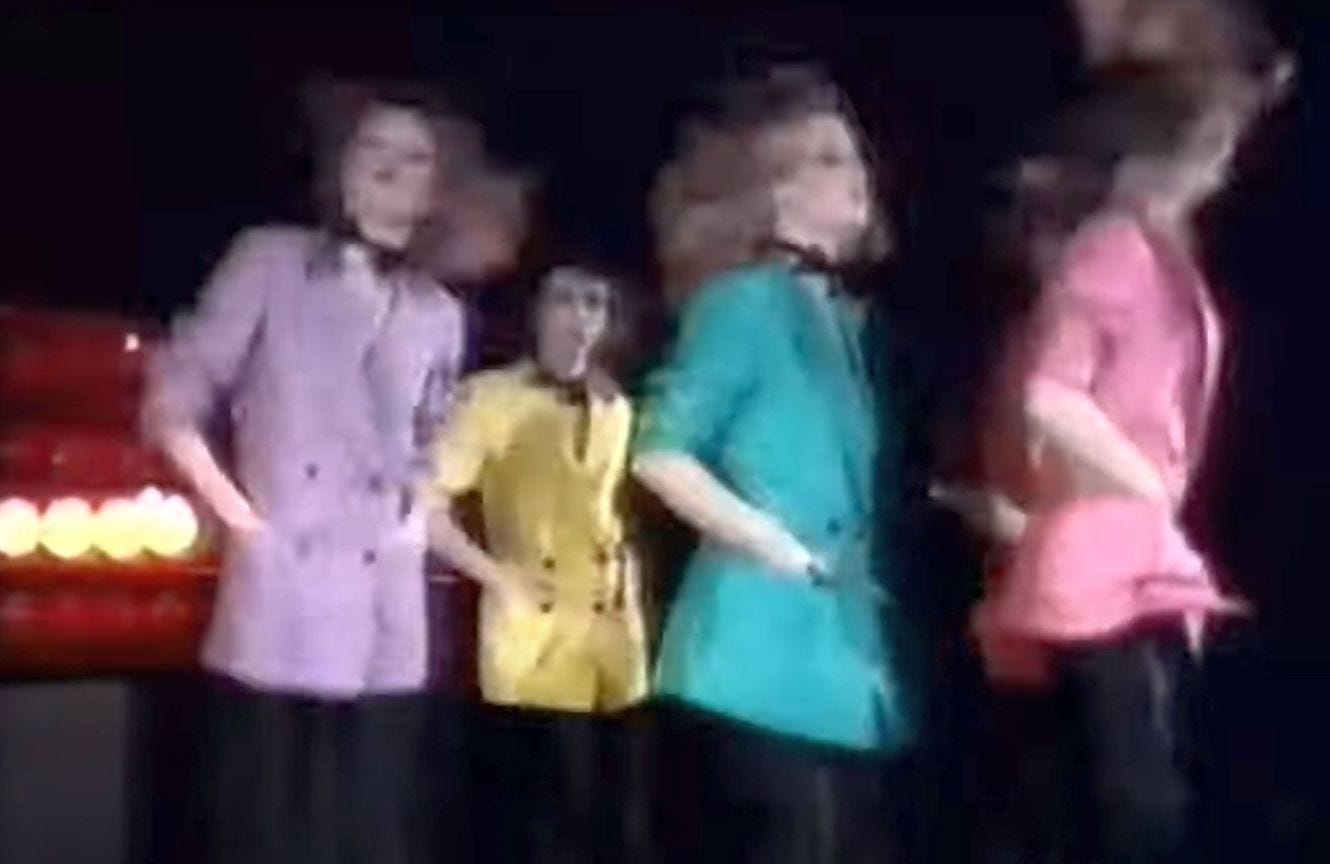
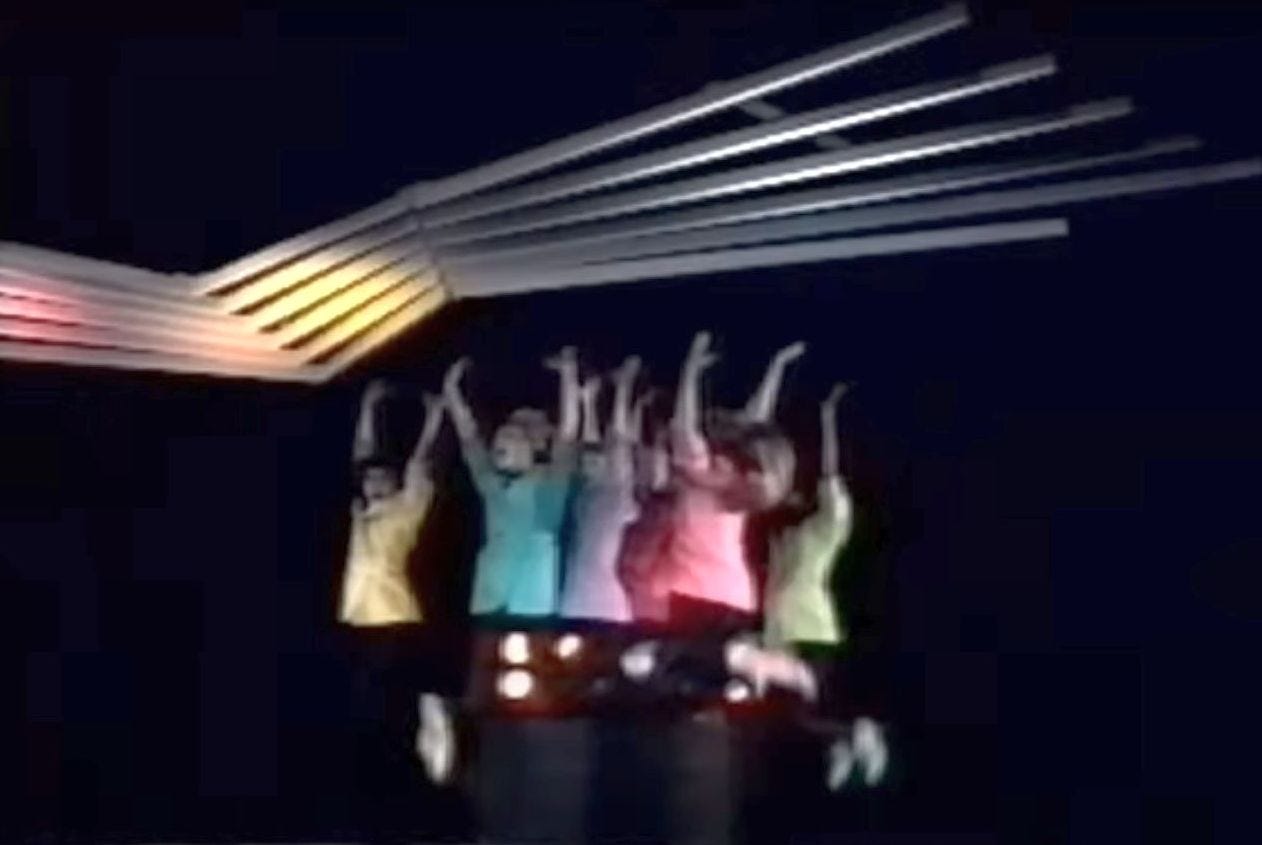
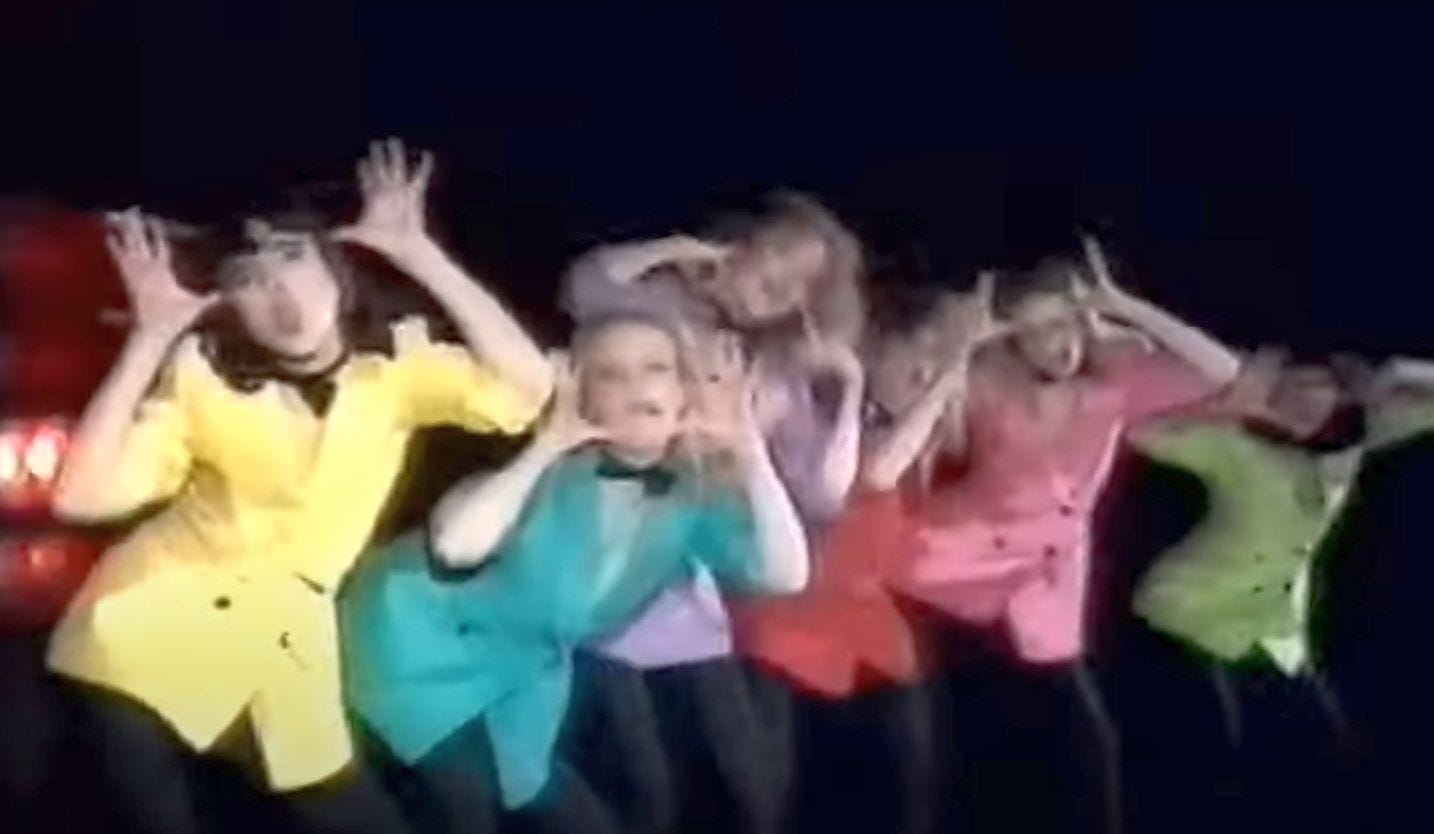
It was an attempt at early punk fashion where symbols of normalised modesty and vestimentary class and occasion were detourned. They danced a synchronised punk dance, keeping their arms taut to their sides and their hands pressed down into the side pockets of the oversized jackets. The dance included a well-rehearsed medley of stock punk moves; thrashing their heads from side-to-side, short bursts of dignified pogoing, alternating straight leg kicking with a swivel motion, the provocative tilted-head insouciant mouthing of the simple chorus, and a vertical jump with arms unanchored from pockets and raised aloft. The camera utilised a crude stop-frame technique to capture the dancers at the pinnacle of each jump, holding the frame a few seconds, and then returning to live action with the troupe scuttling around on another part of the small stage.
On this evening I was in the front room of our suburban house in Derby, watching, taking this in, quite possibly thinking (again) that there must be more than this? Or, in the words of the (ex)artist on the screen… something else? There was. In his book An Alternative Derby, local musician and music fan Johnny Vincent celebrates and laments Derby’s seminal punk gig space the Ajanta Theatre. Evoking a dark mirror version of French philosopher Gaston Bachelard’s Poetics of Space, Vincent conjures up the celebrating of the physical and architectural nuances of undoing and un-dwelling, where dark crevices are sought out and audiences submit to an urge to strip things down to bare elements. He writes
“White walls of the building darkened to grey by years of neglect and harsh weather, the windows bricked up, and loose wires hung from the side flapping about in the wind … With a capacity of 525 the Ajanta had an atmosphere all of its own, this was a venue that once you were inside there were no rules, you basically did what you wanted and that included smashing the place to bits, letting off fire hoses, fighting in the crowd and with the bands, throwing cans and bits of seating around … Like going to a cinema after it had been involved in a riot … the balcony was like a wooden terrace at a football ground with faded red carpet with holes in. People would sit on it pulling the thread and fraying what little was left, pulling it apart bit by bit as you would sit there waiting for the band … from the stage, Derby’s Ajanta Theatre looked like a mouth with teeth missing, as musicians stared down at the destitute theatre space with rows of plush seats long since ripped out and hurled around”
The Ajanta fleetingly became Derby’s punk venue commencing in February 1979 and running sometimes spasmodically and at other times frantically up until November 1980. A visit to the Ajanta was a polysensory and heightened experience. The building stood off Osmaston Road on the western edge of the small shopping and business centre of Derby, the main through route to the local football ground. During its brief period as a punk venue, partly as a consequence of the audience being made to wait outside the tightly locked building right up until the start of each gig, there would be occasional fights and running skirmishes between football fans returning from the game and punks waiting for the gig. Once inside there was a strange release of tension combined with a sense of horror as the nature of the space dawned on you. The punk inhabitants quickly made their mark on the fixtures and fittings as every gig, as a part of a ritual, it got a bit more smashed, partially put back together, and then smashed again.
My own gigging days would start later in 1979, seeing a couple of more commercial punk bands at the larger venues of Derby Assembly Rooms and King’s Hall (a covered over swimming pool where the infamous Sex Pistols gig of December 1976 never happened). Punk and the more pop-friendly new wave was big business, having a strong grip on the music charts.
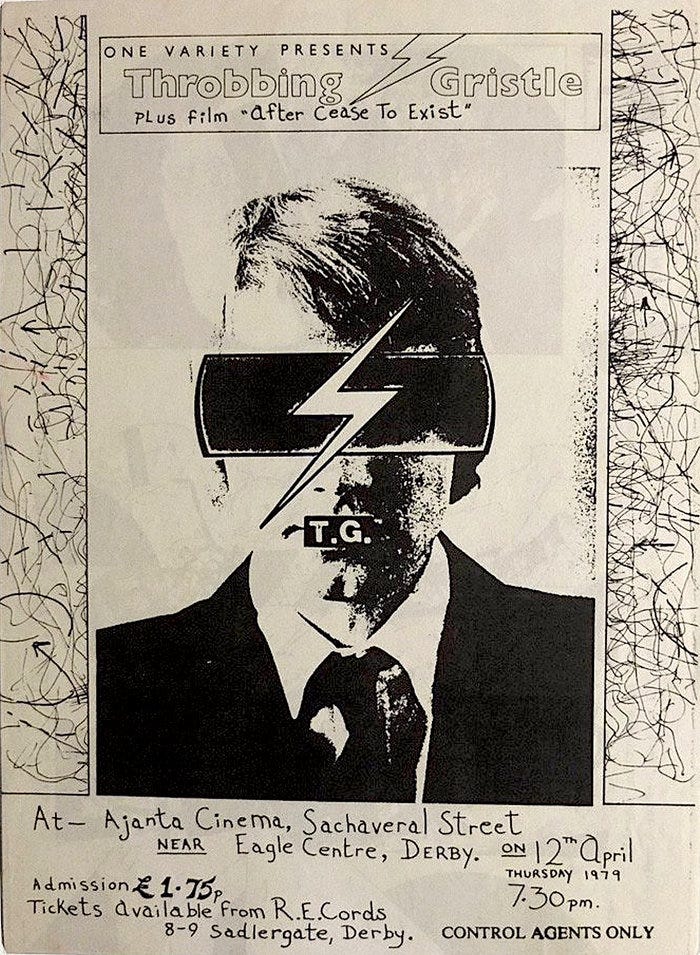
On Thursday 12 April 1979 I was watching Top of the Pops, gathering up my senses and sense of adventure to start attending the gigs at the two larger venues, on safe floodlit streets, with parents waiting. On Thursday 12 April 1979 the post-punk industrial group Throbbing Gristle played an hour-long set of noise and tape-loops to a small crowd at the Ajanta. The controversial frontman Genesis P-Orridge made a short speech before the sonic onslaught began, apologising to the audience for making them forgo Top of the Pops. The Throbbing Gristle gig went ahead with little advertising and evaded reviews in the music newspapers, but would be recorded on the night and subsequently released as a tape and then an album, before proliferating as internet streams and YouTube uploads in the modern era. I have listened to this captivating one-hour set so many times that I now almost feel as if I was there, and not sat at home. However, the opening speech, and quip about Top of the Pops, brings home the reality – implicated, or (in the terms of French philosopher Luis Althusser) interpellated, I am forever trapped in my living-room, in front of the television, surrounded by schoolbooks.
I missed all of the 1979 gigs at the Ajanta. Researching the buried archive of the venue reveals a bewildering number of important bands that played there through its opening year. My stomach gripes when I uncover details – if only I had the intuition and inquisitiveness to make the break. My first visit was in February 1980, to see The Slits, and from that point I never looked back, trying to get to as many events that my pocket money and school hours would permit until its abrupt closure later in the year. I carefully stowed away the tickets and they have travelled with me through life to the present day. Killing Joke, Bauhaus, Crass, Psychedelic Furs, Au Pairs, plus numerous bands who would form the ‘second wave’ of UK punk. Those nine months of frenetic gigging seem to have the duration of a lifetime, but served as some kind of apprenticeship through punk and into post-punk.