
Subcultural Super Collider
SIG5 launch event

Last week saw the informal launch of issue 5 of SIG News (Subcultures Interest Group, though the proximity to the Gerry Anderson acronym also feels apt) with a “bumper edition” spanning 60 pages. SIG News takes the form of a newspaper in the vein of the music ‘inkies’ from the 80s, with a sometimes particular lean (of sarcastic bent) to the proto/pseudo poststructuralism of NME. Behind the frequent ‘Morley-isms’ and 80s-style box-ads is a studious and informative collection of articles looking at past (and present) subcultures in a critical, robust, yet engaging format. Produced by UAL (University of Arts London), the newspaper features writing and research by a mix of authors drawn from PhD students and research staff alongside undergraduate and postgraduate students, technical, library and administrative staff, non-students, graduates and external contributors with an interest in youth, style and music-based subcultures.
Instigated, organised and administered by Professor Russ Bestley, Tim Gibney, Roger Sabin and Kevin Quinn, it is published roughly on an annual basis and is free of charge. Whilst serving as a slick engagement/outreach tool for UAL and a great platform for early career researchers and writers, it is also a valuable source on both understanding a plethora of niche (and not so niche) subcultures and also how we might think about thinking about subcultures. The first couple of issues passed me by (not being a Londoner and all that) but I managed to backtrack them and work towards getting a piece in issue 3 (on MA-1 jackets) and also a piece in issue 4 (on that Heaven 17 sleeve and how the memory of the 80s has been custom-fitted to an interpretation of the sleeve).
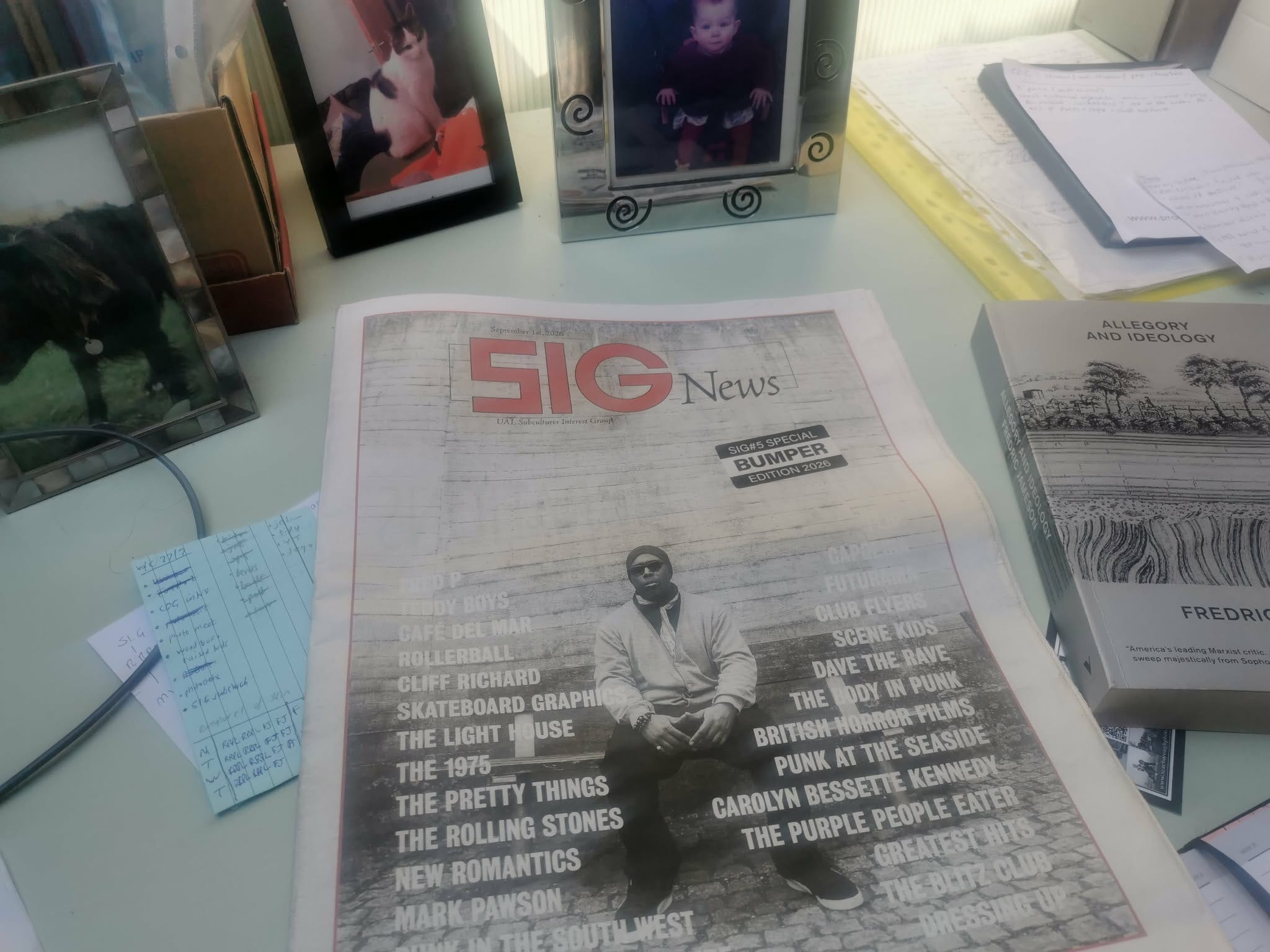
For issue 5 I have a reworked piece on Rollerball and popular culture as well as a project report on the ‘Sex Pistols by the Seaside’ exhibition and series of events. Ive not lifted the work straight from my SUB>SUMED pages, but refined it and brought in a little more academic grounding as food for thought. SIG News is not profoundly academic, but it tends to avoid both promotional ‘puff-pieces’ and repeating unchallenged myths (which often abound in subcultural recollecting). So, for example, in the current bumper issue we have writing on Teddy Boys, Ibizan rave culture, Cliff Richard, Skateboard graphics, New Romantic revivalism, punk in the South West (of the UK), Futurama and post-punk ideology, flyer art, novelty music, and so on.
The launch for the current issue saw the confluence of three ongoing projects to record and contextualise youth culture and subcultures - SIG News itself, the venue of the newly minted Museum of Youth Culture, and a guest stall ‘pop-up’ by the Rock & Roll Public Library. Central to the evening was a pair of round table talks that discussed other projects in larger ‘formal’ museums to capture subcultural scenes (mainly a discussion on the recent Blitz culture events) and a chin-scratching dialogue on what counts as a subculture and how can academia have a role in either interpreting them or using them as critical devices to make a wider contribution to historical knowledge (or indeed the academic tensions glimpsed when subcultures are brought to the table by both the purse-string-holding higher echelons of the university and the ‘on the ground’ activists of subcultures who have a suspicion of the university). There were also a series of lightning talks by current researchers, much of this being autoethnographical (which is no bad thing).
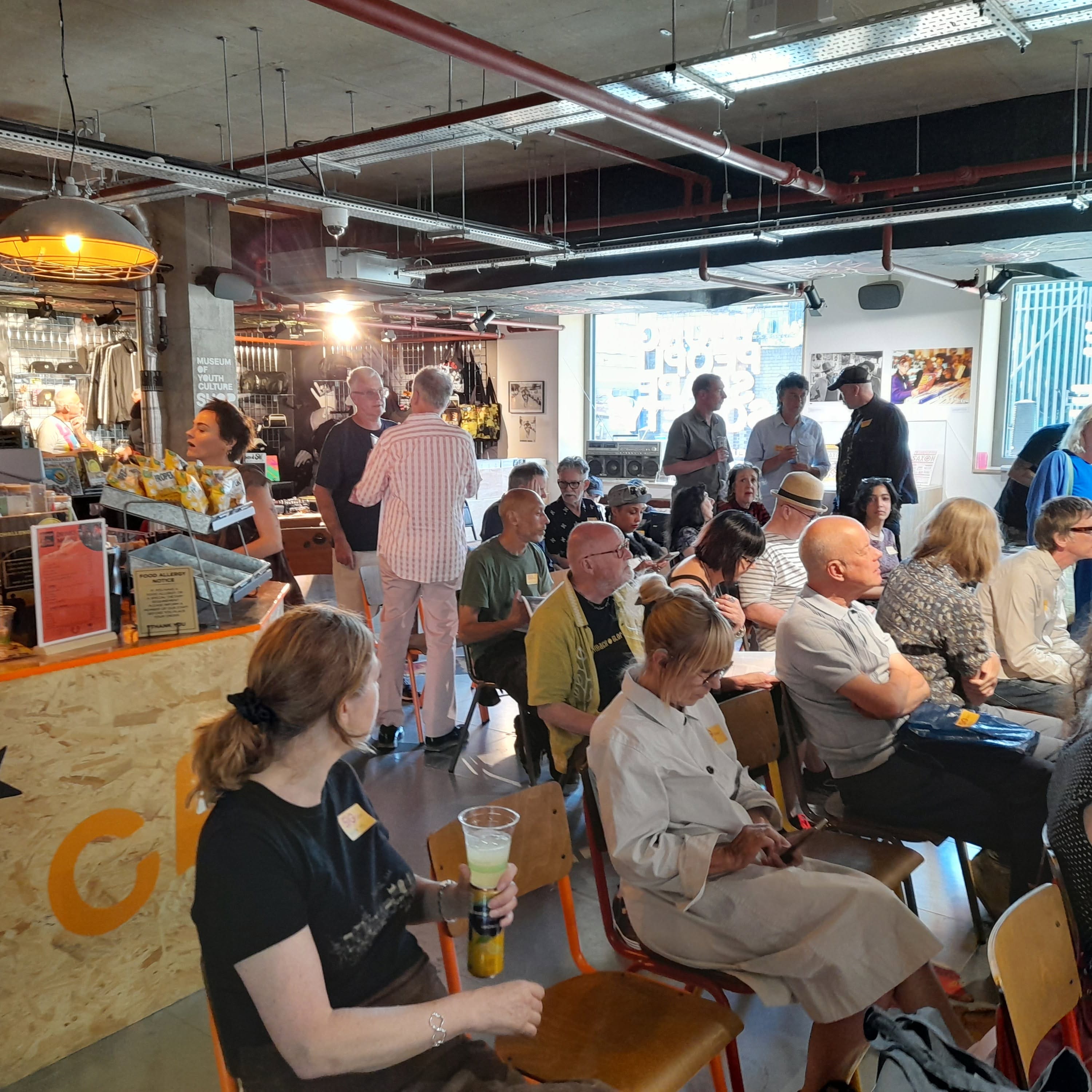
I didnt have time to explore the Museum, but I heard good things about it and the ground floor which hosted the event looked smart. We were set out all over the floor space and it was good to meet many people who I had conversed with via SUB>SUMED. It made my project feel slightly more vindicated. I had a brief chat with Rob Mowbray who is looking at how post-punk probed the future and he remarked on how he had recently looked at the NME article on the 2002 Revue which I had written about in the previous post. I realised after talking to Rob that my piece was somewhat flippant, and there is definitely more work to be done on unpacking why the music press were so scornful and distrusting of ‘futurism’ in the music scene. Rob, who contributes the Futurama article in SIG News, is on the case.
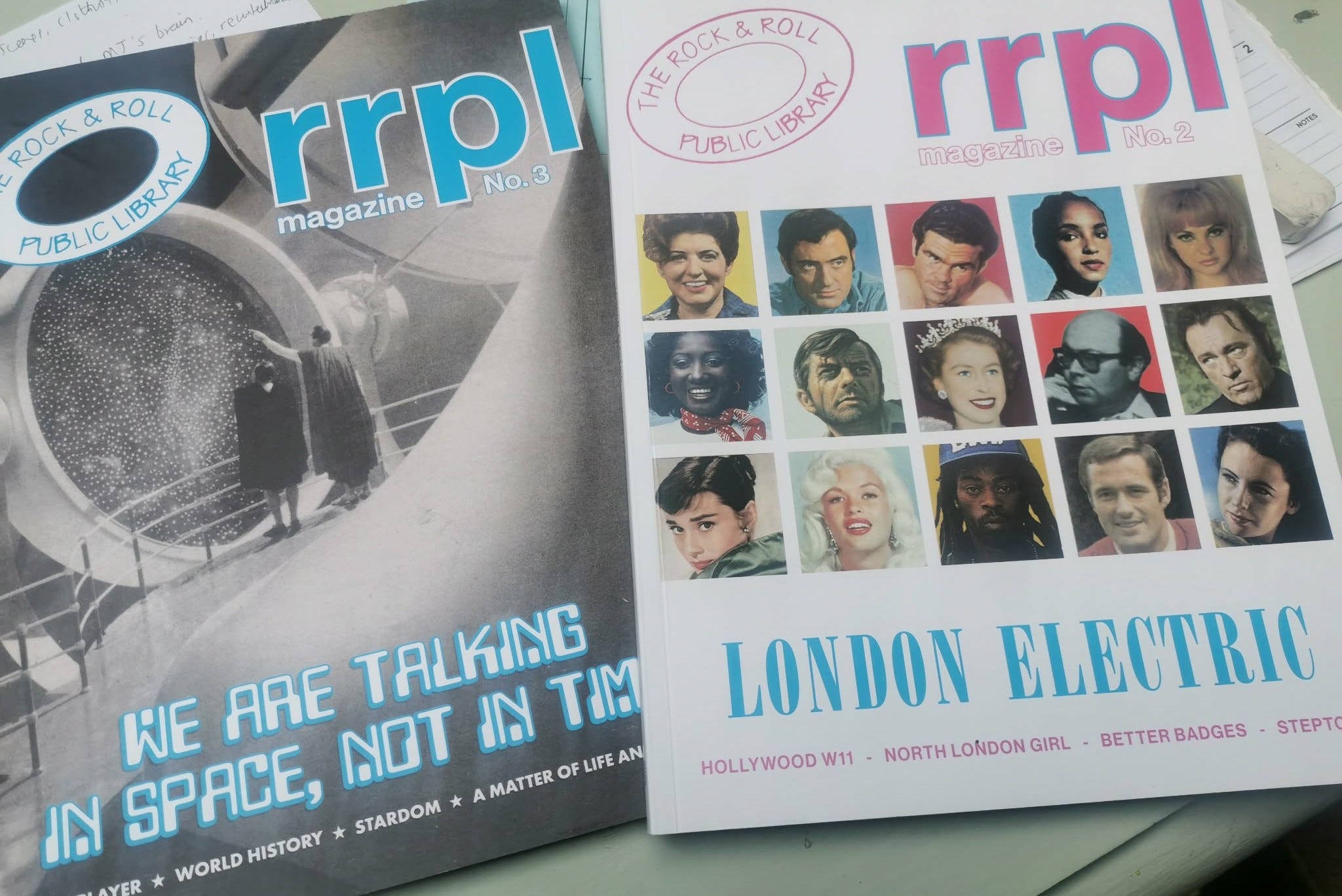
The Rock & Roll Public Library was also much better than I anticipated. It is essentially a curated rewiring of Mick Jones’ (Clash/BAD/etc) brain via his hoarded collection of pop culture ephemera that informed his songwriting and creative output with his bands. The ‘Library’ moves from place to place and is reconfigured each time to dialogue with the space and the present moment in time. Each location produces a magazine which includes a mix of montaged sequences and new writing. This writing is punchy, quirky and well informed, resonating with the ephemera and bringing it to life. It feels like the more erudite and autodidactic output of the 80s as the punk fanzine movement flexed it muscles with publications like Vague and Rapid Eye, informed by situationism and errant art.
I’m struggling in the heat to wrap this up, to think about how as subcultures become a past-participle there is an auto-reflex to keep them relevant as either a revival, a perpetuality, or a memory that serves a role within either critical thinking or the more malleable realm of nostalgia. A few years ago I completed my PhD on how fairgrounds can serve as heritage, and they have a similar popular cultural ‘consistency’ of being complex, transient, hybrid, intersectional and intangible. SIG News, the Museum of Popular Culture and Rock & Roll Public Library all seem to do interesting stuff and share a similar outlook to remain unshackled by either the academy or the formal heritage industry. Subcultures and their timeframes move backwards and forwards, and we are invited (via praxis or intent) to think about how we instrumentalise the past.
Brilliant to chat briefly with you again
Great evening, wonderful to catch up.