
To Destroy
MM 0.2 – Martin Margiela’s arrival in the UK fashion media

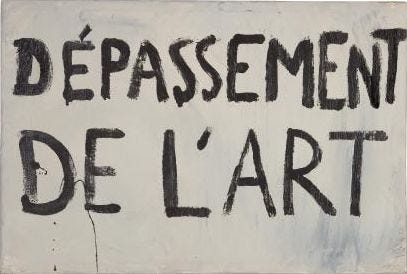
“The only interesting undertaking is the liberation of everyday life, not only within a historical perspective but for us and right away. This entails the withering away of alienated forces of communication. The cinema, too, has to be destroyed.”
So announced cultural provocateur Guy Debord as he set out the strategy for his (anti) film-making adventures. His method employed scratching marks and inserting blank frames of black/white, approaching the genre as a subsurface of surface. His praxis embodied and informed a general situationist approach to art and culture, in that true art must be both critical of the moment whilst containing the seeds and catalyst of its own negation. The negation of object, genre, reflection, critique… everything. Anything else is simply gestural, and open to an inevitable recuperation.
Could clothing, and fashion, have a similar recurrence, 20 years after Debord and his cohort exploded into the heart of Parisian unrest in 1968. This is a possible way of framing the arrival of Martin Margiela in Paris, 1988, with his first fashion show. Film as (sub)surface transformed to fashion as (sub)surface. A parallel praxis of trying to create fashion to destroy fashion. Not just fashion as specific things held up to be semantically decoded and assessed, but fashion (much like art) as a social, cultural and capitalistic system. The resistance of the gestural by destroying the potential gesture. Debord backtracked and put a ban on the broadcast of his anti-films, sensing their gradual encroachment into the avant-garde canon - the ultimate bad joke. Would history repeat itself with an attempt to destroy fashion?
Martin Margiela, the “plus 1” of the Antwerp Six who became the most famous and enigmatic of them all. Margiela created a remarkable figure (and anti-figure) in the world of fashion, confounding both contemplation and articulation, and effectively pulling away the ground that the fashion system stands upon. In fact, layers upon layers of ground, like an archaeological explosion or sartorial depth charge.
Born in 1957, in Genk, he graduated from the Royal Academy of Fine Arts in Antwerp in 1979 and contributed in no small measure to setting Belgium on the fashion map within an avant-garde and intellectual tributary. Asynchronous from the start, he preceded the Antwerp Six by a year, but is now included within that general concept. As a meta-narrative, he moulded and distorted time throughout his career (more on this will follow).
Seemingly not electing to jump in the van on the cross-channel ferry to London with the soon-to-be hailed Antwerp Six, Margiela chose Paris as a place to work after graduation, initially freelancing and then working for Jean Paul Gaultier between the years of 1985 and 1987. After leaving Gaultier, who would plunder the streetstyle milieu for garments such as the reworked MA-1 bomber jacket, Margiela struck out on his own, founding Maison Margiela in 1988 to produce an experimental mix of haute couture and ready-to-wear collections in womenswear.
Starting with a presentation in October 1988 for the S/S 89 collection, Margiela’s early shows are often classed as a seminal sequence of moments, adding to the myth-arc initiated with the arrival of the Antwerp Six (discussed in the previous essay). Margiela amplified a nascent industry of contextualisation and critical consideration, simultaneously attempting to (symbolically) destroy fashion whilst creating a behemoth of intellectual verbiage. I’m going to add to the compost heap of context in the subsequent essay, but for now it’s a bit of archival work to explore the discovery and engagement of Margiela within the UK, and to extrapolate a literary fugitive tangent.
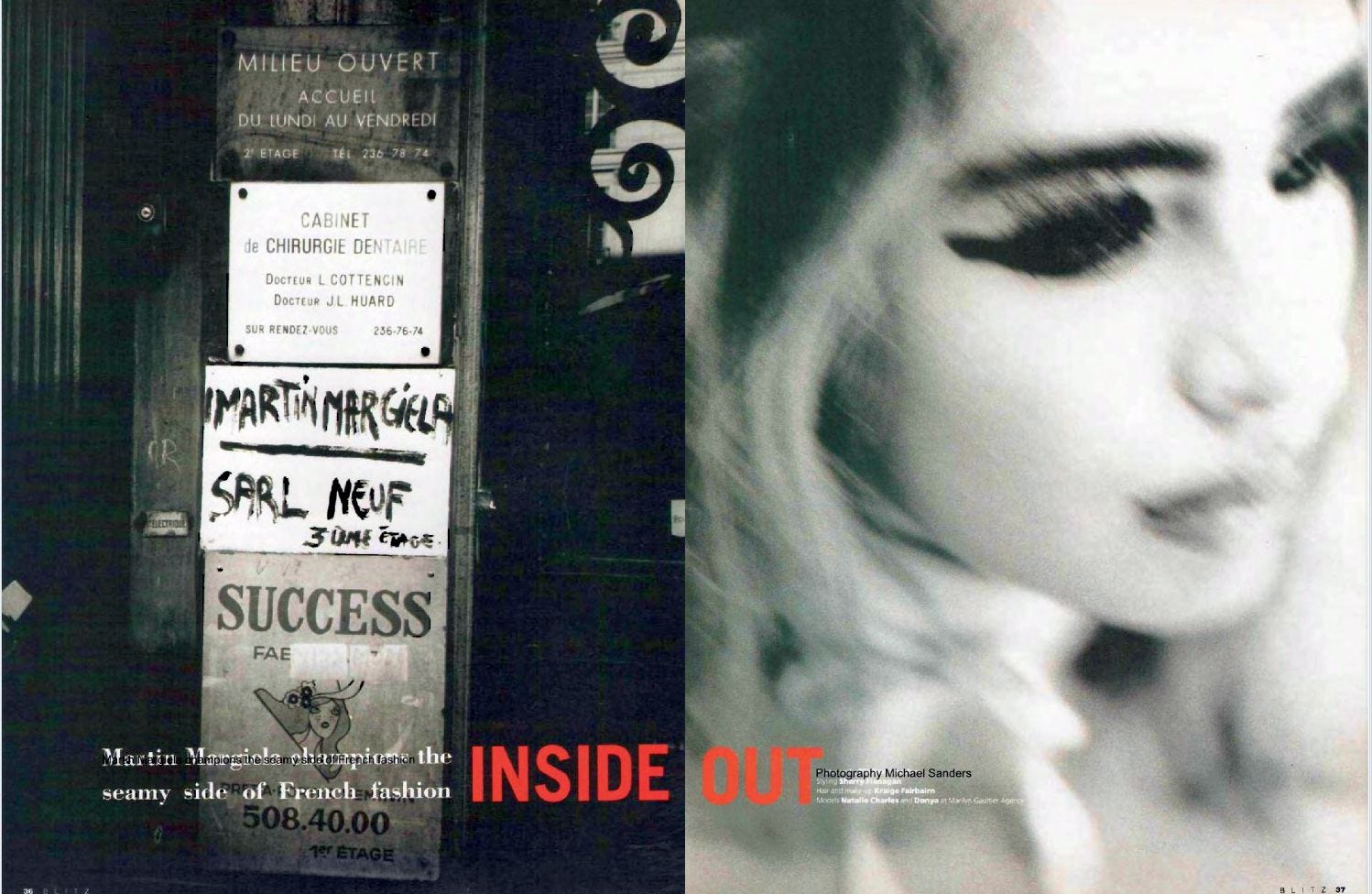
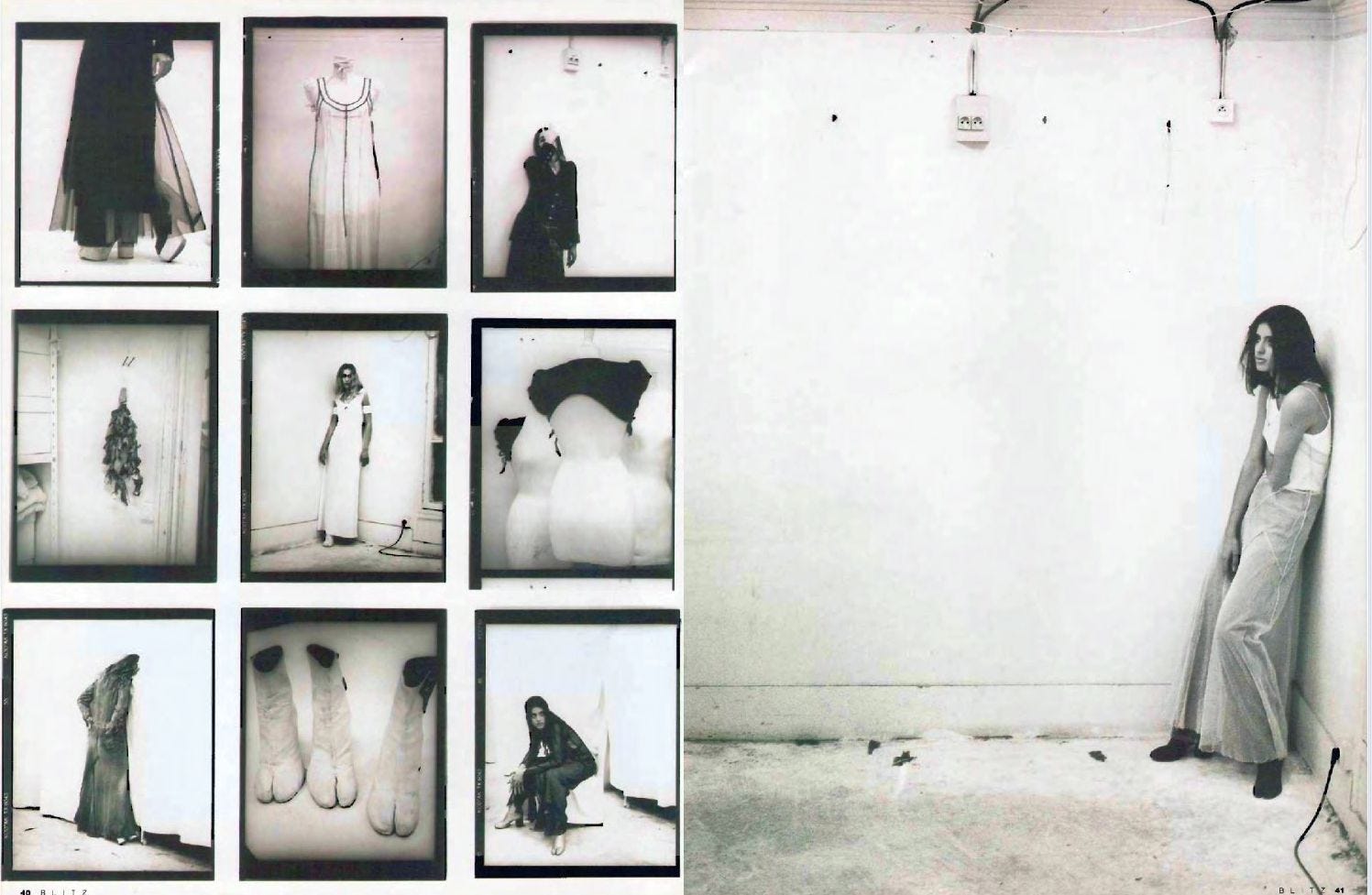
Early UK exposure is difficult to track down. The Guardian has him for a ‘society tip’ in 1990, and there is a brief report from the March 1990 show in Paris (this is actually Margiela’s fourth show) with the label of “abattoir chic”. His name is absent, or at least elusive, in 1991. Of the alternative style magazines, only Blitz (issue 98, March 1991) turns up an early result. Margiela is remarked upon as having caused a storm in Paris with his A/W 1989 collection, though at this time he has no retail outlet in the UK. It is interesting that this collection is remarked as being the first collection to show, whereas historical research suggests it was his second. The third show, in October 1989, would be the show that goes down in history.
There is a feeling, possibly a hope, that Margiela’s apparent deconstructive efforts and anti-glamour will signal an end to clothing that reflects and affords megalomaniac designer cults. The author is careful not to attach a ‘destroy chic’ label to the oeuvre, but it feels like everything discussed and shown is heading in this direction.
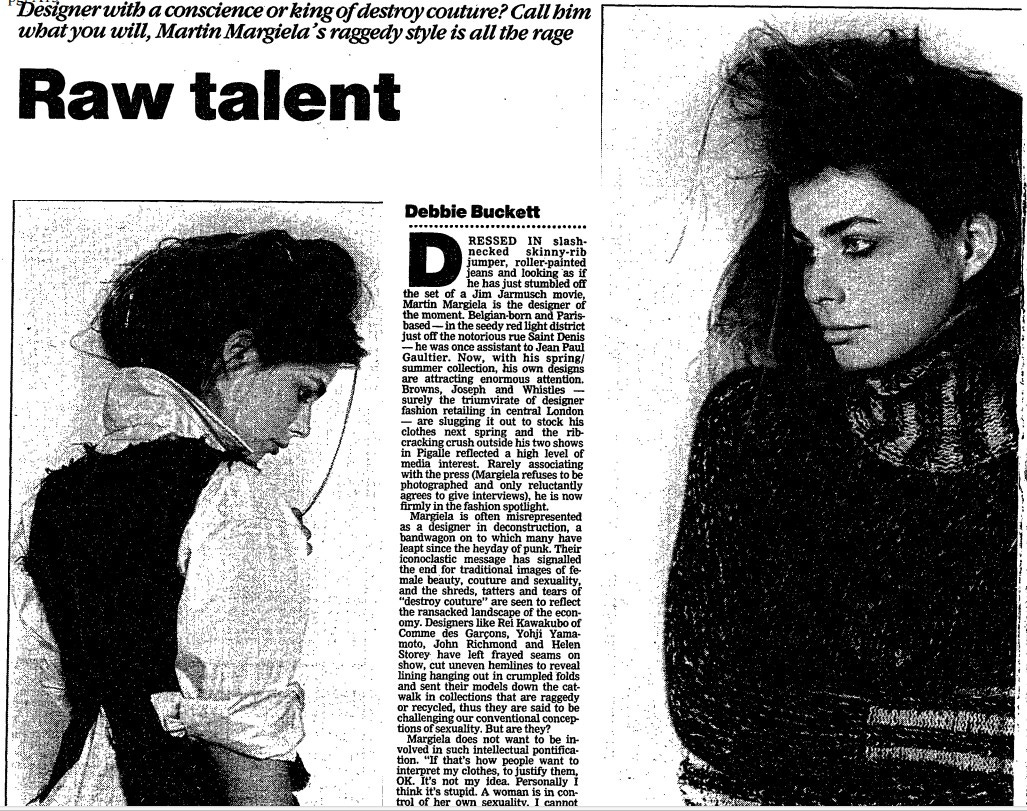
18 months later Margiela attracts the attention of the mainstream press, with a full feature in The Guardian (29 October 1992) by Debbie Buckett using the name “destroy couture”. At this point in time there is a three-way battle between high-end retailers Jones, Joseph and Browns to stock his garments. The journalist brings up the idea of deconstruction but is quick to impress how Margiela deflects the accuracy, validity or even point of any interpretations of his work. Furthermore, deconstruction is treated here as a literal thing rather than a critical and philosophical process (the misuse of deconstruction will be discussed again). The article concludes with a reflection on Margiela’s dalliances with extreme poverty – in terms of his situating shows in down-and-out locations and conjuring up ragged, reworked and disintegrating garments – asking whether he is just “peddling poverty at a price”. It is the haunting of the gestural once again.
A later Guardian feature from 1997 by Susannah Frankel introduces a literary fugitive angle, regarding Margiela’s apparent refusal to be photographed and his reluctance to speak on behalf of the design house. Frankel suggests a parallel to the famous/anti-famous author Thomas Pynchon, with Margiela setting new standards for stubborn anti-celebrity within the fashion design sphere.
It is worth staying with this idea of the invisible figure striving to both assert ideas and detonate the “death of the author”. For example, the murkiness of the origins for the Antwerp Six would suit Margiela, and he added a personal blurring and background-dwelling to the mix. His own relationship to time and visibility defines his work and legacy, even if this relationship tries to escape a temporal framing with attendant moments of visible capture. The designer strives to annul this. There is the incredible effort made by Margiela to inhabit a radical asynchrony, what we might consider as being atemporal – nothing less than a refusing to exist in the now.
For many years this strong myth perpetuated; that by sheer effort it was thought that Margiela remained, as an individual or rather a celebrity-to-be, unrecognised. He has never undertaken an interview, never made himself known in public (including during the Margiela brand fashion shows), and there are few known photographs of him beyond the inaugural shows of 1989. He emerged and then instantly began a process of erasing his identity. This outset elusiveness is signalled as early as 1991 in the Blitz article. Of course, in the Warholian sense that defines our age, he is famous, and all commentaries on Margiela dwell upon this paradoxical assemblage.
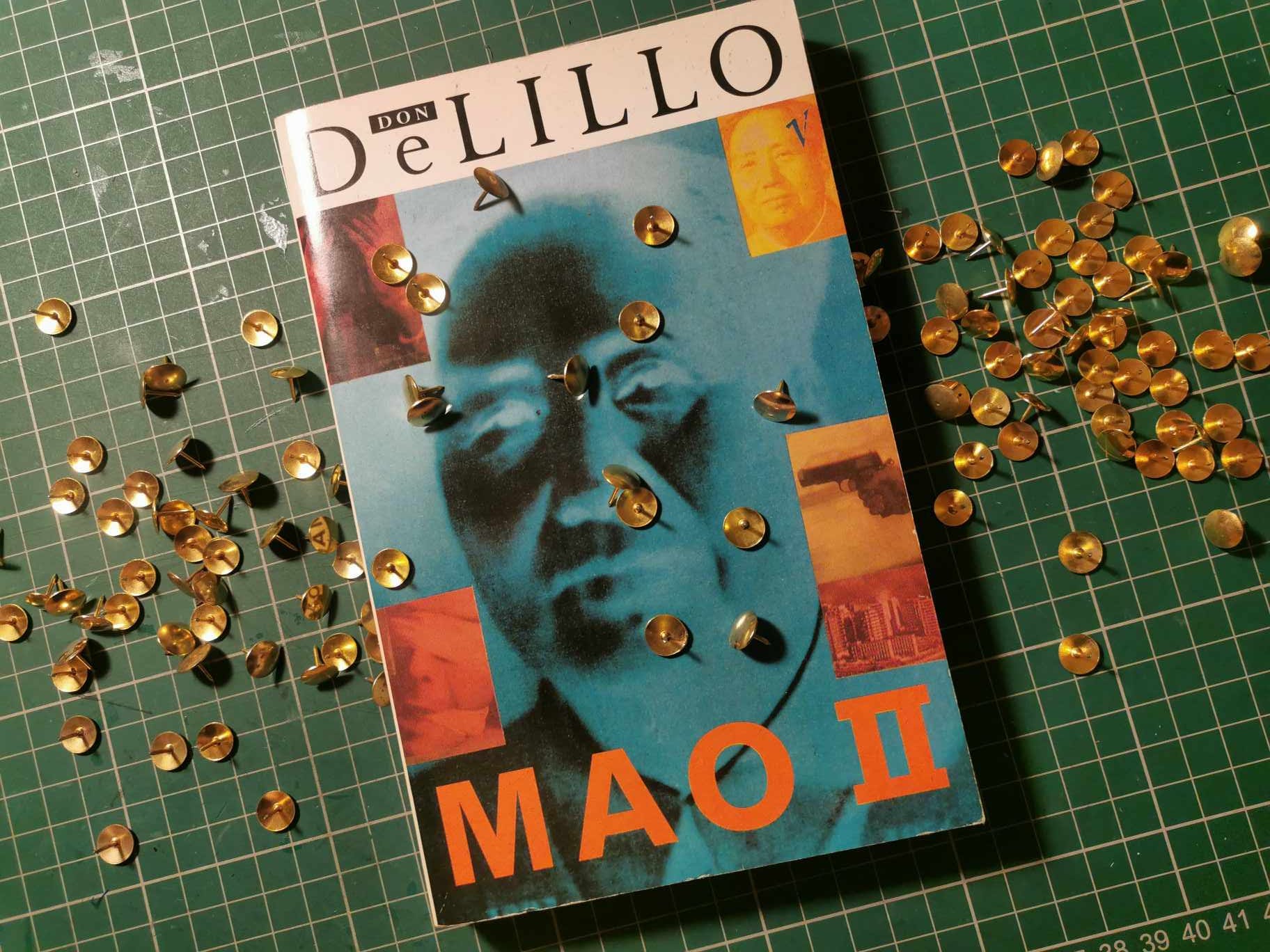
Margiela’s clothing was certainly radical, and so maybe this disciplined anonymity was a necessary frisson to put the icing on the cake, upscaling a fashion product into a wider concept. Rather than evoking the author Pynchon, we can think through the equally cryptic author Don DeLillo, who resides as a kind of dark symmetry to Pynchon. Margiela channels the character Bill Gray in Don DeLillo’s influential but typically elusive and cryptic 1991 novel Mao II, itself titled in reference to Warhol’s silkscreen series on the revolutionary (as) celebrity. DeLillo’s protagonist Gray anguishes over breaking cover and having himself photographed, musing on the reversal of roles between writing as statement making and terrorism. A pseudo-autobiographical meta-narrative hovers in and out of view as DeLillo and Gray’s characters blur as a kind of author-projection of wishful thinking.
In the narrative arc of the novel, Gray disappears from the cultural and literary world to cross over into… something else. Gray, grey, gone. As an example of life imitating art, Margiela left the fashion industry some years ago, into (a different) something else [possibly, but we do not know]. Margiela is gone but his brand continues due to the inertia of a corporate takeover in 2002. Such inane logic of a creative person being replaced by the (aura of the) brand that they created would appeal to Margiela (and no doubt DeLillo/Gray).
The figure of Margiela also informs a parallel modern literary arc, through the trilogy of novels by critical sci-fi writer William Gibson – Pattern Recognition (2003), Spook Country (2007) and Zero History (2010). In contrast to Gibson’s more overt sci-fi and cyber-punk novels, this trilogy (sometimes afforded the name ‘Blue Ant trilogy’) mines the post-millennial subcultural niches, seeking out acts of authenticity, illicitness and mystique. Clothing design and an accompanying elite desirability run as a background theme throughout the novels, culminating in the final novel with a mystery brand entitled Gabriel Hounds, whose designer (as with Margiela) remains anonymous and unclaimed in the world of prolific visual culture.
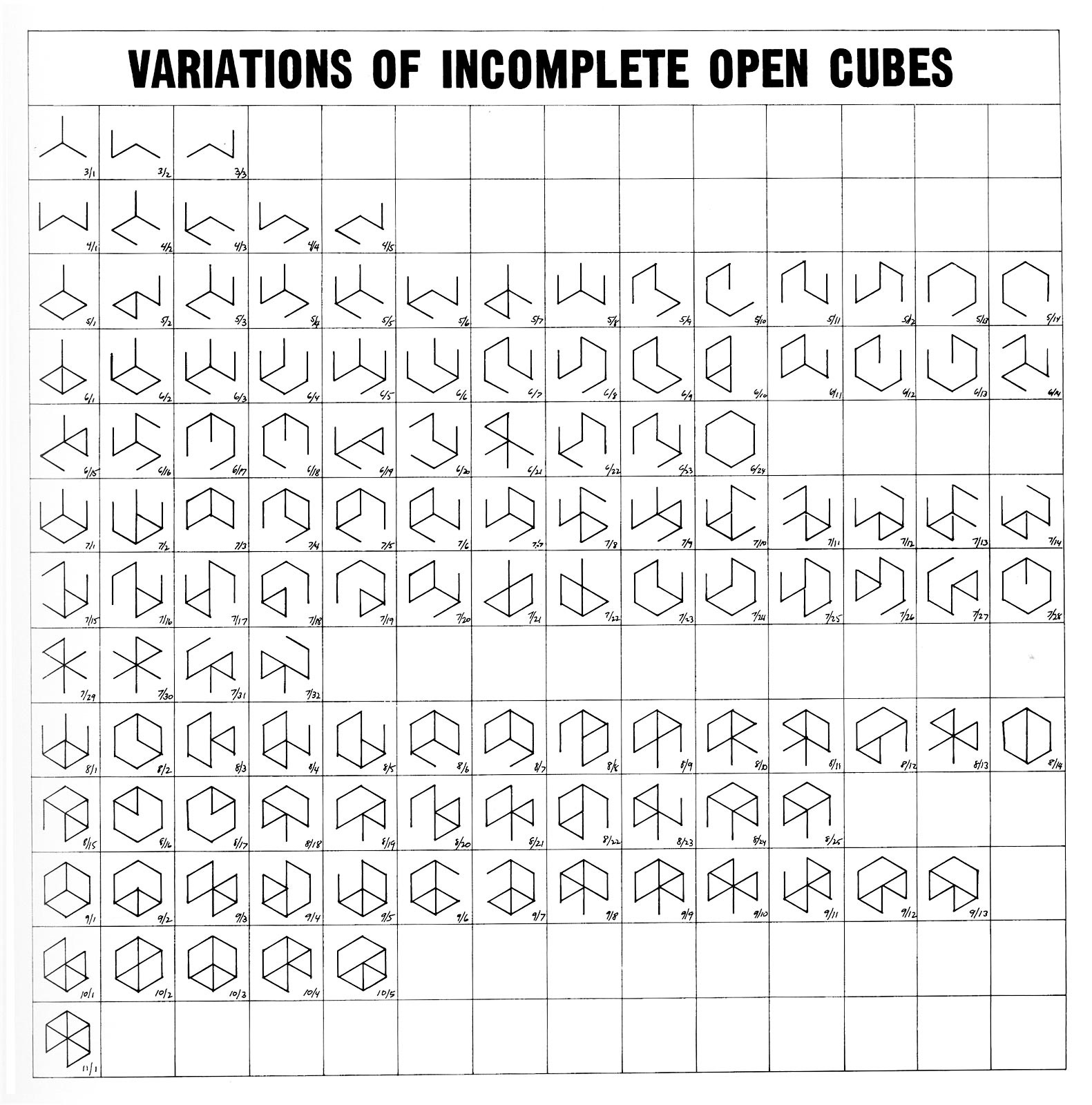
Margiela introduced a system for identifying his clothing rather than a direct branding and/or logo. Clothing had a simple number array from 0 to 23 arranged in a three-row grid, connoting the conceptual mathematical art of Sol LeWitt. A simple ontology is introduced whereby the circled number represents the strand of the collection, for example ‘10’ for men. This label is anchored to the garment on the four corners with thick white cotton thread, such that (on unlined garments) the obverse of the anchoring is seen as four flashes of white thread pointing inwards from an invisible rectangle. This discreet and secretive methodology, a code for those in the know, ironically plays on the appeal of branded clothing – something that the author William Gibson freely incorporates into his characters’ traits.
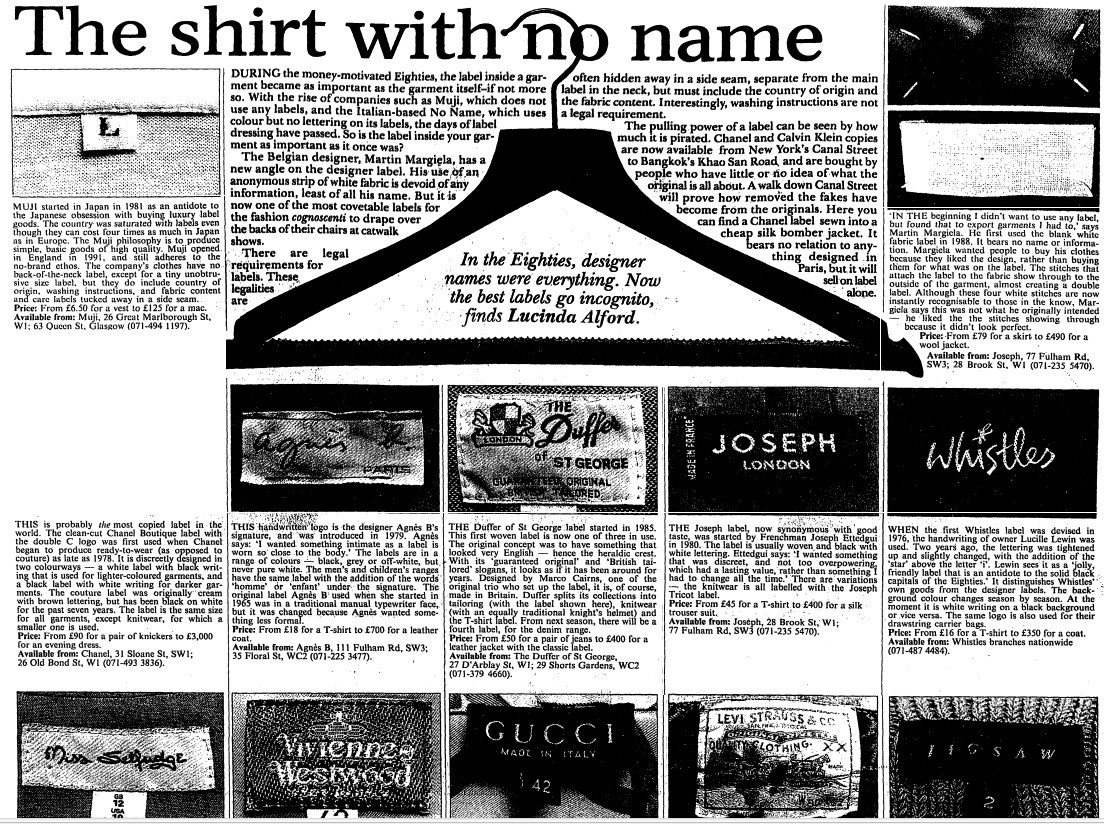
Margiela’s quasi-anonymous labelling formed the basis of another Guardian article (9 May 1993). The article jokingly illustrates the dilemma of a designated anonymity, the impossibility of saying “this is the empty set” by placing a statement of emptiness in the set. Margiela offers a retort by saying that the four stitches are intended to signify imperfection rather than covert identity. The article also looks at faking of labels, and it also appears that my archival reproduction ironically has the Chanel logo blanked out.
Fashion theorist Barbara Vinken calls this prioritisation and identification of label a griffe, a signature that hooks in the consumer, arguing that in post-fashion (her term for the contemporary movement of fashion) the reversal of labels advertising clothing is achieved: the clothing becomes an advert for the signature label. It playfully hints at the quixotic nature of Naomi Klein’s No Logo proposal, trademarking the attempt to signal invisibility or even nonexistence.
The mythical clothing labels in Gibson’s trilogy – some of which are never proven to actually exist within the context of the novel – are also defined by their plain character. Gibson takes the somewhat easy and unimaginative option of having these mythical and much sought-after labels create clothing that blends utilitarian non-specificity with military practicality and durability. This could be thought of as playing on the late 1990s fad of supermodernism carried through by labels like Griffin, Maharishi and Mandarina Duck, possibly more so with obscure millennium labels such as Undercover and Number (9), or some of the new techwear labels such as Acronym.
Anyway, this introductory essay was intended to simply introduce the designer via a short musing on Belgians-as-pop-culture in the 80s. I have gotten carried away and started to consider contexts such as atemporality and intermedial fiction. Plus I’ve evoked the spirit of the situationists which is never a good idea. The next essay looks at some other contextual frameworks for Margiela drawn from philosophy and art criticism.
this was so good