
Tough Futures
1978, post-punk and the evil twin of synth-pop

In spring 1978, three independently-released 7” singles set out a possible blueprint for a synth-pop still to come, simultaneously astounding and confounding critics in the UK music press. Electronic music via affordable synthesisers was stirring interest, as restless experimenters with iconoclastic intent began to raise their heads above the parapet of punk, prog and everything else. There were rumblings at the end of 1977, with Sounds publishing its perceptive two-part series ‘The New Musick’. This collaborative feature utilised newbie journalists such as Jon Savage and Jane Suck, recruited through the artier end of punk fanzines as a necessity for something yet to be named (as post-punk) was pulsing at the surface. However, the more workaday journalists of the UK music press were less open to ontological challenge, and electronic music that steered away from a grandiose prog pomp was generally anchored to either the European sweep of Kraftwerk or the US scuzz of Suicide. Maybe even an awkward tangent of disco. This trio of records was something markedly different, or perhaps a bit of everything yet different at the same time. And there was a portentous sense of doom and foreboding – but not in prog way, not grandiose and melancholic in equal measure. This was like a series of swift knife actions, a repetitive stabbing executed at close quarters, whilst laughing.
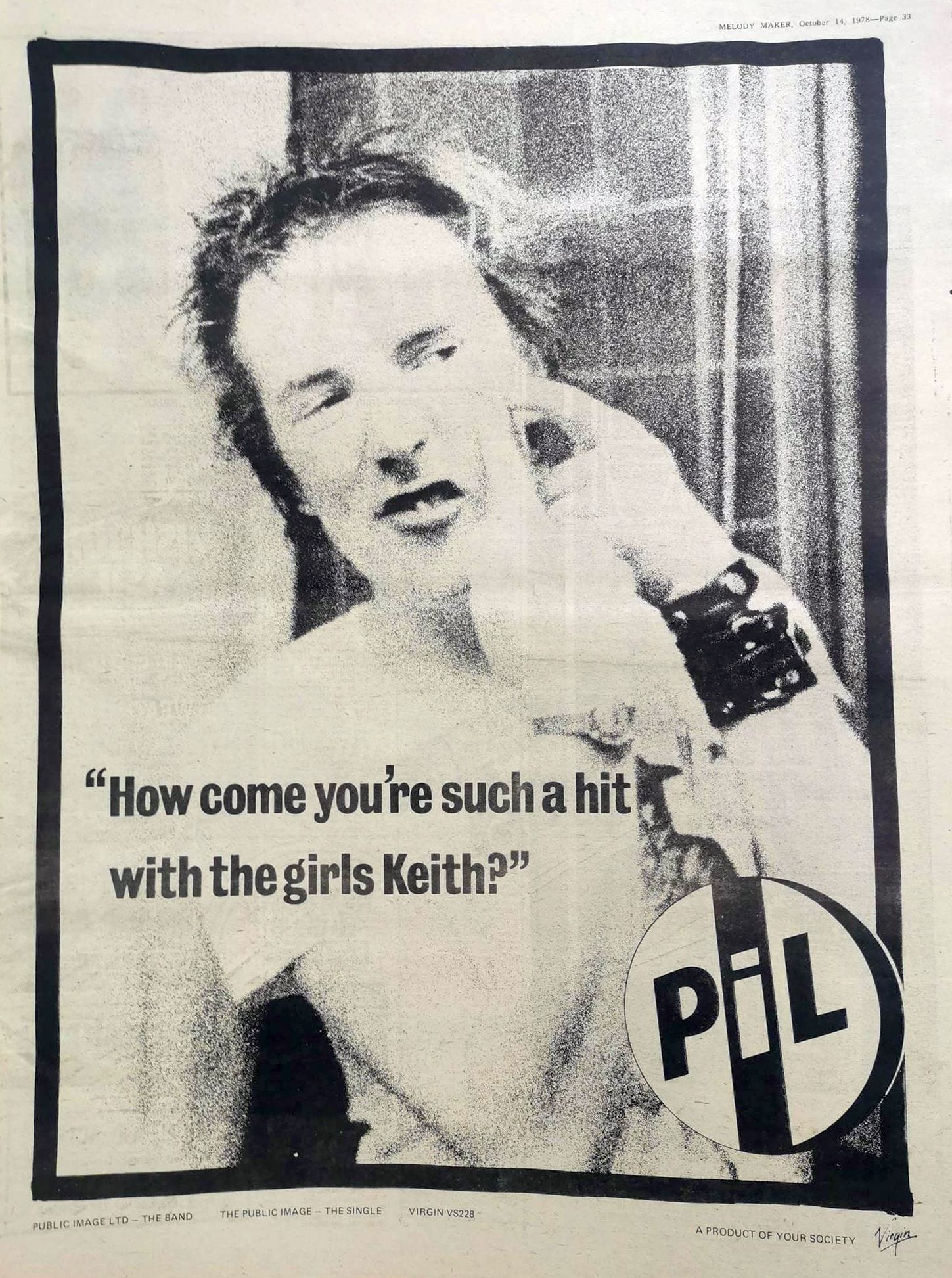
1978 is nominally acknowledged as the start of post-punk, in both a negative sense (Sex Pistols imploding after their ill-fated tour of America in January) and a positive sense (the founding of the Rough Trade label with arty Parisian electro-punks Métal Urbain at the outset of the year) but there was an air of recalcitrance as to what to do next. For example, Lydon’s new project PiL were still promoted in a punk vein, pictured popping spots, swigging cans of lager and ejecting a faucet of piss-poor lager captured by photographers as a perfect arc like an imprimatur of punk’s token shock tantrums. Virgin were hedging their bets, hoping to appeal to Pistols fans. Released in October 1978, their self-titled debut single - although musically removed from a punk blueprint and very much a post-punk moment - was more a cri du cœur or exorcism of Lydon’s manipulation under McLaren.
But other things had stirred in 1978, before PiL authenticated a putative genre. Like the proverbial glut of buses that arrive after a long wait, 7” singles from The Normal, Throbbing Gristle and the Human League landed with an uncanny sense of shared spirit and aesthetic. We have come to know this sound as synth-pop, a portmanteau which combines a mode of instrumentation and a (subverted or otherwise) pop form, though there is a further element in the mix. Post-punk DIY spirit informs these records, from deadpan vocal delivery, a fixation on boredom, to archly packaged exteriors. For example, label names – Mute, Industrial and Fast Product – emphasise the mundane and an ironic anti-business perspective. In addition, all three records explore literary, art and philosophical angles from dystopian authors (J.G. Ballard) to occultists (Aleister Crowley), with the discomforting presence of Andy Warhol’s 1962 Death and Disaster series looming large with electric chairs, assassinations and car crashes as image fodder.
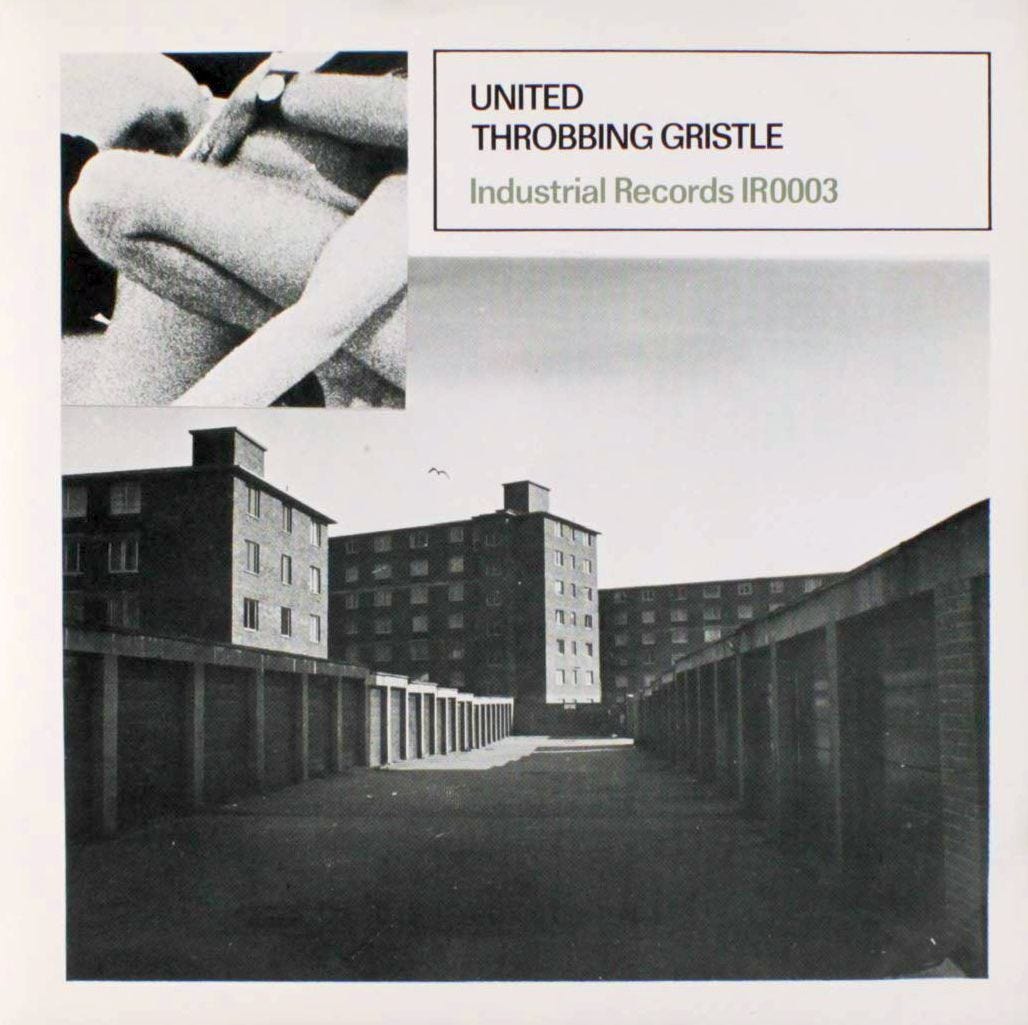
The record sleeves are split between Letraset assemblages hijacked by delirious town-planners and sinisterly ambivalent photographs. For example, the Human League’s ‘Being Boiled’ utilised a Letraset assemblage and a couple dancing alongside an undulating skyscraper-scape, borrowing from the post-Pop architectural designs of the Independent Group crowd. The Normal adopt a similar stance with stencils of ‘normal’ living inserted into line-graphic television frames on the sleeve reverse, and an unnerving crash-test image dominating the front of the sleeve to assert the Ballardian overtone. The sleeve to Throbbing Gristle’s ‘United’ depicts a row of garages and a brutally lit and de-peopled housing project, with an inset photograph of tangled limbs. Its flipside has a band member bowed down under a shower and an inset photograph of Zyklon B gas, a morbid holocaust denotation just in case the connotation of the front isn’t subtle enough. The etched run-out grooves of the Human League single declare “insurgent pop” and “resistant product”. Everything has a rebus element, and subversive devices are employed on every surface. The mundanity of the everyday is blurred with the horror of genocide, murder, self-immolation, famine, and on and on.
46 years later these three records, and their six tracks, still have a quality that stands outside of time. It was a synth-pop that had never existed, and perhaps equally so a synth-pop moment that was never quite repeated in its stark and twisted nature. How was this perceived at the time?
Exhibit A: The Normal
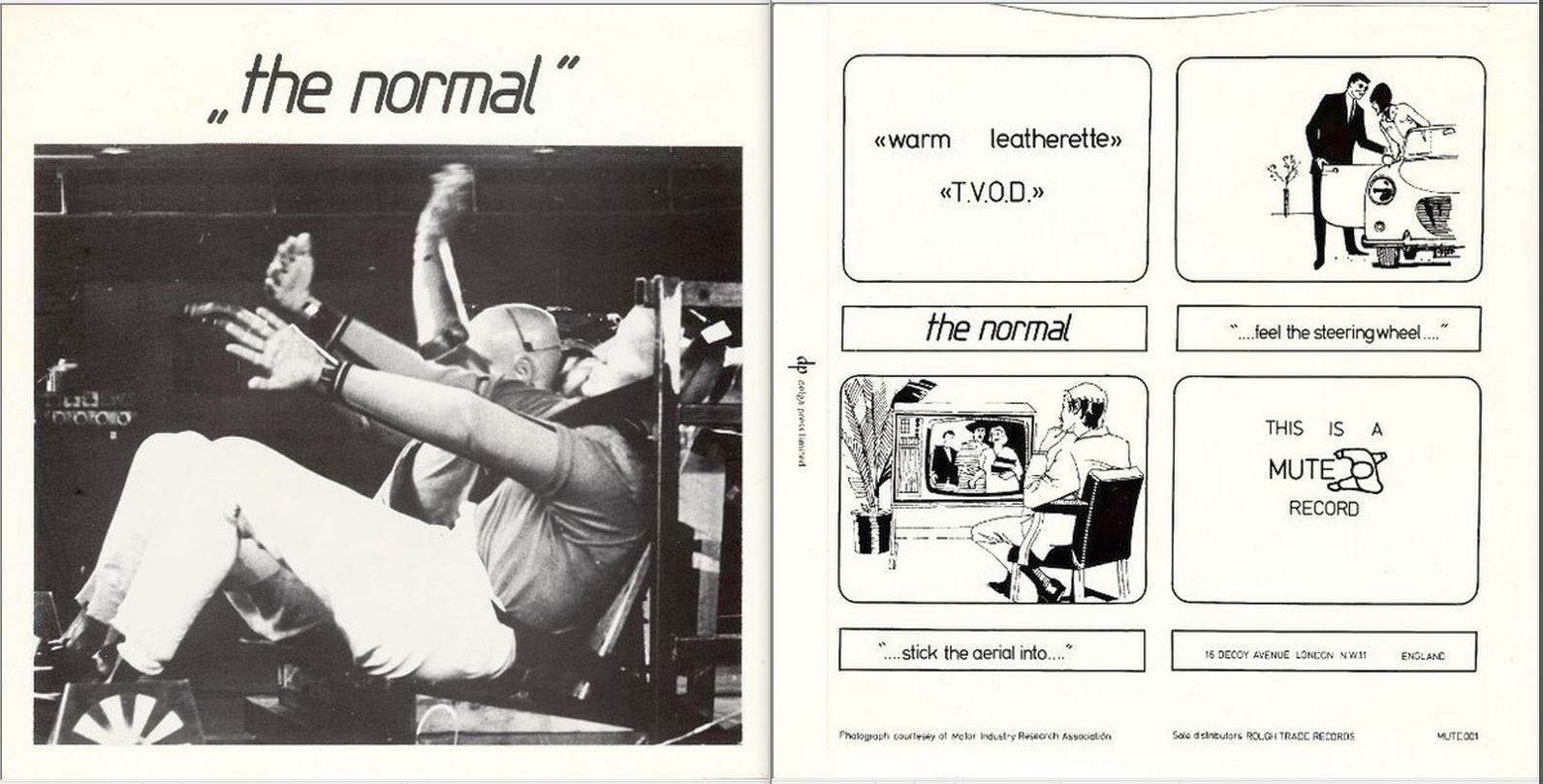
Taking these records in the slight chronological order they arrived, we start with The Normal. Seemingly arriving out of nowhere, The Normal’s debut single ‘Warm Leatherette’ / ‘T.V.O.D.’ broke cover in early April 1978. The subject matter switched between Ballard’s 1973 novel Crash and the joys of mainlining a TV by sticking an aerial into your arm. Sounds journalist and punk zine writer Jane Suck had chanced upon it at Rough Trade and had one of those ‘wow’ moments. She feverishly reviewed it as a pre-release, proclaiming it as the single of the century, with a “Kraftwerk style disco psycho moon stomp”. A month later on formal release and the tracks were too much for Melody Maker’s Ian Birch who was struggling to find reference points. Writing in NME, Andy Gill offered a description as a more accessible take on Cabaret Voltaire (though that band were yet to release anything, and so it was very much an ‘in-the-know’ reference point!).
It is a record that has never gone away, whilst at the same time never breaking cover for the big time - even in the early 1980s when anything synth-pop was being aggressively remarketed and consumed. Its harsh construction and dark subject matter have seen to this perpetual underground, or at least crepuscular, status. It is, when deconstructed and listened to hard, a brutal record. The industrial music academic S. Alexander-Reed in his chapter in the Mute records monograph is unsparing as he pulls the track apart in what seems as an act of aural and mental self-flagellation. It becomes an exercise in boredom, seen by the author as a preset to the decade of the 1980s to come. Boredom would resurface as a combined theme and mode of construction in later records by Throbbing Gristle, with tracks such as ‘Five Knuckle Shuffle’.
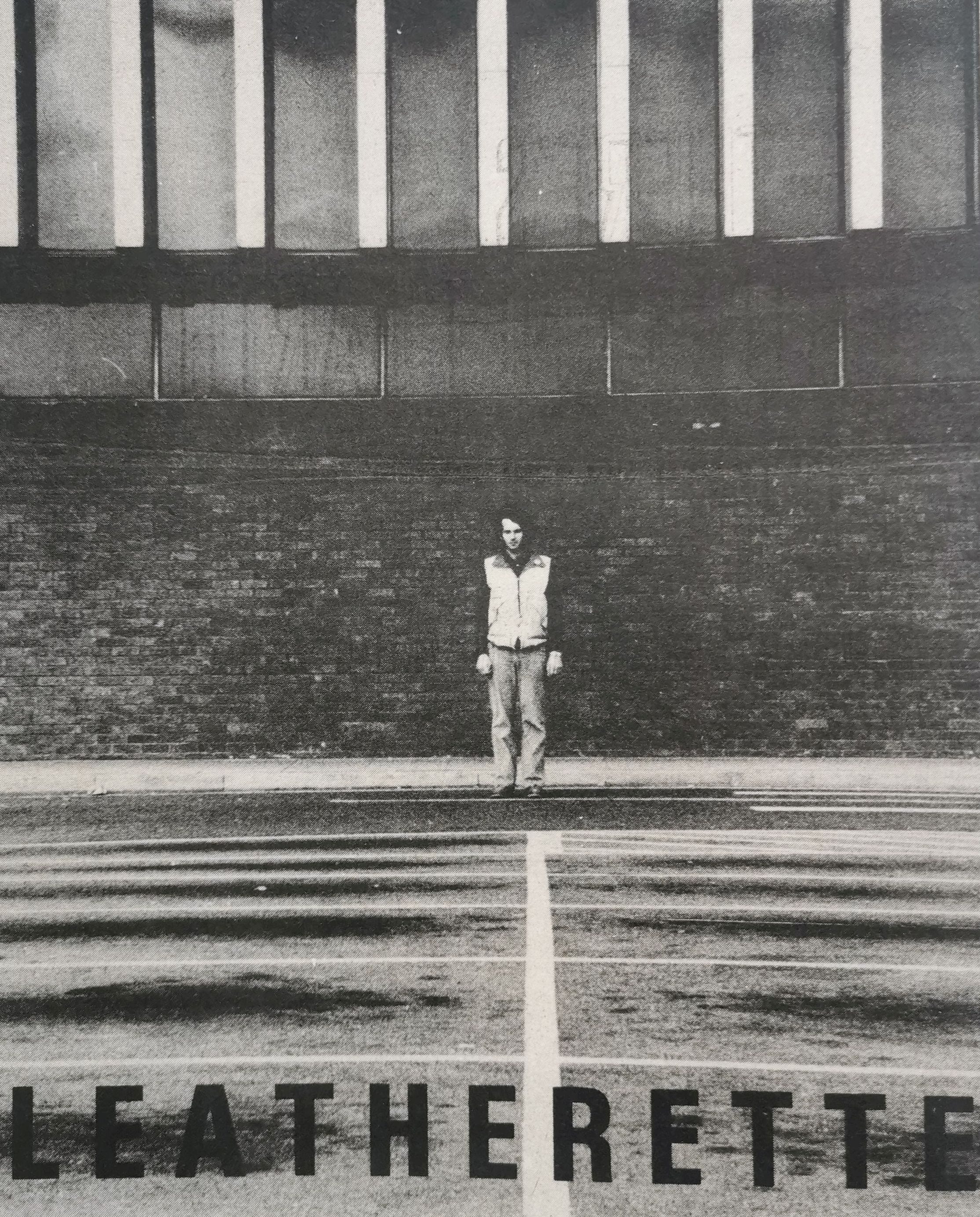
Unsurprisingly, The Normal’s first feature was in Sounds, later in May and penned by John Gill. The project was revealed to be the work of Daniel Miller, who had previously worked in film editing and had a passion for Krautrock and the DIY punk aesthetic now re-routed through newly affordable electronics. The article included an artfully composed photographic portrait of Miller (by sleeve designer Simone Grant) incorporating a clever geometry of foreground horizontal lines (car park bays) and background vertical lines (stanchions on a modernist building) resembling the ‘hold controls’ on a TV. It is taken at the concrete utopia of Brent Cross. In the article Miller explained how he was driven by using sounds to conjure someone else’s images rather than making a fashionable “utilitarian muzak” such as encountered in shopping centres or office blocks.
Exhibit B: Throbbing Gristle
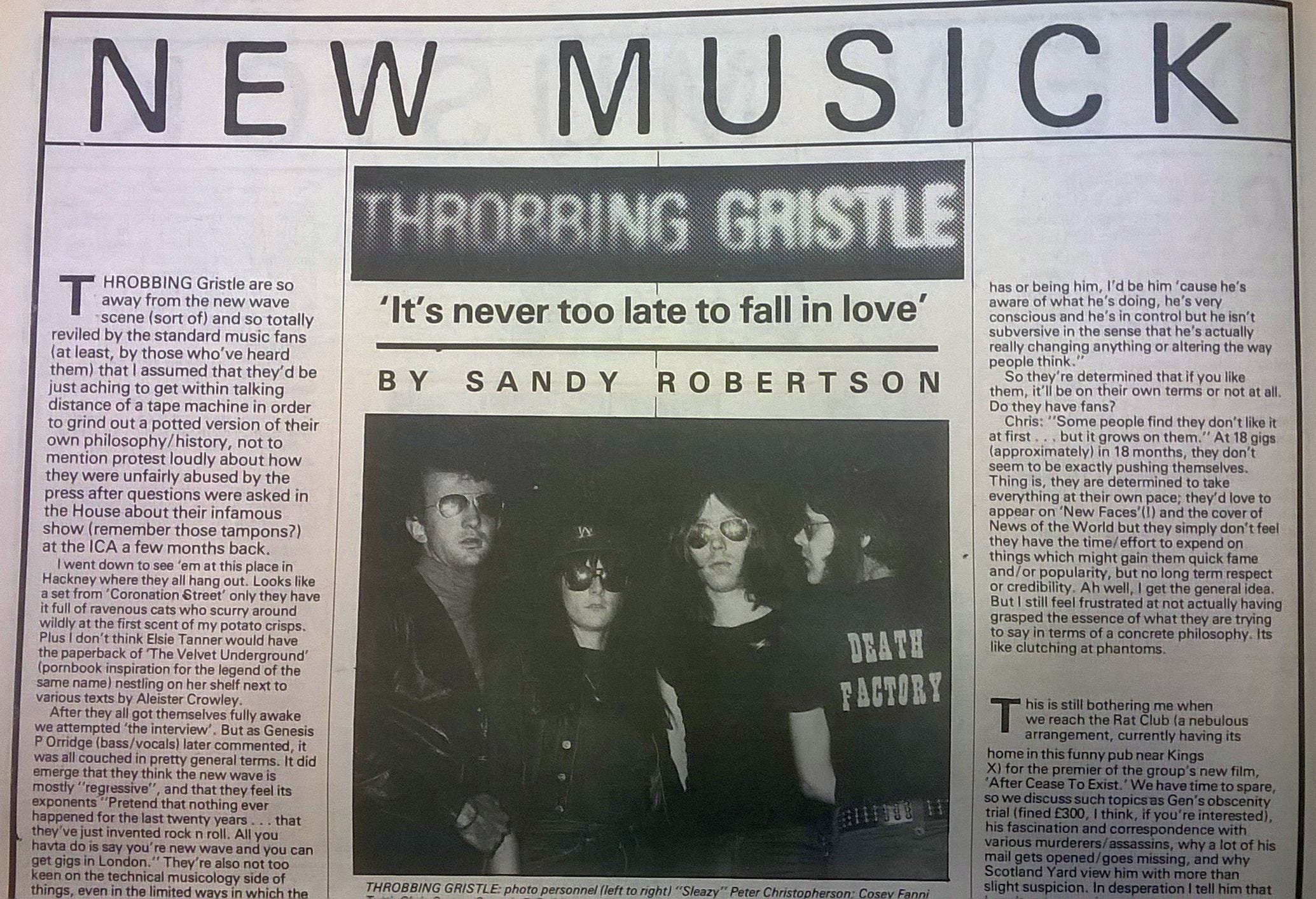
Throbbing Gristle should not be considered here. They were not nice, and the records they made were not nice. Pre-dated by the radical performance art group COUM Transmissions formed by Genesis P-Orridge and Cosey Fanni Tutti who channelled the degraded ‘Actionism’ of Vienna long before Midge Ure rebranded the city with runaway horses and dry ice, Throbbing Gristle were formally inaugurated in mid-1975. Ultimately operating as a quartet, oftentimes more so as a covert team of specialists trained in some as-yet-determined dark arts, they were boosted by the addition of Chris Carter who brought in an electronics genius and Peter Christopherson who channelled his dank, prurient interests through surreptitious sampling and defiled field recordings. Strategising approximately and unevenly on the opportunities opened up by the nascent punk scene, they burst into the public eye in October 1976 with a controversial performance at the London ICA. After spending 1977 wrestling to illustrate the strictures and limitations of punk, they moved to focus on a new sound that was christened as industrial music. Their debut annual Second Annual Report documented this struggle by gathering sequences of live excerpts presented as a subversive and secret company document, and circulating as much by word of mouth in late 1977. They had already featured in the Sounds ‘The New Musick’ feature, refusing to fit into compartmentalisation, so their next move was a bit of shock.
Landing in May 1978, Throbbing Gristle’s ‘United’ offered up a superior synth-pop moment courtesy of Chris Carter’s electronics skills, gathering elements of the industrial force (or ‘Tesco Disco’) that the band had assembled through 1977. As stated, Throbbing Gristle were not nice, either as individual components or a collective endeavour, although ‘United’ disguised itself as (perhaps) approaching nice. This ‘niceness’ would be Carter’s input, while the rest of the band pick away at structure adding mistreated guitar stabs, samples and noise, and a lyrical narrative that suggests on the surface the usual inane glibness but quickly reveals something else. Structurally and sonically, ‘United’ builds from a muted 4/4 beat and hisses of compressed air escaping, to sequence in squalls of synth bursts (said to be the sound of a Coke bottle having its lid flipped off) and P-Orridge’s oh-so-deadpan vocal.
The single acquired a clutch of strong reviews, making single of the week for NME as a “simpleminded dance tune with a hook that’s impossible to fight off”. Though the reviewer is cautious of assigning this accolade, admitting that the band had spent “many years of being dismissed as upstarts on the lunatic fringe of the Arts Council empire” and are normally known to be “metronomes […] propagating white noise”. Others who knew TG and their confrontational and non-conformist ways were cautious at the gloss, cottoning on to the tactic that subversion works best within “hummable melodies”. As Jon Savage eulogised in his review for Sounds, it was a “near perfect synthetic mantra to dance at dawn to or to chant on the terraces”. The notion of the football crowd - also incorporated as a hand-clap intro in TG’s 1980 single ‘Adrenalin’ - was a mischievous ruse. It mocked punk’s own attempts to attach itself to terrace culture with bands like The Clash (who utilised football fan vernacular in both the 1977 single ‘Remote Control’ and a ‘dun-dun-dundundun’ staccato guitar in their February 1978 hit ‘Clash City Rockers’) and Sham 69 whose ‘Kids are United’ was also at large. Whereas Sham reach earnestly for a bit of authenticity, TG offer a chant of “love is the law” in the middle of the record, imagining the football crowd as an insurgent Crowleyesque body. At other points the song refers to the band becoming a blended whole, P-Orridge basing the lyric on the two mail artists Rhoda Mappo and Billy Haddock who took their togetherness into life and art, and (according to the admittedly unreliable P-Orridge) further imagined themselves in love as P-Orridge and Tutti.
It is interesting in that the music newspapers shunned reviewing, or even mentioning, the more brittle and uncompromising b-side ‘Zyklon B-Zombie’ – a vicious piece of post-Auschwitz-meets-glue-sniffing polemic that was anything but a proto-synth-pop moment (well, Jon Savage does, and admits he finds his own personal limit right here).
Exhibit C: The Human League
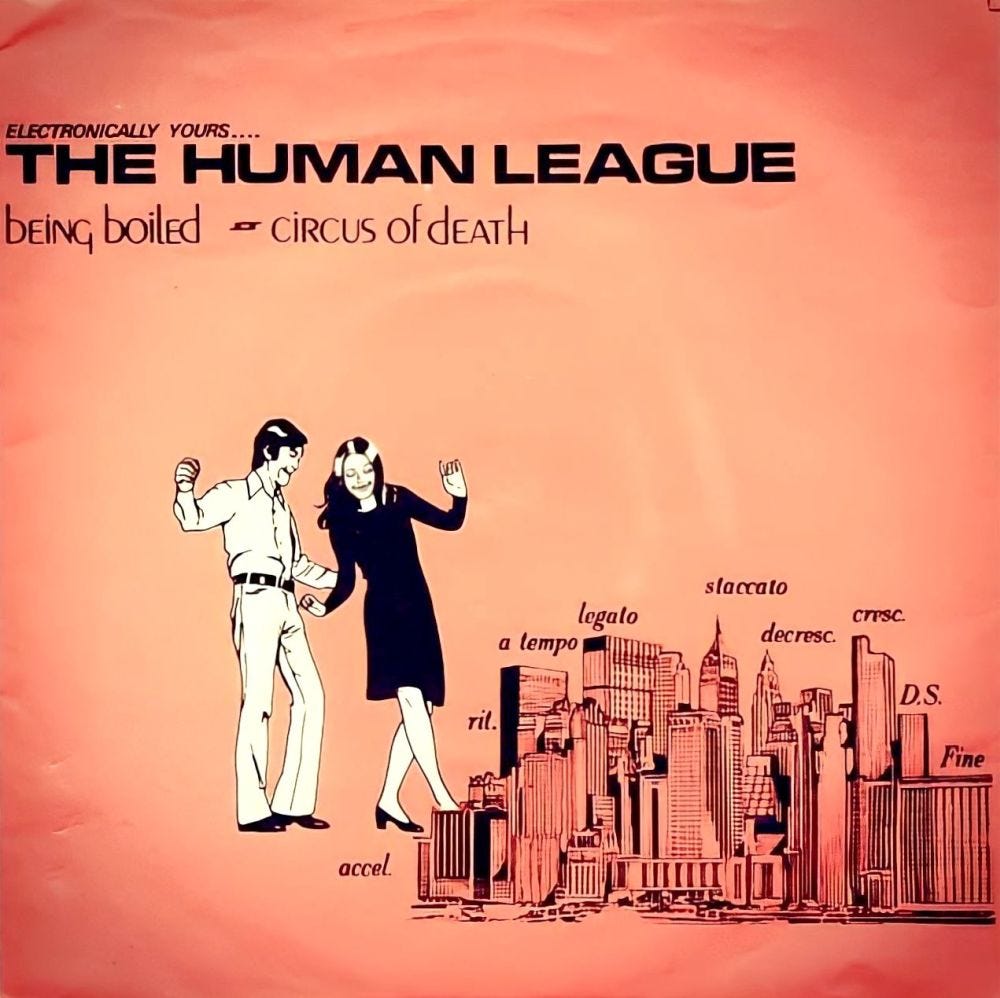
Completing the trio, the Human League’s ‘Being Boiled’ / ‘Circus of Death’, was released on Fast Product in June 1978. The lead track legendarily commences with a spluttering sequence of valves and circuits coming to life, before vocalist Phil Oakey intones “OK. Ready. Let’s do it”. Recent mythology suggests that this line was inspired by the last words of convicted murderer (and Throbbing Gristle icon) Gary Gilmore as he embraced his own execution by firing squad in January 1977. As with much of the history of the band, even blue plaques with incorrect details, it is questionable (the other suggestion is that it is a quote from the John Carpenter film Dark Star (1974) which is also sampled at the end of ‘Circus of Death’). It certainly feels like the listener is undergoing a personal electrocution, mercifully switching to a brief tribute to John Carpenter’s eerie synths before a sludgy but bombastic funk groove gives the cue for Oakey to commence his bizarre lyrics about “sericulture”. ‘Circus of Death’ is equally unorthodox, with a conceptual introduction outlining how the listener will experience the structure of the song. We then get even more abstruse lyrics and a hook that sounds like The RAH Band’s 1977 hit ‘The Crunch’ played at quarter speed, as if accompanying a malfunctioning fairground ride.
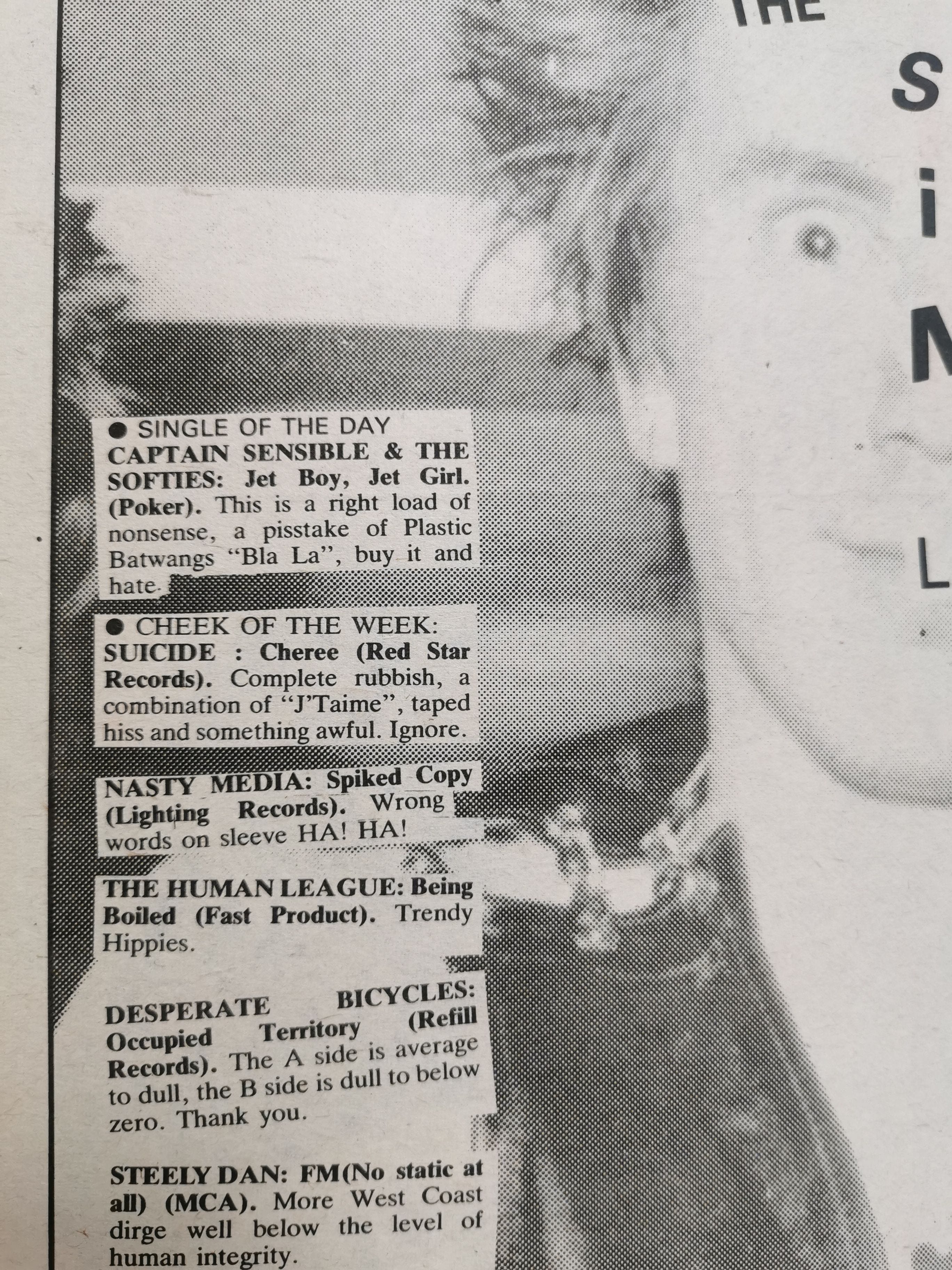
The record press were cautious, though Melody Maker’s Colin Irvin acknowledged the “heavy-heavy sinister overtones” of the tracks. Matters weren’t helped when the single was guest-reviewed by a punk-pouting Lydon in NME who resorted to the two-word put down of “trendy hippies”. Lydon and NME were still trading off a punk payola with an urchin style photograph and a thoughtless layout of ransom note lettering seemingly assembled in under five minutes. The Human League, with their wry and subversive manager Bob Last, were always playing games and gambling all out with the potential path for their own success. An early mainstream interview can be found in Chris Westwood’s August 1978 feature in ZigZag and John Gill’s Sounds feature from 12 August 1978 where we glimpse some blurred images of the band with a suitably industrial-urban backdrop. The press were clearly intrigued by the Human League, and the band were then part of an NME Sheffield feature in early September.
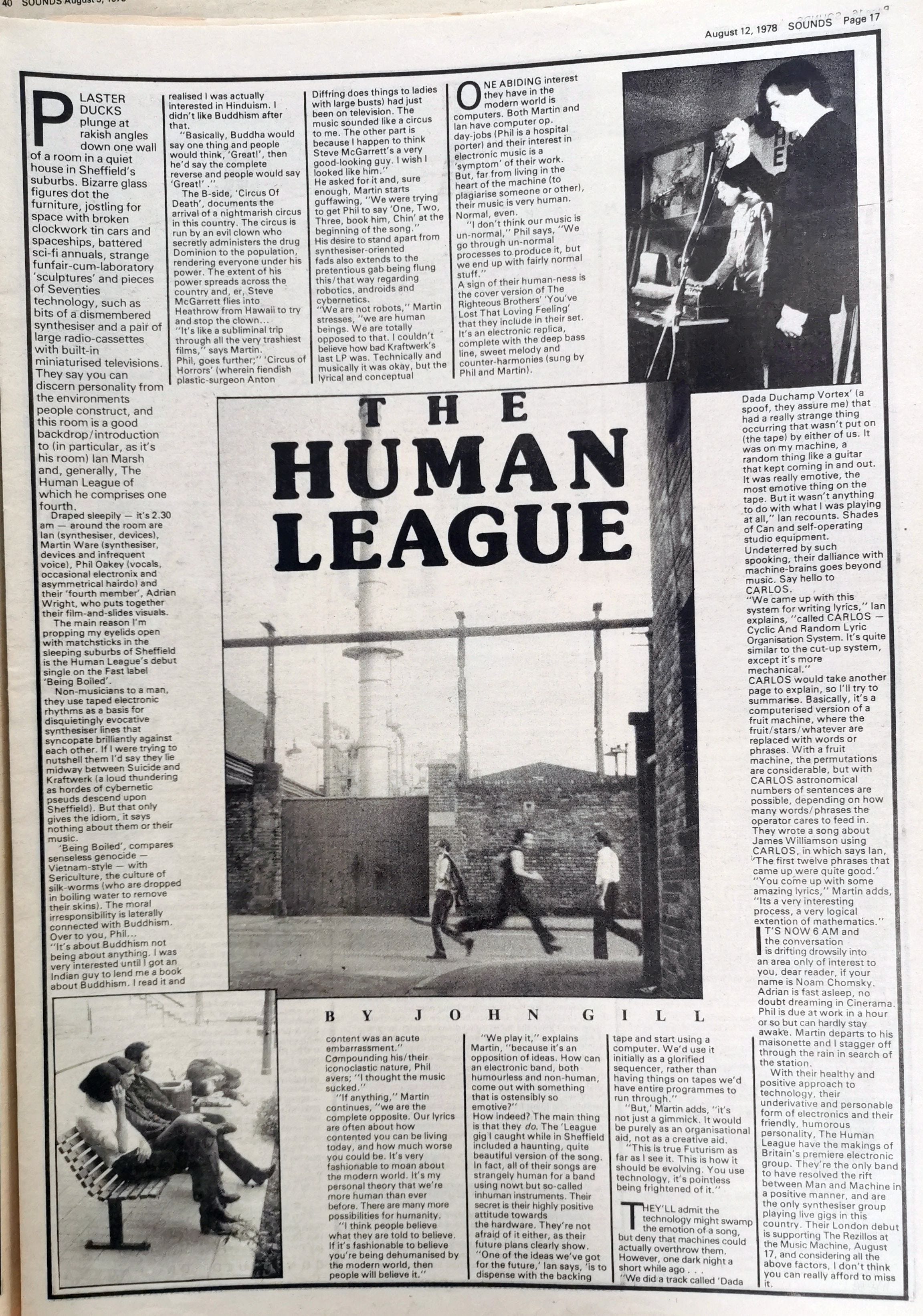
There is some playful animosity and structured distancing towards Throbbing Gristle and other bands in the scene, with Human league lynchpin Martyn Ware stating in the ZigZag article (and presumably making reference to the important ‘New Musick’ feature in November 1977 Sounds): “When we started, electronic music was ‘unknown’ in the commercial sense, but since then Throbbing Gristle and Devo and those Ohio bands have surfaced and it’s become something very hip”. Continuing in this vein, John Gill’s NME interview recounts the jokey exchange around an earlier track entitled ‘Dada Dada Duchamp Vortex’ completed when the band operated as The Future, while fellow band member Ian Craig-Marsh goes on to explain an automated lyric generating system christened CARLOS – Cyclic And Random Lyric Organisation System. This can be read as a further nudge at the Burroughs influence that informs both Throbbing Gristle and fellow Sheffielders Cabaret Voltaire, being “similar to the cut-up system, except it’s more mechanical”. Marsh and Ware were computer operators, so the story holds a semblance of truth.
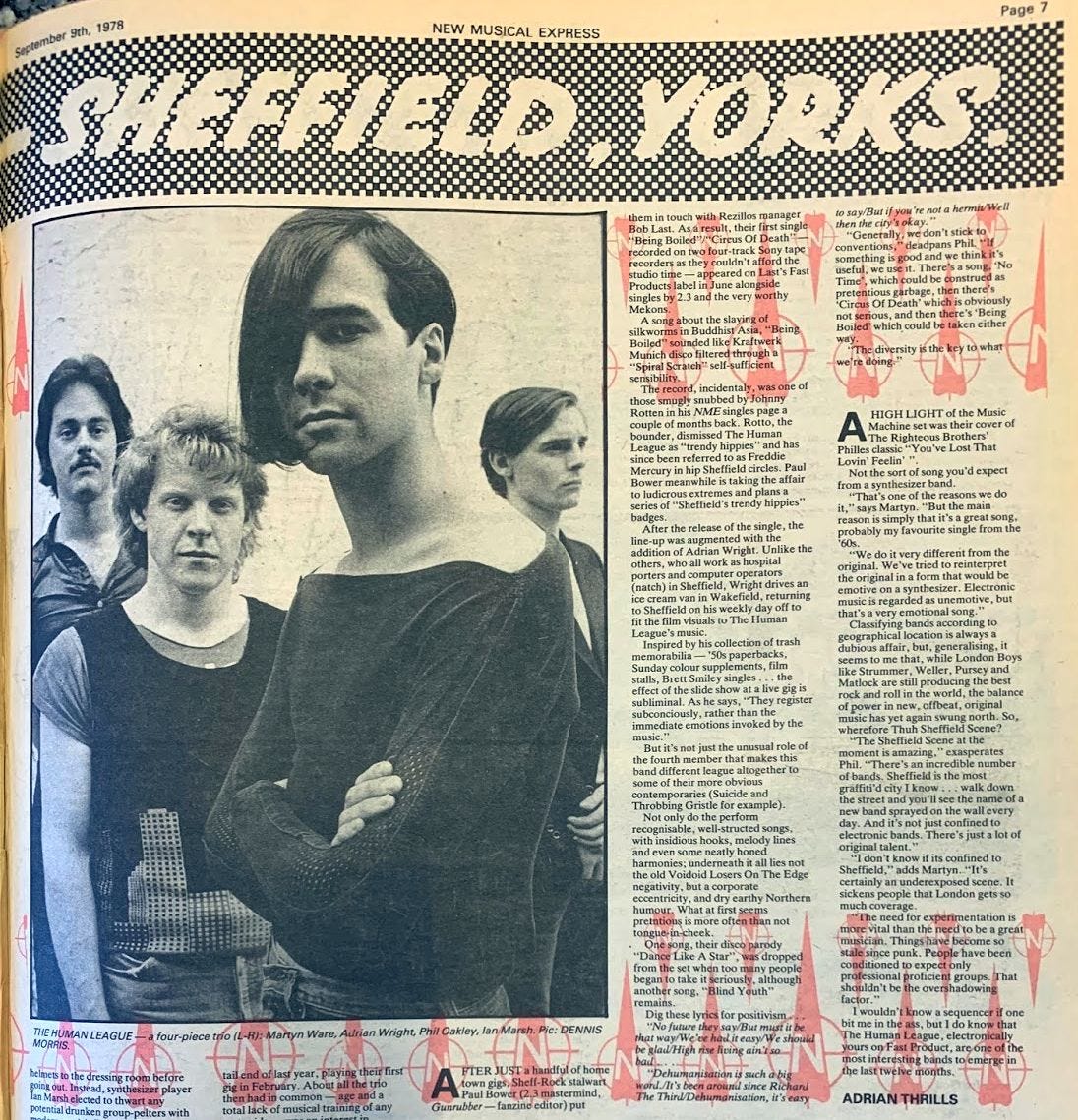
The NME Sheffield feature is premised on the city’s “rash of experimental drummerless trios”, with ex-local Andy Gill tackling Cabaret Voltaire and 2.3, and Adrian Thrills introducing the Human League. The band toy with the interviewer and typically mix sarcasm and indifference. The double-page spread is dominated by a photograph of the band with Oakey to the fore introducing the wider world to his distinctive look and haircut, soon to become an imprimatur of the city. The band adopt a stance of a small phalanx, with three members staring into the camera and Ian Craig-Marsh staring at something out of view – the classical hors champs pose of post-punk intellectualism. They are dressed in a slightly futuristic fashion and adopt a rigid deportment, giving the impression of a flight crew from Space 1999. Oakey inevitably grabs the attention, dressed in a feminine top – long-sleeved, box-cut off the neck and shoulders, with airtex adornments – and his asymmetric fringe cropped to a stylish bob. Though he fashioned himself on the science fiction writer Michael Moorcock’s polymorphous character Jerry Cornelius, he came across more a transgendered Gerry Anderson figure.
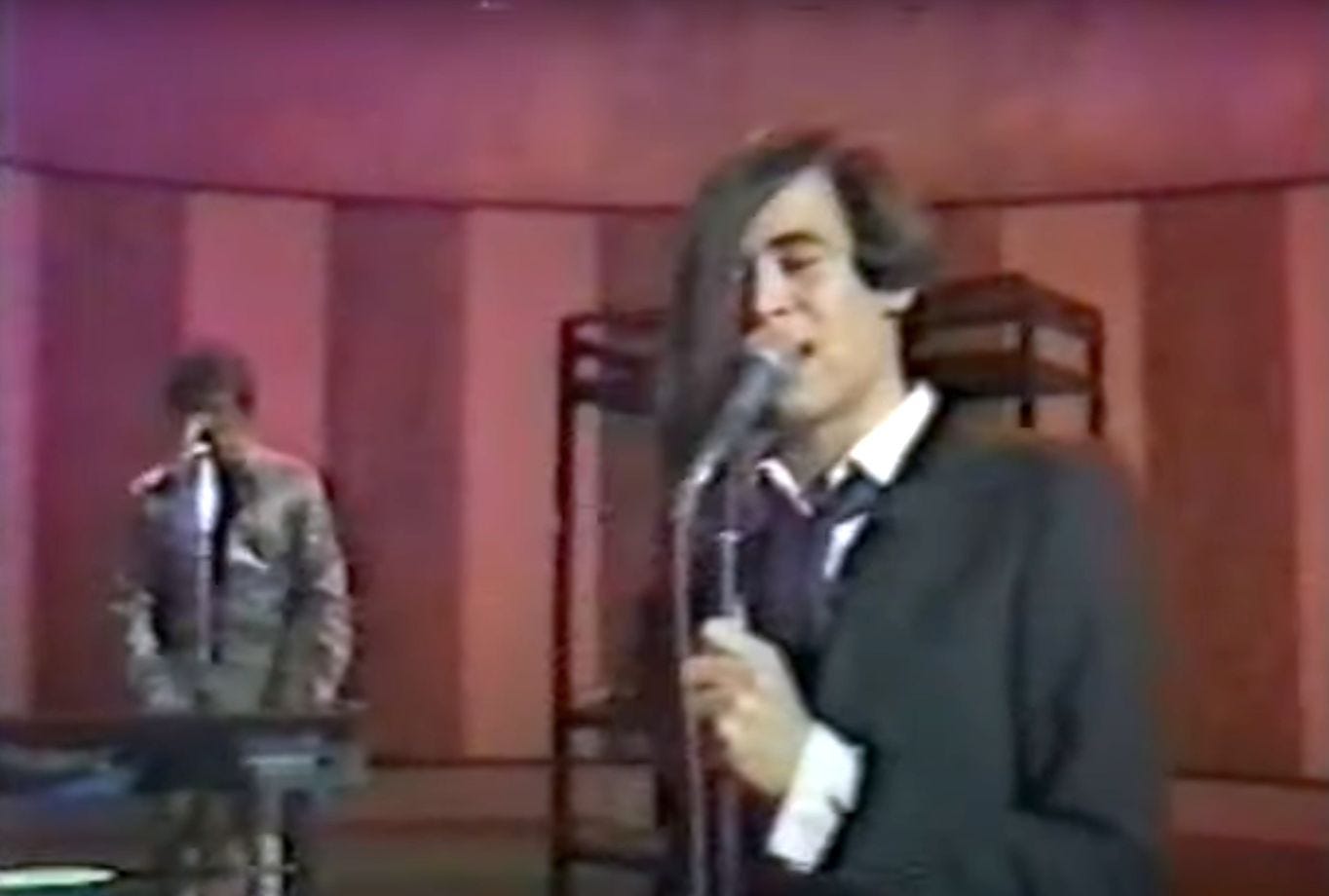
Things progress, and they procure a spot on Tony Wilson’s What’s On programme, a music and arts feature that had grown in the mid-1970s as part of Granada News. The transmission date of this broadcast is disputed, and it may even be as late as 15 February 1979, recorded when the band opened the Fast Product tour at Manchester’s Factory a week or so earlier (and going by the length of Phil’s asymmetric hair!). They receive a rousing introduction by Wilson, though as a television first for post-punk ironic synth-pop it fell a bit flat. There were soon-to-be-cliché opening shots (spinning tape and film spools, plugs being pulled out and pushed in, a single finger holding down a note on a keyboard) but the band looked awkward and nervous, trying too hard to feign disinterest and pull off the requisite bored look.
The Human League did not undertake a standard tour to promote their single, playing only sporadic dates after landing various support slots in the punk scene, notably with Siouxsie and the Banshees at the end of 1978. It was, inevitably, hard work prompting any kind of appreciation from punk audiences – even the more outré elements associated with The Banshees. In their practice of always offering a meta-critical view of their music and its performance, they developed a series of Perspex ‘riot shields’ to protect their equipment, and themselves, from spit, flying beer, and bottles – a proleptic gesture where they foretokened their hostile reception. They are allocated a couple of live review spots as they progress through 1978, trying to gain a foothold whilst making their own ascent deliberately improbable. You can sense how what they are doing is not yet conceived in the contemporary lexicon, with reviewers collectively remarking on similar tropes such as Perspex cages for the synth players and Oakey’s haircut. They cover their bases by speculating that the band might actually be one big act of satire…
1978 in retrospect
Satire it wasn’t. All three records sold well and registered in the Alternative Chart – a weekly Sounds chart compiled from a rota of local shops. All three also figured prominently in the end of year journalist picks. They were also nightclub records, but for a nightclub that did not yet exist. In his retrospective playlists for the seminal club Billys – operating in the final months of 1978 and a fledgling haunt for the soon-to-be named new romantic scene – Rusty Egan has all three records proudly present.
1978 concluded against what writer Richard Evans, in his book Listening to the Music the Machines Make, has called a “transformative backdrop”. A post-punk synth-pop escape route continued to be glimpsed with the debut releases of Thomas Leer, Robert Rental and Cabaret Voltaire, who all had awkward electronic (anti) pop offerings before the end of the year. Though something more commercially palatable was also incubating. Gina X Performance released Nice Mover and the single ‘No GDM’ late in the year, and Robin Scott (as M) preceded his 1979 breakthrough ‘Pop Muzik’ with the more glam-rock hybrid ‘Moderne Man’ around summer 1978. Perhaps most importantly and influentially, Ultravox dropped their exclamation mark and glam-punk experimentalism to release their third album Systems of Romance in September 1978 alongside the lush single ‘Slow Motion’, though they constantly grappled with hostile press reviews. It proved too much, and the band ruptured in early 1979. Artists like Gary Numan and a newly-established Simple Minds were watching from the wings, ready to shape 1979 with a batch of softer synthetic anthems.
Our original trio took differing paths. Daniel Miller toured The Normal with Robert Rental in early 1979, included in a Rough Trade package tour with Stiff Little Fingers and so attracting a less than hospitable audience. It was a testing relationship and The Normal never received much publicity beyond that early Sounds interview. There is a further interview by Chris Westwood (a young journalist who plays an important link in this scene) in October 1978 ZigZag, where he strives to disarticulate this new scene from disco and electronic crossovers like ‘Popcorn’. Miller then conceived his Silicon Teens project which played out through late 1979 and 1980, though it never had the subversive edge of his original Normal release. It was more saccharine than strychnine. His Mute label went on to greater things with the arrival of Depeche Mode, perfecting the polished and palatable form that defined the common memory of what synth-pop is.
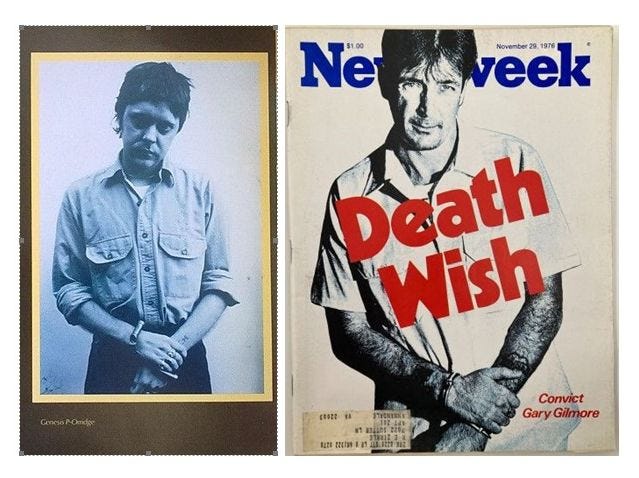
Throbbing Gristle continued doing what they did with their furtive electronics, contorting and smashing archetypes, until their inevitable rupture in 1981. Having channelled Gary Gilmore on the eve of his execution by firing squad with a series of mock-up postcards in January 1977 (a stunt that got them into Sunday Mirror), P-Orridge returned to the subject with subtle portrait inside their final album Heathen Earth in which he assumed the pose of the condemned man.
The Human League aimed for the commercial success that Numan so expertly manipulated, but were perpetually their own worst enemy. They signed a deal with Virgin Records and produced two albums, but pursued a series of conceptual stunts and gestures that ultimately saw them crash and burn through 1979 and 1980. At the end of 1980 they split in two, and emerged in the new year as two separate entities. Post-punk contrariness was put aside as both bands embraced the new pop sensibility and The Human League (mark 2) and Heaven 17 helped define a new decade.
[Note - This article was originally written for the nostalgic New Romantic magazine Blitzed!. I was writing to a tight word-count restriction, whilst at the same time wanting to cover quite a lot of ground. Not easy. So, I have fleshed it out a bit more here //waffled// and brought in some of the research from my monograph on Throbbing Gristle which covers the Sheffield scene and backdates the start of synth-pop]
Beautiful writeup.
Somehow, in all these years, it never occured to me that all three singles could have possibly emerged in the same year.