
Why the Long Face?
Heaven 17, anti-imagery, and The Luxury Gap (Part 4 - 1982, BEF, 'Let Me Go')

// onwards and (?)upwards - part 4 covers the continuation activity of Heaven 17 into 1982 when record releases and promotion were split between trying to get a hit single and curating and producing the Music of Quality and Distinction album - the gist: things continue to not quite happen //
Even though the three singles released in 1981 had not made a dent in the Top 40, the album sold well and reached #14 in the album charts (unfortunately, the next single of the title track from the album fared worse). As ever, everything was cast in a half-light measured against the soaraway success of Dare, aided and abetted by The Human League grabbing the coveted ‘Christmas number one spot’ at the end of the year. They were challenging Adam and the Ants as the de-facto British pop act, whilst coming up strongly from the rear was synth-pop northern-soul fetishists Soft Cell who grabbed an unexpected autumn 1981 number one with ‘Tainted Love’ and a heavily curated Depeche Mode who made an immediate impact on the hallowed top ten with their gloopy but irresistible love-and-life songs. Just about to enter the pop fray was the equally strategic fellow-Sheffielders ABC.
The Human League, or more so Phil Oakey, had an image that courted curiosity and celebrity, though there were moments (social commentary, politics) on Dare that went beyond pure pop pulp. Mind you, pop moments like ‘The Things That Dreams Are Made Of’ are once in a lifetime. Penthouse and Pavement, meanwhile, evoked a level of curiosity raised by the high conceptualism, powerful artwork, and matching (intellectual) reviews. As outlined in the preceding two parts of this essay, the band had a strategic look of the corporate man, though this was quickly absorbed into the novelty of 1982 image culture as a multitude of synth-pop bands and ex-new romantics started to monopolise the charts and music press. Any critical leverage initially exerted by Heaven 17 was soon dumbed down.
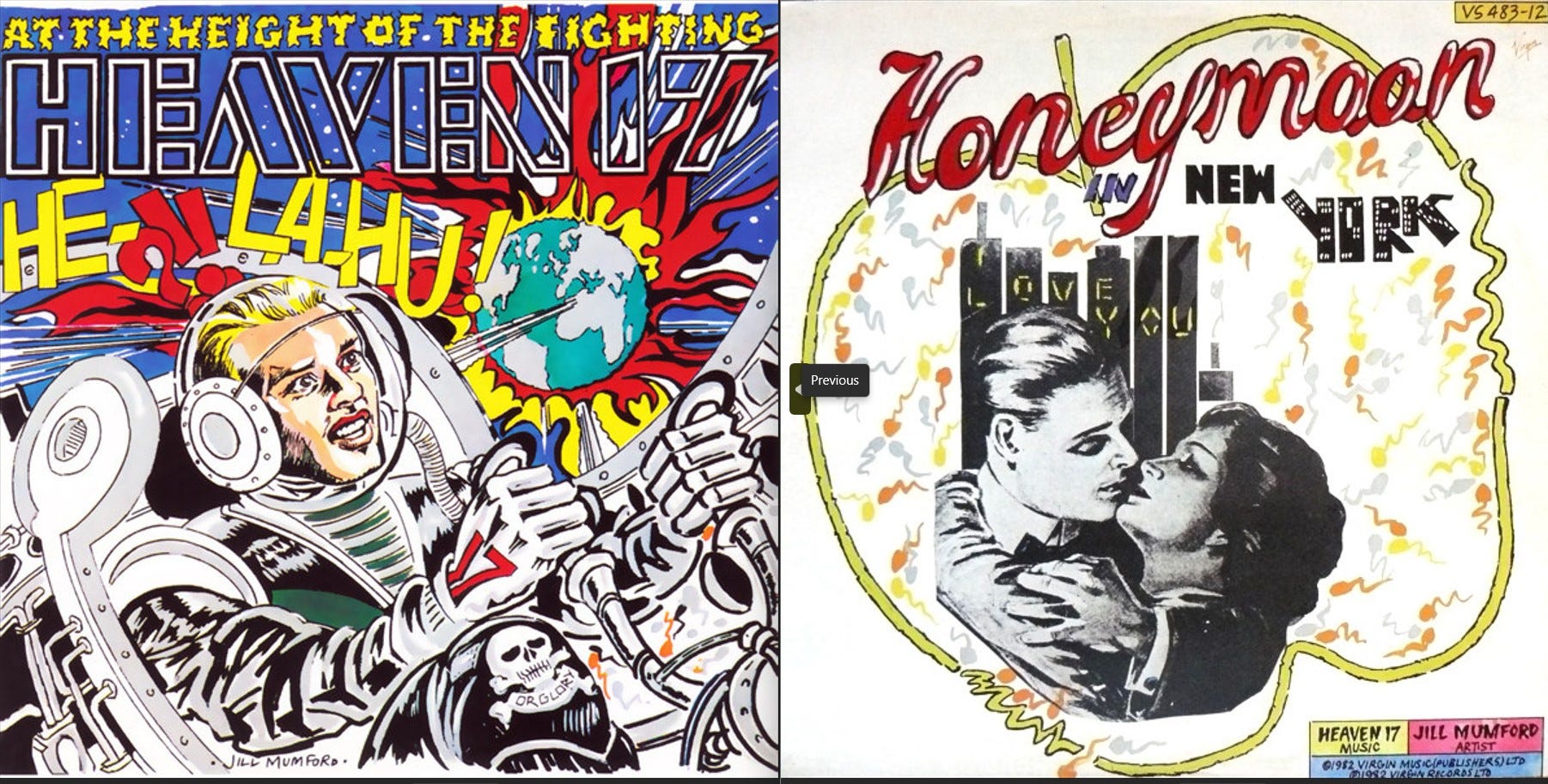
The album’s good reception led to a quick follow-up single with the February 1982 release of ‘The Height of the Fighting (He-La-Hu)’ twinned with a new super-brief instrumental track ‘Honeymoon in New York’. It was the fourth and final lift from the LP, with the track augmented by the in-demand horns of Beggar and Co and a reinforced drum sound. The funky trio had paired with Spandau Ballet in July 1981, though Spandau had been a constant stalking horse and butt-of-jokes to Heaven 17 throughout the previous year. The packaging went against the accumulated corporate concept of 1981, with well-respected designer Jill Mumford creating artwork on both sides. The whole thing (record, artwork, and abandoning of brand concept) comes across as a rush job with a Lichtenstein pastiche on the front and a hasty comic book frame on the reverse. It looks to be Glenn Gregory piloting a spaceship that is retreating from Planet Earth (of Duran Duran?) about to be destroyed. He has a red ‘17’ insignia on his gloves and a biker style death or glory skull on his knee protectors. Ware in his autobiography admits to the song having little in the way of interpretation, instead being inspired by chanting over singing and the apocalyptic tone of Edwin Starr’s ‘War’.
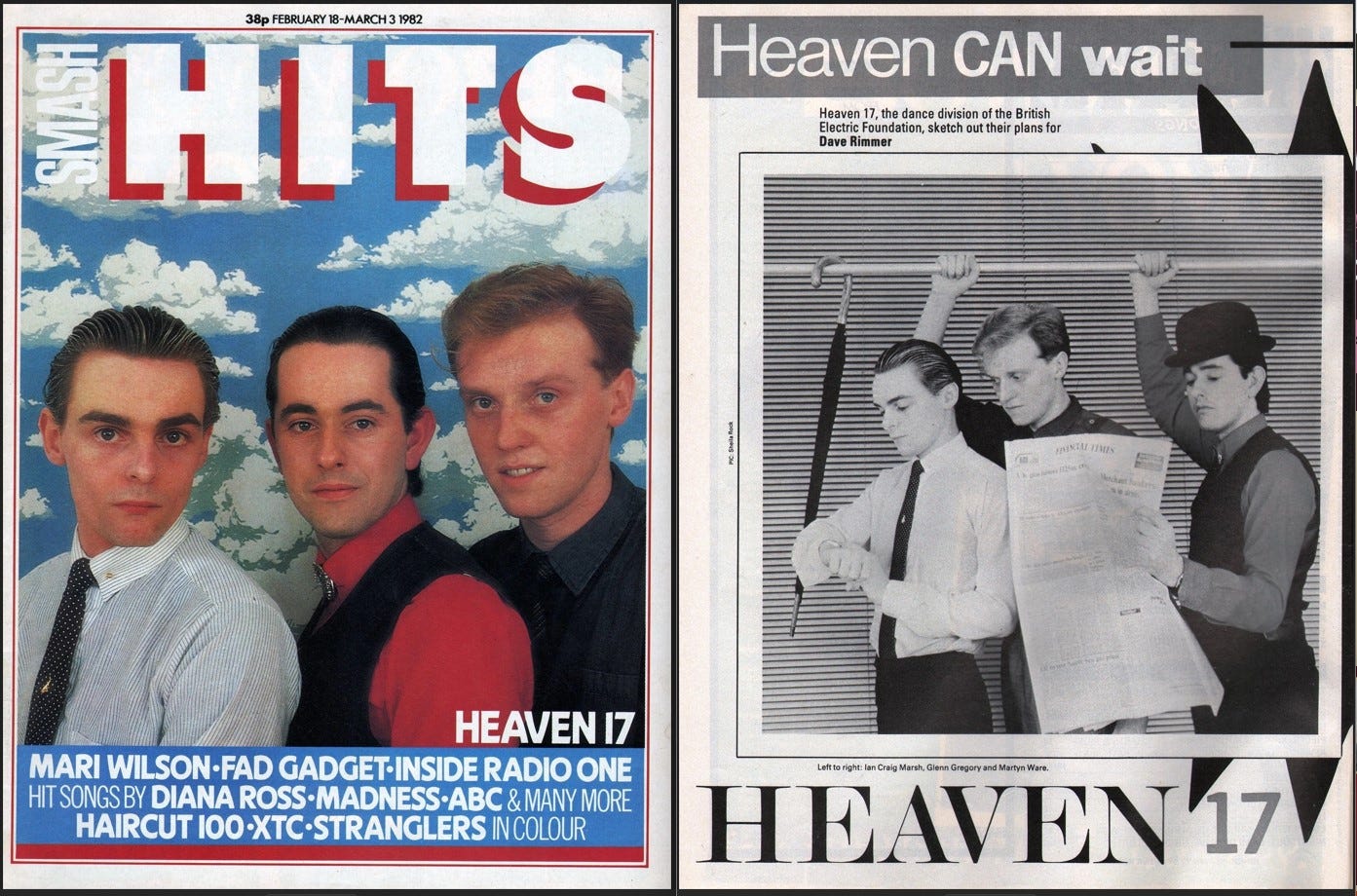
Once again, the single failed to have a chart impact. It did, however, win them a cover feature in Smash Hits where the corporate look was reinforced, albeit with an odd photograph of the trio offering gradations on a near smile against an unsettling backdrop of painted fluffy clouds in the surrealist style of René Magritte. This was the start of the dumbing down applied to the band from the outside. The corporate concept becomes just another look. The cover is bereft of a typically punning strapline, adding to the indecisive awkwardness of the whole thing.
On camera (and scene-setting) duty is erstwhile pop stalwart Sheila Rock. The feature, sitting alongside the perfunctory lyrics to the single and a full portrait of the band as if commuting on the tube, played on the corporate concept, suggesting that the band were the “front-runners” in this style. Smash Hits had voted the album artwork “best dressed record” and suggested it looked to be “straight out of Dallas”. As usual, the band play down any intent, but it is this interview where Gregory remarks that they might be setting a trend amongst young pop consumers who have taken to carrying briefcases. We also get a plug for the new project Music of Quality and Distinction (their guest-artist cover versions collection, its name inspired by an advert for a shirt brand). This album is taking a while to surface, and in the slight gaps between conception, compilation and release some of the featured acts such as Billy Mackenzie would suddenly be catapulted into the public eye (The Associates found sudden chart success in February 1982).
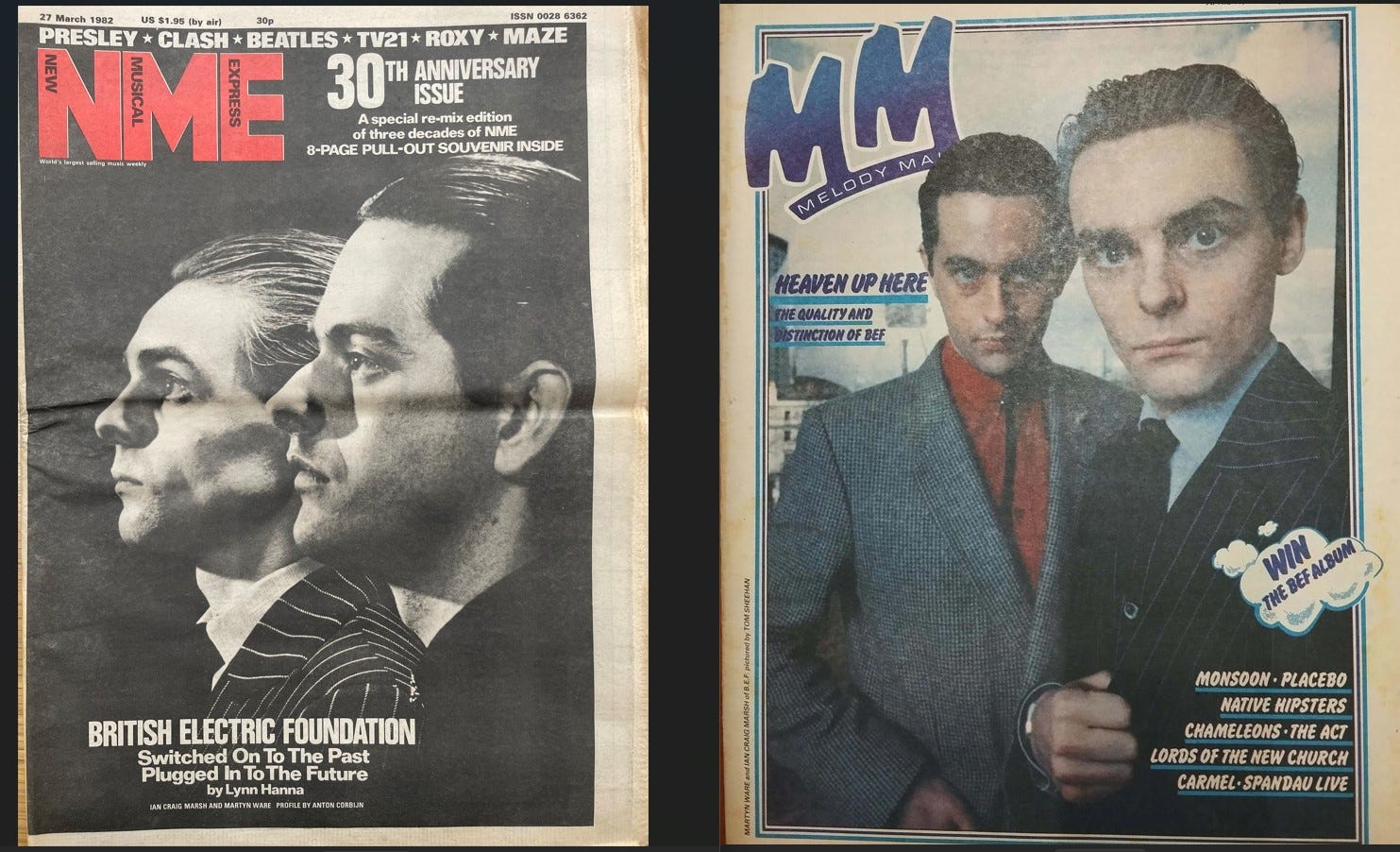
At the end of March BEF get a cover feature in NME, with a heroic composition of Ware and Marsh captured in front-lit chiselled-countenance side profile like a pair of Leninist monuments. For the third time, it is Anton Corbijn on camera duties. It is a 30th anniversary issue of the newspaper and includes a ‘re-mix’ of the past, in many ways synching with the BEF project Music of Quality and Distinction which is on the cusp of release. The album’s release coincides with a second cover feature in Melody Maker, in which Marsh and Ware adopt hard stares that very much connect with the ‘Bex look’ of Alan Clarke’s The Firm flagged in the previous part! There is also a BEF feature in Sounds.
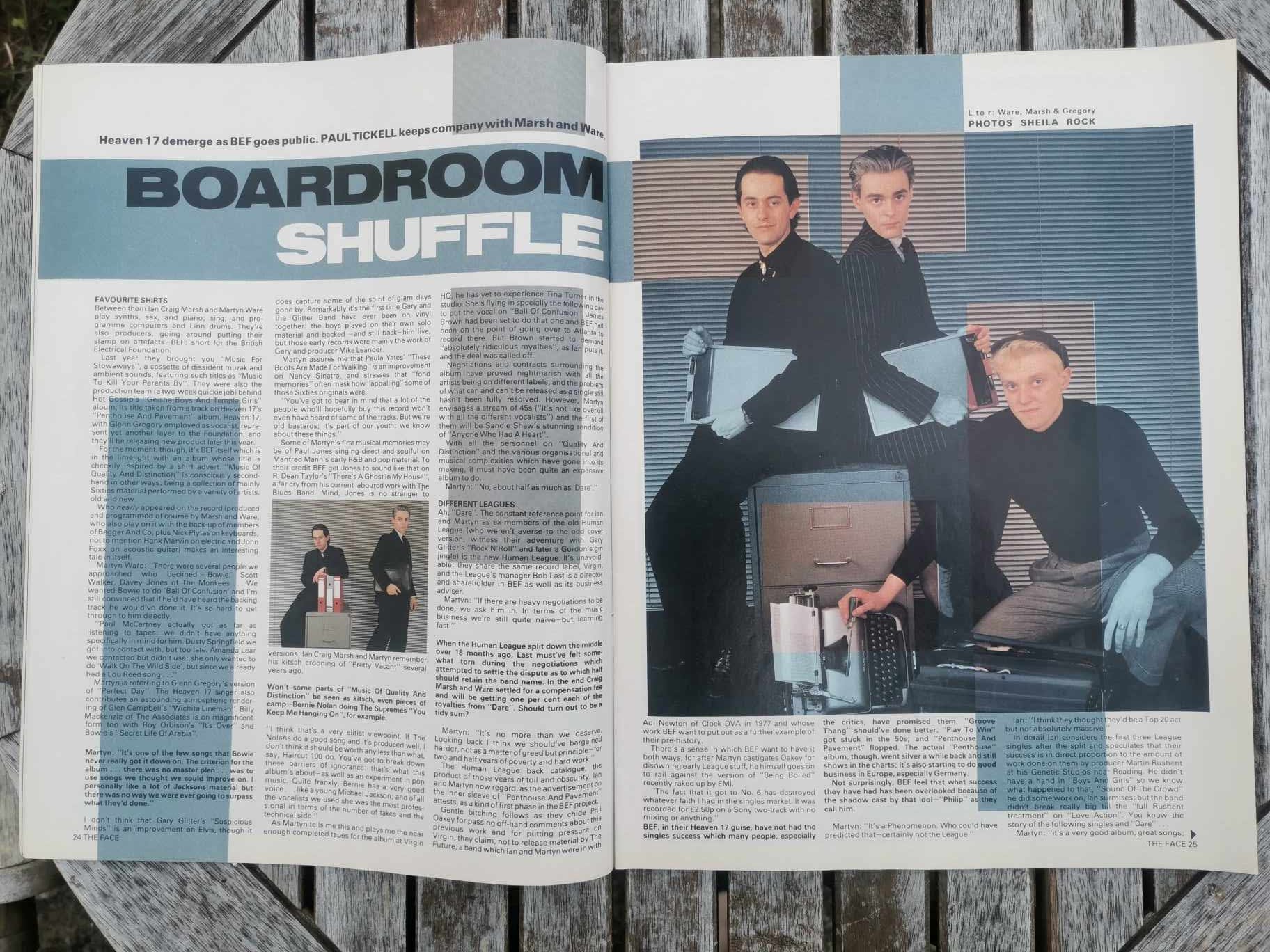
April also sees appearances in a couple of style magazines. BEF are featured in The Face (#24, April 1982) and Heaven 17 return for New Sounds New Styles (phase 2 issue B, April 1982), bagging the magazine cover. In The Face they are promoting the new project and continuing with a full-on corporate look, re-using the Sheila Rock photo session from Smash Hits. The tube illusion has gone, and the trio cluster around a low filing cabinet - though for some reason Gregory is posing as a technician mending a broken typewriter. Perhaps a distinction at a BEF board level with Heaven 17 noted as undergoing a “demerge” giving rise to possibly the first and only use of this term in a headline. Once again, in the feature they expound upon their corporate approach, arguing that their company-to-company relationship to Virgin blurs the strategic roles between labourers, producers, consumers and audience. They put forward the argument that the suited image is a statement against the “veneer of pseudo-mysticism” that suggests recording artists are anything but parts of a corporate entertainment machine. But you feel that the power of this approach and persuasiveness of the argument is waning.
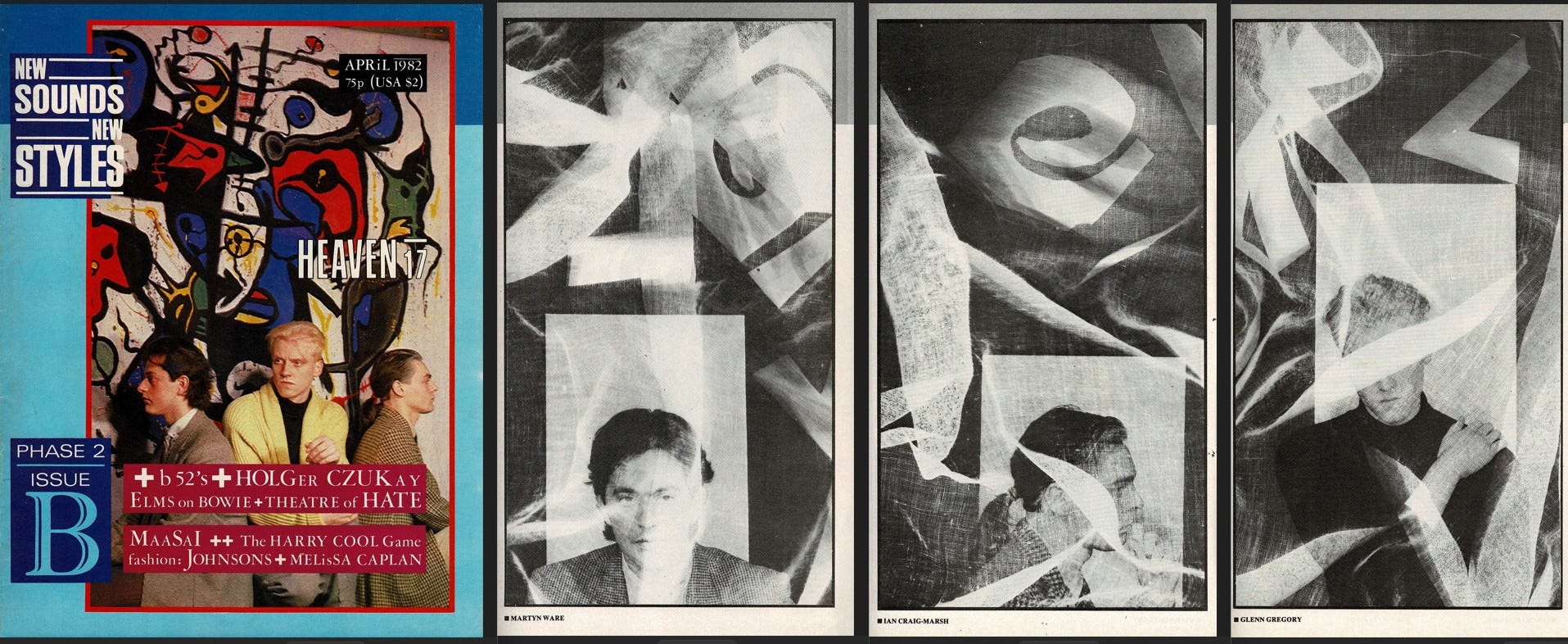
New Sounds New Styles, with its somewhat laughable pseudo-intellectual numbering system, opens up to a wider view of Heaven 17 where we getter a fuller espousal of their left politics. The style nature of the publication dictates a layout that synchronises with the Neville Brody and Malcolm Garrett era of sumptuous ingenuity – we have design by Carmen Dublin and photographs by Panny (Panni) Charrington who worked with many independent labels in the early-to-mid-80s. With an art and design focus from the interviewer (Graham K. Smith) we get also an enquiry into the poor artwork on the last single whereby the band effectively disown the design! The magazine front cover has the band assembled under what appears to be a Joan Miró artwork (or a hotel-lobby-artwork copy), glimpsing a slight relaxation from the regimented corporate look. There is still an implied sartorial dichotomy between the ‘board level’ BEF (Marsh and Ware) and the Heaven 17 worker (Gregory).
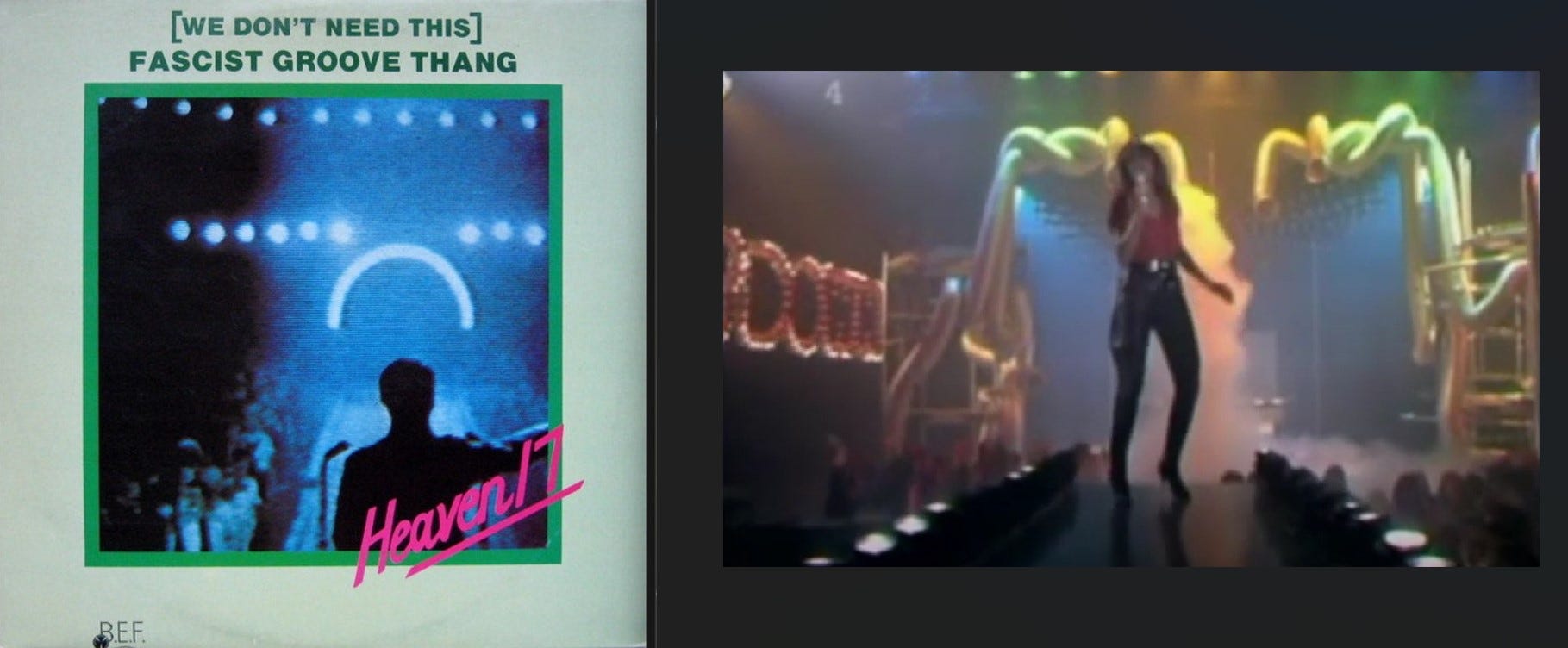
Whereas Music of Quality and Distinction never hit the heights as a best-selling project/compilation, the inclusion of Tina Turner’s ‘Ball of Confusion’ catapulted the previously struggling singer onto a new plane of success that would resonate through the 80s and 90s. The track had a BEF synth-propulsion and an accompanying video that saw repeated plays on the nascent MTV station. There were moments when Turner struts on an illuminated catwalk akin to a lit-up aeroplane runway that we have an almost reproduction of the clever disco-not-disco sleeve artwork for ‘Groove Thang’. Turner’s revitalisation, and BEF’s role in it as producers, secured some financial stability to press forward with other projects.
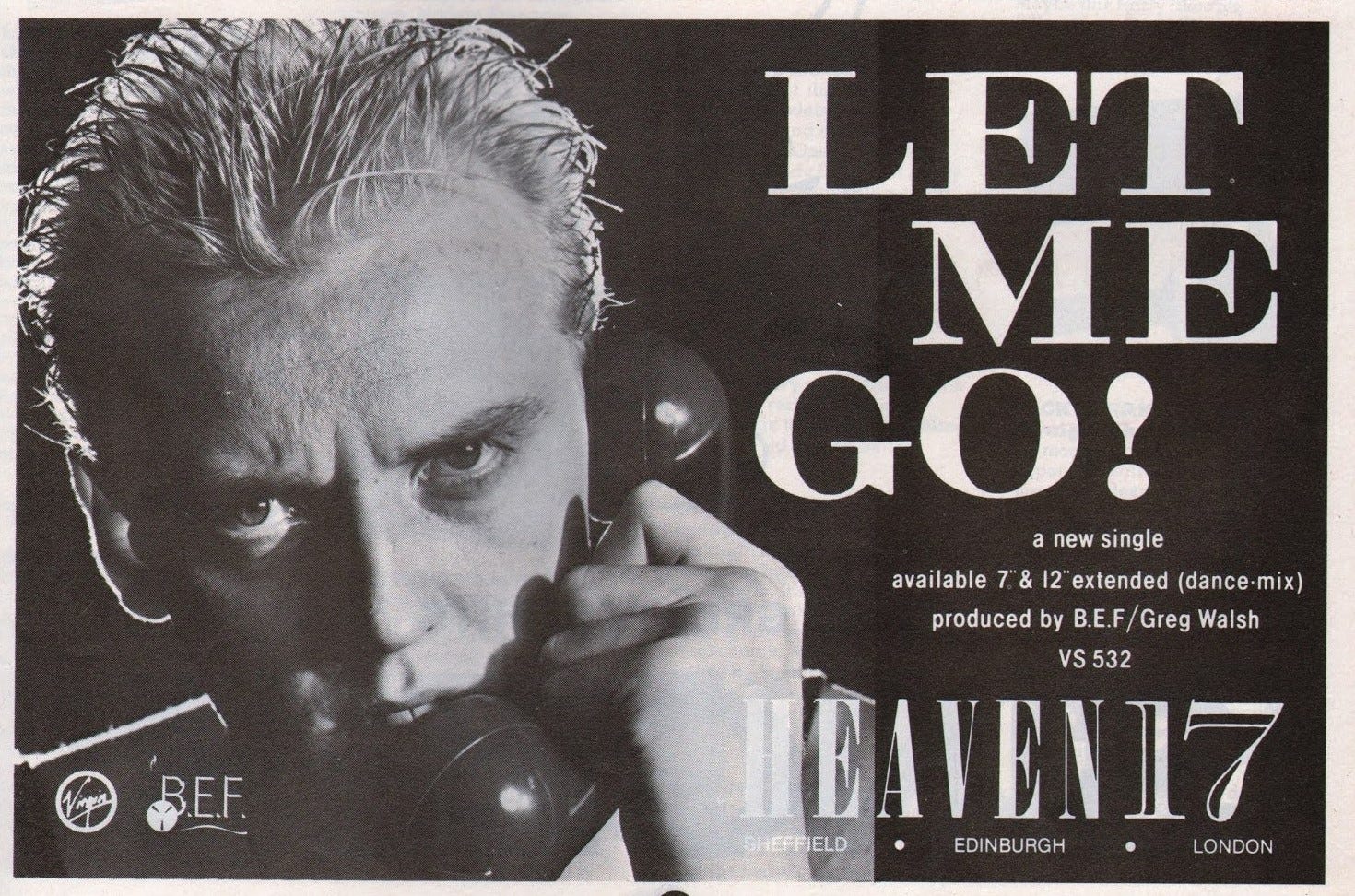
Press coverage then slows down until October and the launch of an entirely new single - ‘Let Me Go’. To many scene observers, this was the hit that should have been, with its incredible use of Linn Drum and innovative bass programming of a Roland TB-303 (a device that would shape the dance music scene at the end of the decade). John Wilson’s guitar skills were switched to rhythm duties, and the interplay between lead and backing vocal is something else. It is a stunning track, and I’ll leave you in the capable hands of post-punk monk for a fuller appreciation. Ware’s autobiography acknowledges the power of this track, and he recalls how the melody and chord sequences came to him in a dream.
The sleeve artwork and advertisements feature an in-your-face Gregory clutching a telephone (as per Marsh on Penthouse and Pavement), though the business sheen has retreated. Gregory has a different intent in his eyes and takes on a different appearance (ie NOT Michael Heseltine) with his wet-look hair. The photograph, matched with a noir-ish reverse, is the work of rising star Jamie Morgan who was about to change the direction of magazines like The Face and (with stylist Ray Petri) conjure up the ‘buffalo look’ in 1984. The sleeve still has design credits to Malcolm Garrett’s Assorted Images, but the emphasis on upfront, styled photographs is switching and in turn making the days of plundering avant-garde art movements like the Russian Constructivists a retreating tactic.
On a purely personal level there is a bundle of memories for me around this track. It was released at the start of November which was always when I built a big bonfire in the field at the back of our garden. I’d spend October collecting wood whilst also working the half-term potato picking which meant a couple of things: money for fireworks and some pilfered spuds to wrap in foil and bake in the ashes of the fire. The 5th of November fell on a Friday, so that was an added bonus as no school the next day. It was also the launch of a new flagship music programme on Channel 4, The Tube, running between 17-15 and 19-00 – so time to watch that before lighting the fire. The channel itself was new, having been on air for four days and whipping up a lot of anticipation. Possibly due to a connection to The Tube’s presenter Paula Yates who had made a singing debut (of sorts) on Music of Quality and Distinction, we got an extended feature of Heaven 17 performing ‘The Height of the Fighting’ along with new single ‘Let Me Go’ and a new track ‘Who Will Stop the Rain’ (pencilled in for a US only release). Bizarrely, I vividly recall how ‘Let Me Go’ immediately sunk in, and singing it (in my head) whilst getting the bonfire lit.
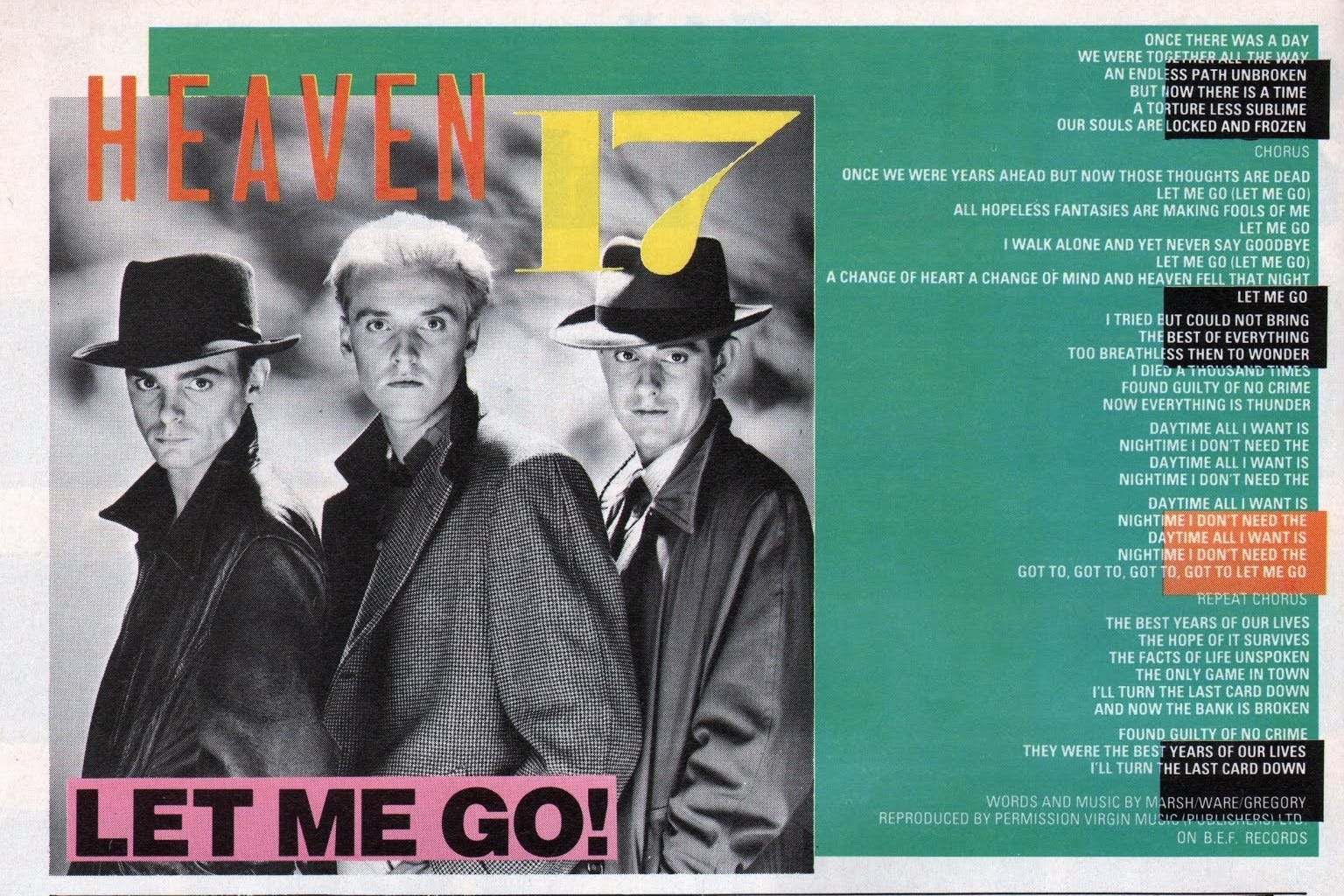
Frustratingly, the single reaches #41 and so avoids any further mainstream TV airplay. It does warrant a song lyrics feature in Smash Hits, and we get a snapshot of the trio with a new look. Outdoor raincoats and fedoras, a more classic look – still corporate in a traditional sense, but a definite demarcation from the ‘raincoat brigade’ look of post-punk Factory Records music fans. This look – verging on a cinematic noir effect – is tied in to a video for single. Directed by Steve Barron and filmed in a moody black and white, the video opens with a shot of a London Standard newspaper headline announcing the crash of BEF shares. Drawing from the de-peopled scenes of Kubrick’s Dr Strangelove (1964), Gregory anxiously stalks a paused city and briefly joins up with Ware and Marsh to wander along Lothbury and the grand banking premises. Apparently useless bank notes blow in the wind, swanky cars are abandoned, and phone box doors swing open. The film jumps to frequent nightmare sequences shot in colour, as Gregory struggles through a motionless packed crowd.
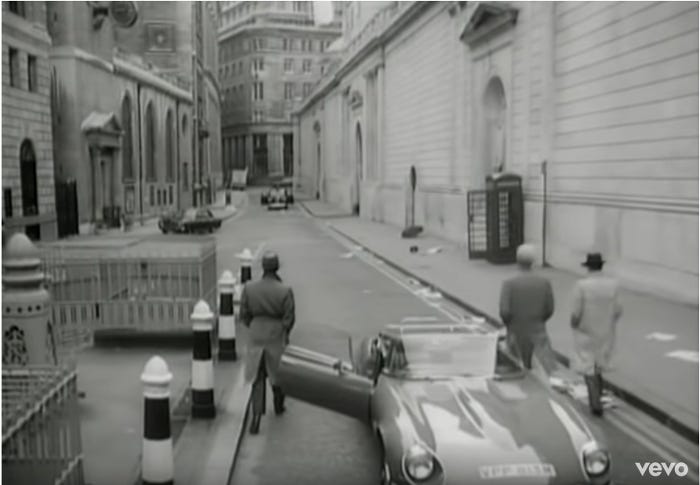
The meaning of ‘Let Me Go’ remains ambiguous, with the video doing little to resolve matters. It clearly could be, in the standard pop music tradition, about a love affair turned (or turning) joyless and sour. But that isn’t overtly signposted. The song sensibilities constantly switch and contexts are glimpsed and hinted at through lyrical fragments. It feels more intangible, like a friendship, or energy and hope of youthfulness, breaking down. It could even be a more cryptic metaphor for a societal mourning as Thatcher begins preparation for the defence of her leadership into a second term of government. These nagging feelings would be emphasised with the forthcoming album The Luxury Gap.
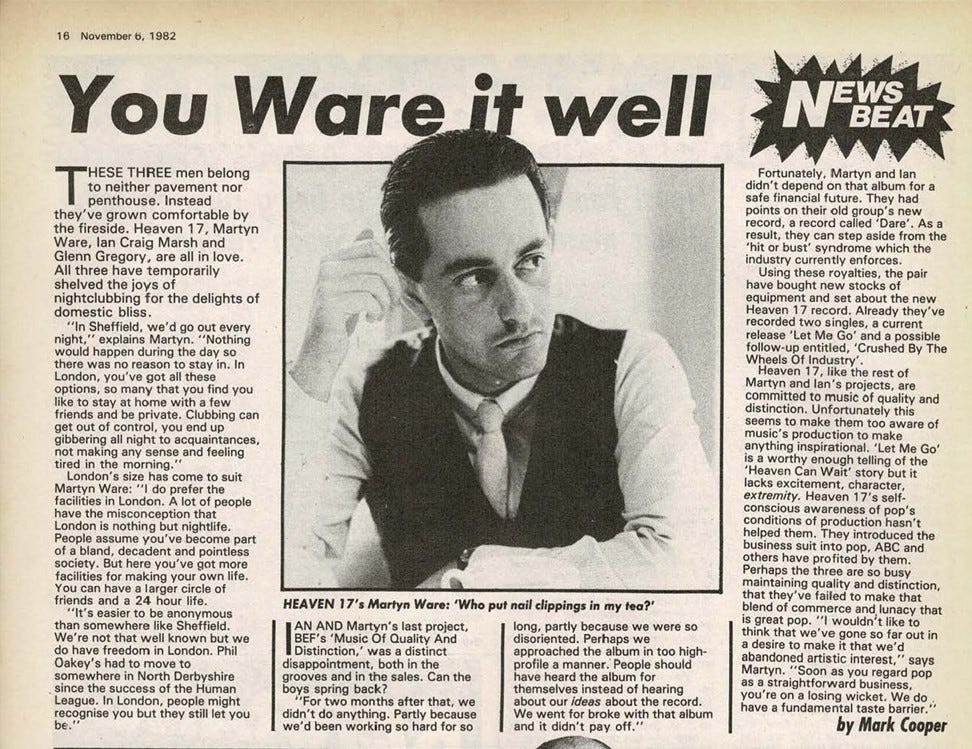
There is little press coverage that I have recovered from this time. A short article in Record Mirror (6 November 1982) provides a useful point to end this section, where the journalist does more reflecting than the interview subject (Ware). It is revealed that Music of Quality and Distinction had disappointing sales, and that the band were both exhausted and slightly rueful about over-investing their conceptual sheen to what should have been a more straightforward compilation album in which the acts should speak for themselves. There is then a long quote by the journalist Mark Cooper which includes a castigation on the journey so far: “Heaven 17’s self-conscious awareness of pop’s conditions of production hasn’t helped them. They introduced the business suit into pop, ABC and others have profited by them”.
Perhaps time to regroup and rethink.
I very much enjoyed this series. Thanks